
The Customer
Le Figaro has been publishing since January 1826, and is the oldest national newspaper in France. It marked its bicentenary at the Grand Palais in January 2026. The paper anchors Groupe Figaro, France’s leading digital media group, whose thirteen brands reach more than 32 million people a month and 6 million a day, with 400,000 subscribers behind them.
Quentin Barigault leads data engineering and analytics for the Datalab, an entity dedicated to delivering BI and analysis for the group. His team of six is responsible for every number that reaches the business, serving more than 200 internal users across executives, marketing, and the newsroom itself.
The newsroom is what makes the problem unique. Quentin’s team tracks how every article performs, across everything Le Figaro publishes into: the site, social platforms, video, and podcasts. A single article performance report draws on more than ten sources. Journalists use it to decide what deserves a bigger position on the home page, and that decision has a short shelf life. If the numbers arrive too late, Le Figaro could miss an important moment of the news cycle.
For management the deadline is just as fixed. Critical dashboards have to be on the desk every morning, complete and checked, before the day’s decisions get made.
"We are not a bank with thousands of Dags. My problem is different. It is not about the volume of Dags. It is about the timing, and the timing must be perfect." Quentin Barigault Lead, Data Engineering & Analytics, Le Figaro
The Challenge
Le Figaro ran for roughly four years on a managed Airflow service. The team experienced recurring network-related reliability issues, but the main limitation was the lack of visibility across the platform as a whole.
- No observability above the Dag level. The service offered nothing to watch pipelines as a connected system. Monitoring was entirely the team’s job, done by hand, one Dag at a time.
- Difficult impact analysis. When a pipeline failed, identifying which downstream processes or dashboards were affected required manual investigation.
The second gap did the most damage, because it turned every failure into an investigation. With ten upstream sources feeding one report, a break anywhere could quietly poison something downstream, and the team often learned about it when a stakeholder asked why a dashboard was empty. Nothing in the platform could answer the two questions that matter most when something goes wrong:
If this Dag fails, what breaks?
If I change this Dag, what else do I have to fix?
Support was the other frustration. When environments went down, the team was largely on its own.
Meanwhile the ambition was growing. The newsroom wanted signals in near-real-time, not a batch that would land the following morning. That was not a project the team could start while it was still firefighting the platform underneath it.
The Solution
Quentin and his team evaluated Astro themselves first, running their own tests on the free tier. They also looked at another hyperscaler’s managed Airflow offering, since part of the organization runs on that cloud, but the feedback pointed back to the same class of problems they were trying to leave behind.
What sold him was how little time stood between having an idea and running it.
"In my job I have to be able to act fast. With Astro I am not waiting on the system just to create the system. I deploy an environment and I go straight to the code." Quentin Barigault Lead, Data Engineering & Analytics, Le Figaro
The migration went better than expected. Quentin admits he was nervous going in. Inside two months the production workload was running on Astro, and daily reporting never stopped.
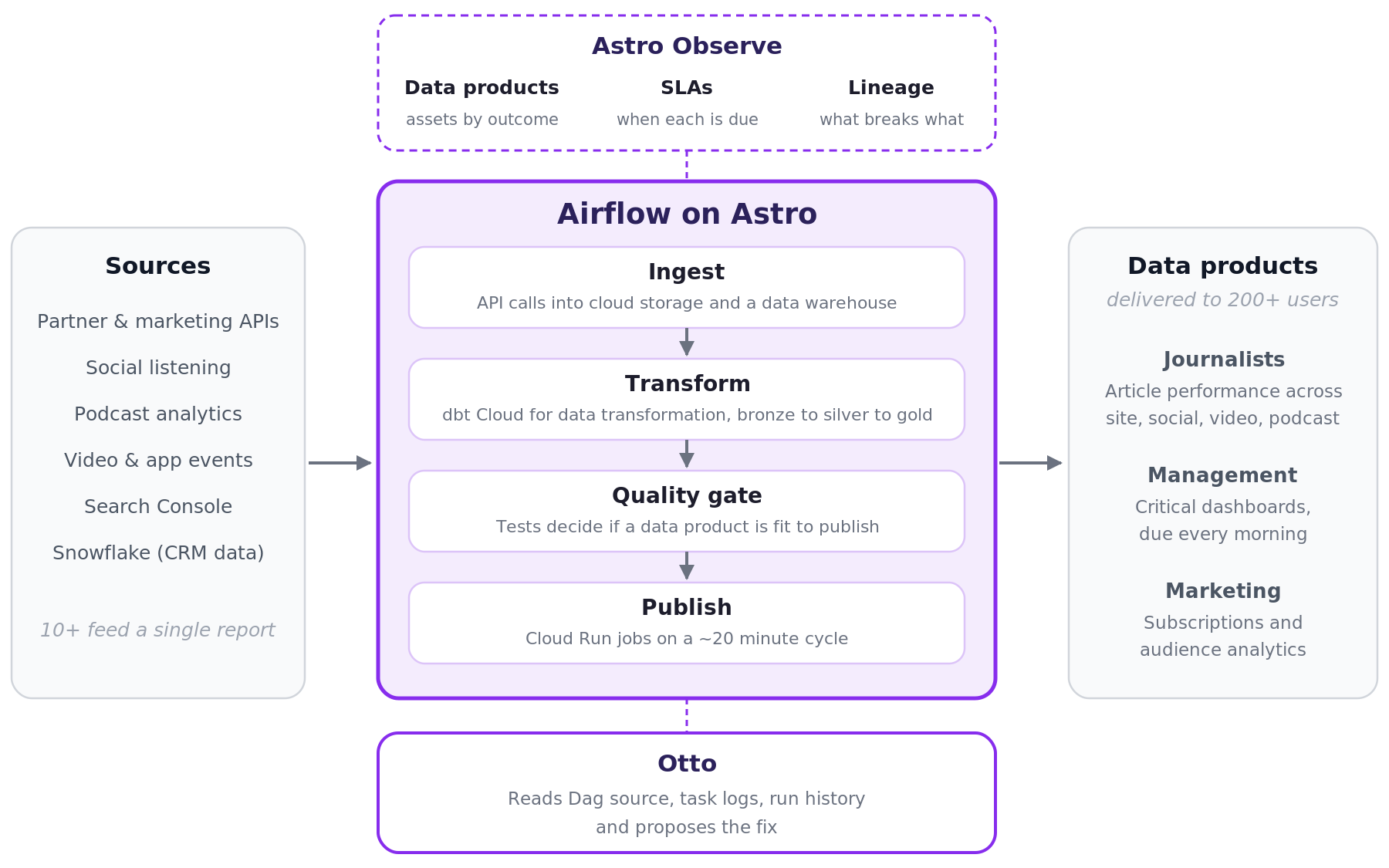
Astro provides the orchestration layer for the platform. More than ten sources land, transform, and pass a quality gate inside Airflow on Astro before anything reaches a dashboard. Astro Observe sits as a layer on top, so the team declares the data products the business depends on and the time each one is due, instead of watching individual Dags to find out whether it arrived. Otto is a separate agent rather than part of Observe: it reads into the deployment itself, so when Observe raises an alert the diagnosis has somewhere to start.
Two capabilities on that top layer changed the team’s daily life:
In Astro Observe, Quentin declares a data product for each output the business actually depends on, composed of the assets that feed it, then attaches a ready-by time. Observe infers the upstream dependencies itself. When a data product is going to miss its time, the people waiting on it are told automatically, before they ask.
"I say I want this table ready at 10, every day. If something happens, the alert reaches our stakeholders in time, and it does not come from me. That takes the pressure off my shoulders. Everybody already knows, so I can spend my attention on the fix instead of on writing emails." Quentin Barigault Lead, Data Engineering & Analytics, Le Figaro
Lineage answered the two questions the old platform could not. Before Quentin changes a Dag, he can see everything that change will touch. When one fails, he can see every downstream Dag and dashboard it takes with it. Work that used to mean opening Dags one at a time is now a single view.
"Lineage tells me what a change will break before I make it, and where a failure lands when something does. For a data team, that is the key benefit of Astronomer." Quentin Barigault Lead, Data Engineering & Analytics, Le Figaro
Otto: Cutting the Distance to Root Cause
When an SLA breach or a failure alert arrives, Quentin opens the investigation in Otto, Astronomer's data engineering agent for Airflow. Otto reads the Dag source, the task logs, the run history, the connections, and whatever else the deployment can tell it, then works through the diagnosis interactively instead of handing back a stack trace. For a six-person team covering a platform this broad, that is the difference between an afternoon of log archaeology and a fix before the morning deadline.
What Quentin values most is that Otto connects a code-level problem to the deployment configuration around it, which is where the answer usually sits. Some of his Dags carry long dependency chains, and narrowing those by hand is the slowest part of any incident. Because Otto is grounded in the deployment rather than in general Airflow knowledge, its summary already reflects what was actually running when the Dag failed. Together with lineage, it is the main reason he estimates his team now debugs three times faster than before.
"Otto is very good at summarizing the issue, taking the context from the deployment, and offering me a solution. It gets me to the root cause 3x faster than before." Quentin Barigault Lead, Data Engineering & Analytics, Le Figaro
The Results
The platform stopped being the thing the team worried about, and the newsroom got faster.
- Core pipelines in production in under 60 days, with no interruption to daily reporting, on a migration the team had expected to hurt.
- Debugging time accelerated 3x, through lineage and Otto-assisted root cause analysis.
- Confidence to deploy near-real-time pipelines (every 20 minutes), instead of only the next morning, so journalists can act on a story’s performance while it is still on the home page.
- Data products under explicit SLAs, with stakeholders alerted automatically on a breach rather than discovering it themselves.
- Downtime is no longer the team’s daily preoccupation, the single complaint that defined the previous platform.
The change the team noticed was not really about tooling. Before, an incident meant a data engineer discovering a problem, working out what else it touched, and telling everyone by hand. Now the alerting reaches stakeholders without them, lineage answers the scope question on sight, and Otto turns the log hunt into a completed investigation. The engineer goes straight to the fix. The same six people absorbed a growing platform without growing.
"My manager has noticed the difference with Astro. Less downtime, more reliability on the platform, and when something does go wrong we are not starting from zero. The SLA alert tells us, the lineage tells us what it touches, and Otto is already proposing the fix." Quentin Barigault Lead, Data Engineering & Analytics, Le Figaro
What’s Next
The next chapter is event driven. Le Figaro is building toward real-time ingestion, with newsroom signals such as article shares arriving as they happen rather than on a schedule, and has already stood up an Airflow 3 environment on Astro to get there. Running alongside it is a machine learning proof of concept that clusters newly published articles and assigns each one a topic automatically, every twenty to forty minutes, so a piece about Paris or about a breaking political story is categorized as soon as it goes live.
None of that is a new instinct for a 200-year-old newspaper. Knowing what readers are reading, and knowing it in time to act, is the oldest job in the building. Astro gave the team the reliability and visibility needed to move from next-day reporting toward near-real-time data availability for their most important newsroom use cases.



