According to our State of Airflow 2026 survey results from the beginning of the year, the majority (68%) of Airflow practitioners are using at least some AI to write Airflow code. At the time, though, there was no existing agent focused on data engineering or Airflow specifically. Our respondents highlighted issues with hallucinations, outdated Airflow syntax, a lack of attention to best practices, and missing business context.
Since then, we’ve developed Otto, the first data engineering agent for Airflow. Otto was built as an agent harness that incorporates skills derived from our years of experience running Airflow at scale. With those skills alone, Otto proved itself extremely adept at data engineering. Based on the results of our data engineering benchmarking tests (which we developed jointly with researchers at Carnegie Mellon), Otto was not only more accurate than other popular agents such as Claude Code, but it also spent significantly less time and energy re-discovering context, resulting in a 40% lower token burn.
With these skills, Otto is able to incorporate up-to-date Airflow syntax and best practices into its work. However, the real challenge is about context, not just skills. In order to effectively troubleshoot Airflow environments or write new workflows, agents need access to specific contextual data (such as deployment configuration changes) that aren’t natively accessible to agents in open-source. To make it possible, we built a context layer into Astro that surfaces that information within a particular Astronomer customers’ environment. This layer is what makes agentic work on Astro really work at a level beyond just drafting boilerplate code.
Now, with gratitude to the many organizations who helped us with feedback throughout its time in Labs, Otto is officially moving into Preview. This means it will be supported with a 95% uptime SLA and coverage from our world-class support team.
How Otto helps reduce troubleshooting time by 3x or more
Otto is here to help investigate alerts and outages, draft Airflow code to remedy problems, and help with upgrades and migrations. Because of our work building an agentic context layer on Astro, Otto is able to understand the full picture of each Astro Deployment it’s tasked to support. Rather than asking you to copy and paste logs into a separate chat window, Otto is ready to help immediately with insight into your run history, connections, and Deployment configuration. As a result, it’s excellent at connecting a diagnosis across both the code-level issue and a broader deployment problem. Le Figaro, one of the most influential newspapers in France, estimates that Otto reduced their troubleshooting time by 3x.
"Otto is very good at summarizing the issue, taking the context from the Deployment, and offering me a solution. It gets me to the root cause 3x faster than before." Quentin Barigault, Lead, Data Engineering & Analytics, Le Figaro
Otto is already able to offer one-click root-cause analysis, right inside of the Astro UI. It can also be called via API or triggered automatically as part of an alert, so that a thorough investigation is available alongside your alert notification. Another early design partner, the global asset manager Janus Henderson, has built full self-healing pipelines aided by automated Otto investigations, with an estimated 95% reduction in MTTR.
As Otto developed, we noticed another interesting story around incidents. For our customers, the majority of Airflow failures (62%) were actually sourced from a problem outside of Airflow itself. Often the root cause is found within platforms like Snowflake or Databricks, which forces data engineers (and agents!) to search in more than one place to troubleshoot. To solve this, today we’re introducing custom MCP support. This greatly-anticipated feature allows Otto to dig into any external platform with an MCP server, so it can form a complete diagnosis of the issue with one investigation.
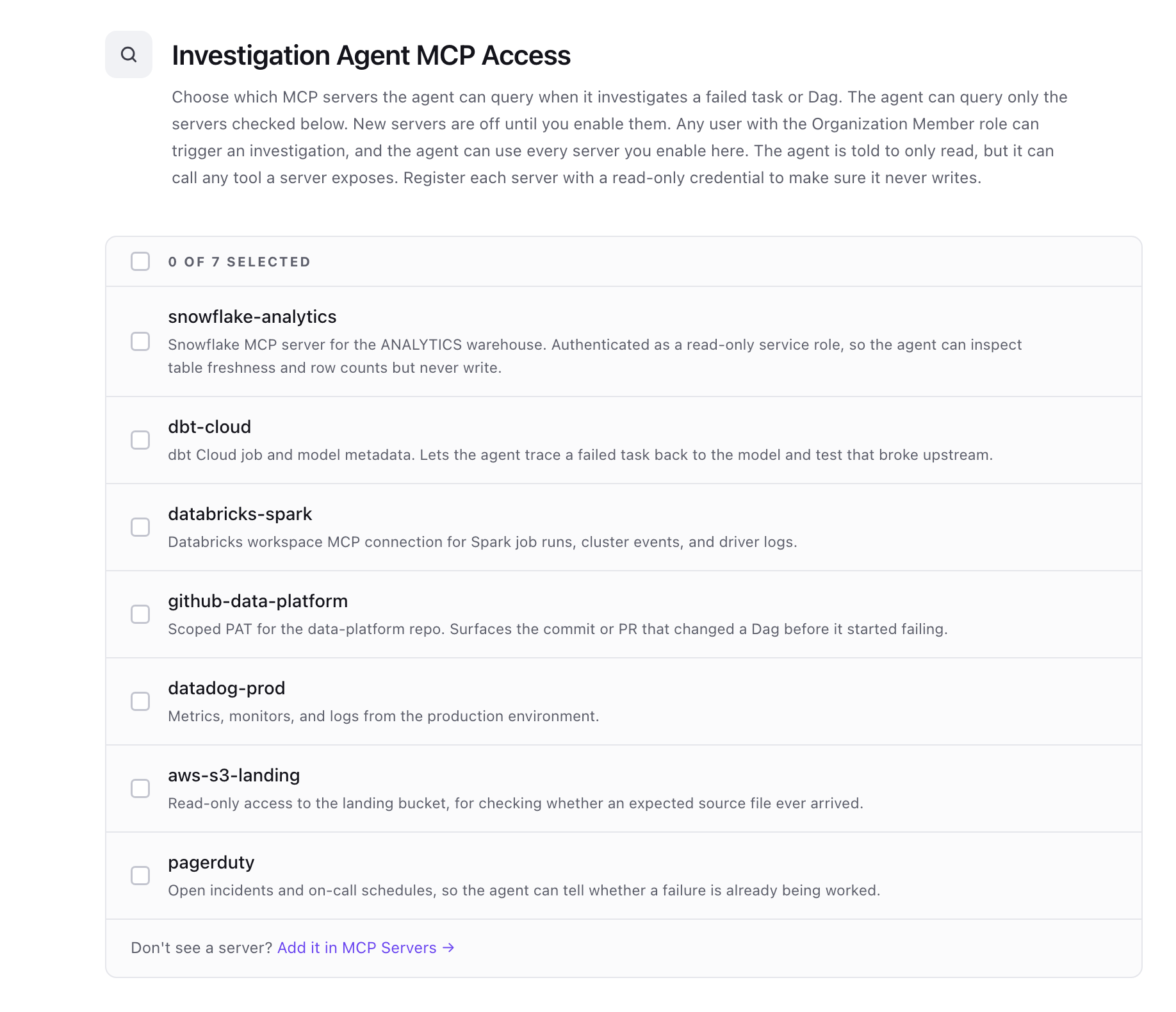
Today’s graduation into Preview also introduces two other features: Dag-level memory, which allows Otto to learn from human or agent-drafted notes left on any previous Dag failure to help with recurring issues, and user-level and API token AI spending caps, so that you can control costs while still allowing your teams to benefit from Otto’s troubleshooting and authoring capabilities. All three features are available in Labs to all customers, starting today.
Otto is available wherever you work on Airflow
In addition to the Astro UI, Otto is accessible wherever your team gets their Airflow work done. Astronomer customers can now kick off investigations from within the Airflow UI directly, so you never even need to leave Airflow to benefit from Otto’s one-click root-cause analysis.
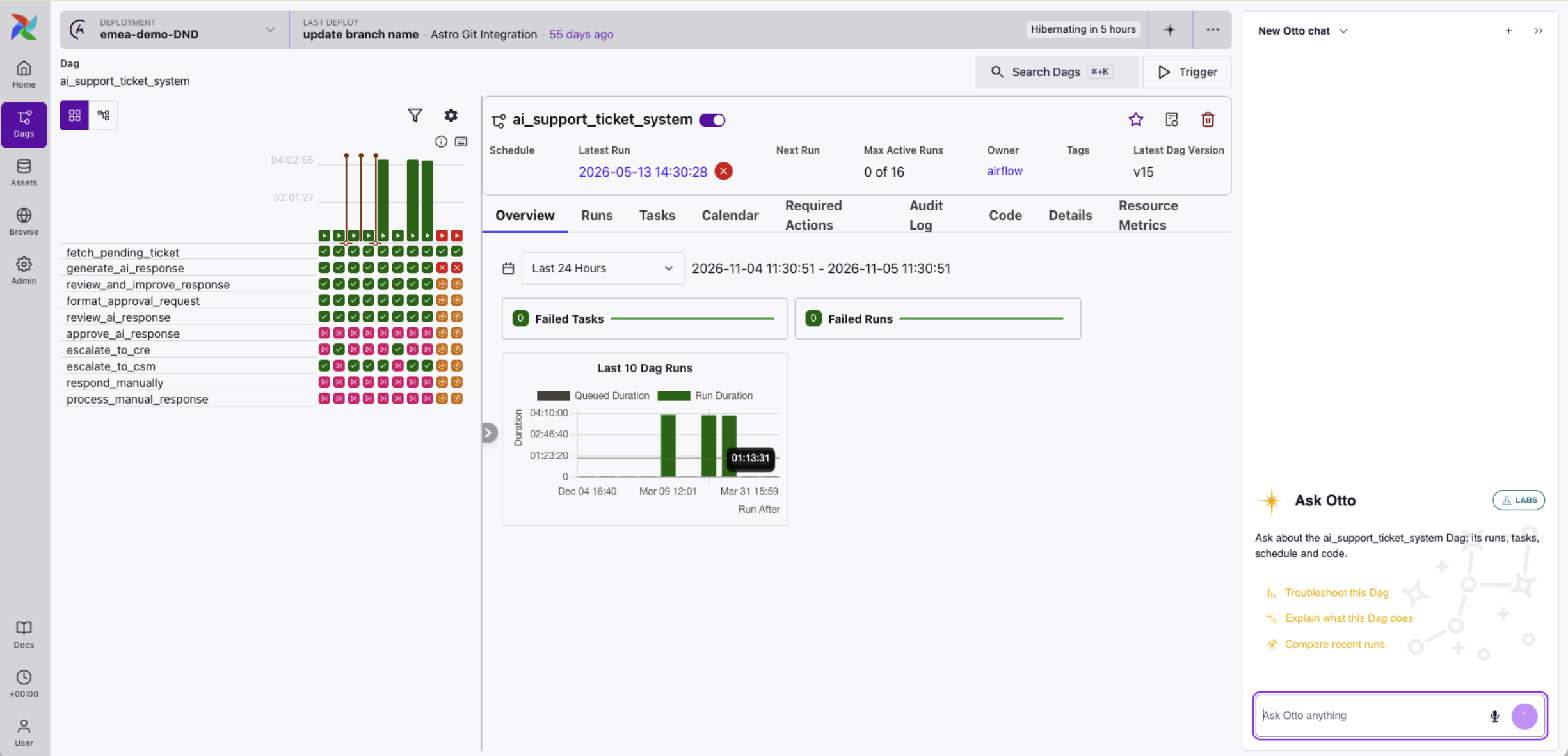
If you usually write your Airflow code somewhere else, Otto is available within the Astro CLI, and we’ve released extensions for VS Code and Cursor which give you the ability to ask Otto for support drafting code specific to your organization’s best practices and actual environment.
Finally, as part of the rollout to Preview, we’re also opening up access to Bring-Your-Own-Model, which allows you to substitute the usual hosted models for Otto with one of your own. If your company has an existing drawdown or policy decision regarding specific model usage, reach out to your account representative.
What’s next for Otto?
Otto continues to improve and develop. We’re looking at ways to increase Otto’s interface surface for both humans and agents, and to incorporate self-healing pipelines in an accessible and routine way across more of our customer organizations. Until then, Otto is an excellent option to help your teams reduce their troubleshooting time, plan upgrades or migrations, and author code for new workflows.
New to Astronomer? Learn more about Otto by talking to our team →
