ORCHESTRATING THE FUTURE OF Gaming
Top data trends: LiveOps-speed, cheat-resistant, personalized games
Introduction
Gaming companies win on retention, integrity, and LiveOps speed. Players expect low latency, seamless cross-platform play, and experiences that adapt in real time. Regulators demand stronger privacy controls as studios collect granular behavioral data at global scale, including COPPA-driven requirements for younger audiences. Costs keep rising, so studios need data that drives measurable outcomes, not just reporting.
This guide profiles five data-driven investment areas gaming companies will prioritize over the next three years:
- ML / AI: productionized for code generation, game creation, anti-cheat controls, and more
- Real-Time Analytics & LiveOps: turn telemetry into decisions and automated actions fast
- Fraud Detection & Fair Play: detect cheating, bots, and payment fraud early; enforce consistently
- Player Experience & Personalization: unify player identity and behavior to drive tailored experiences
- Governance, Security & Compliance: control player data and proprietary IP
For each initiative, we define the target state, the constraints that block it, and the capabilities required, mapping how Astro, built on Apache Airflow®, supports execution.
WHY AIRFLOW AND ASTRO?
Apache Airflow has grown to become the industry's most widely used system for orchestrating data workflows, as well as being one of the world's most active open source projects. Astro, Astronomer’s unified orchestration platform, elevates Airflow into an enterprise-grade control plane purpose-built for high-scale AI and data driven environments.
INITIATIVE ONE ML and AI Operations
Machine learning and generative AI are transforming how games are built, balanced, and monetized. ML models power anti-cheat systems that detect sophisticated aimbots and triggerbots with 99%+ accuracy. Recommendation engines personalize in-game offers based on player behavior, boosting conversion rates. Churn prediction models identify at-risk players days before they leave, enabling targeted retention campaigns.
Beyond traditional machine learning, generative AI is unlocking entirely new capabilities:
- Code Generation: AI assists developers in writing game logic, shader code, and automation scripts, accelerating development cycles
- Visual Asset Creation: Generative models create textures, character skins, environmental assets, and concept art at scale
- Procedural Content: AI generates dynamic quests, dialogue trees, level layouts, and even music that adapts to player behavior
- NPC Intelligence: Large language models power conversational NPCs with contextual awareness and natural dialogue
- Game Design Assistance: AI analyzes player feedback and telemetry to suggest balance changes, progression tuning, and feature prioritization
The opportunity is significant. According to industry research, games leveraging ML see improvements in player retention of 20-30% and can increase revenue per user by up to 40% through optimized monetization and personalization.
Realizing AI ambition
Most AI initiatives stalls at the same failure points:
- Notebook-to-production gap: Models look good in notebooks, but shipping them requires data engineering and platform work most teams can’t spare.
- Stale data, degraded models: Training data ages fast in live games, so model quality decays and predictions drift.
- Brittle retraining and feature pipelines: Retraining jobs fail quietly, and feature engineering lives in scripts with no tests, lineage, or ownership.
- Latency blocks real-time use cases: Inference is too slow or inconsistent to support anti-cheat, LiveOps triggers, or in-session personalization.
- No end-to-end visibility: Teams can’t trace bad outputs back through data, features, training runs, and deployments, so failures are hard to debug and fix.
Deploying AI in production gaming requires orchestration that connects data sources, manages model lifecycles, and ensures reliable execution at scale. Here's how Astro enables it.
| What you need | How Astro helps |
|---|---|
| Multi-step orchestration to automate AI/ML lifecycles (feature generation, training, evals, inference) | The Airflow Common AI Provider orchestrates end-to-end AI workflows with branching, tool calls, and retries, turning complex LLM and agent data flows into manageable pipelines. |
| Real-time and parallel AI workloads | Event-driven scheduling and parallel task execution enable real-time inference on game events such as user actions, feature interactions, or telemetry updates. Astro auto-scales to handle spikes in usage. |
| Secure, local execution for sensitive data and models | Remote Execution (discussed in Initiative 5) separates orchestration from execution so training and inference run inside your VPC; PII along with proprietary data and models never leave your environment. |
| Visibility that links AI behavior back to data | Astro Observe and native pipeline checks tie data quality checks, anomalies, and SLA breaches directly to AI pipelines, so teams can trace bad outputs through complete data lineage. |
| Recover long-running agent and training jobs without restarting from scratch | The task state store persists external job IDs and checkpoints across task retries, so a failed agent step or model fine-tuning run reconnects to its still-active job instead of resubmitting a duplicate and burning expensive GPUs |
| Fast, safe iteration on AI workflows | Astro Runtime, IDE, and CI/CD provide a hardened Airflow distribution, browser-based Dag development with AI-pair programming, and Git-driven deployment to ship AI changes quickly with rollbacks. |
| Flexible and future-proof | Building on Apache Airflow, gaming teams can integrate any model, AI framework, or inference engine without re-architecting their workflows, ensuring long-term flexibility as AI use cases evolve. |
AIRFLOW & ASTRO IN ACTION
Airflow is already used by some of the most demanding AI companies and agentic workloads on the planet:
- OpenAI has standardized on Airflow across its business with over 7,000 pipelines spanning research to operations and finance, all while providing a foundation for 10x growth. You can read more in our Airflow in Action blog post.
- GitHub relies on Airflow to process billions of developer events per day, orchestrating feedback loops and detecting usage patterns that are used to continuously improve Copilot. The Airflow in Action post has more detail.
The gaming industry is following suit: A leading mobile game developer standardized on Astro as the orchestration layer for its central data platform, owned by the data products team. Astro coordinates player telemetry ingestion, modeling, and data products in the warehouse that power BI and reporting across the business.
It also orchestrates AI/ML workflows, including near-real-time retraining pipelines running on Vertex AI with Apache Spark and Ray, so game teams can ship experimentation and ML-driven features on top of a trusted, governed data foundation. The company is also using that same foundation to power AI-driven GenAI use cases across the studios’ creative and customer support departments.
INITIATIVE TWO Real-Time Analytics & LiveOps
Live operations define success in modern gaming. Players expect fresh content, live events that react to community milestones, and experiences that adapt to their behavior in real time. LiveOps isn't a single workflow but rather an ecosystem of interconnected data products serving different stakeholders. Example use cases include:
- Event Performance Monitoring: Track participation rates, completion metrics, and player sentiment during live events to optimize rewards and duration
- Economy Balance: Monitor in-game currency flows, item pricing, and marketplace transactions to prevent inflation or deflation
- Content Engagement: Measure which game modes, maps, and features drive retention vs. churn to inform roadmap prioritization
- Player Segmentation: Identify cohorts by behavior, spend patterns, and engagement levels to enable targeted campaigns
- A/B Testing: Compare variants of game features, monetization offers, and UI changes to optimize player experience and revenue
Why LiveOps breaks without orchestration
Studios that run LiveOps well improve retention and lifetime value, but only if their data stack can keep up with the pace of gameplay. Legacy stacks cannot. Telemetry sits in queues for hours, dashboards lag reality, and overnight reports are stale by the next morning. That forces LiveOps teams to make high-impact calls, for example extend an event, adjust rewards, ship an emergency patch, based on intuition instead of current signals.
LiveOps requires orchestration that unifies batch and streaming data flows, ensuring consistency and reliability across the entire data lifecycle.
| What you need | How Astro helps |
|---|---|
| Unified coordination across batch + streaming | Astro orchestrates streaming platforms rather than replacing them. A single workflow coordinates ingestion, streaming aggregation, serving caches, and archival for replay and training. |
| Event-driven operational workflows | Sensors and triggers kick off downstream actions when telemetry arrives or thresholds trip, including leaderboard updates, matchmaking adjustments, alerting, and rollbacks. |
| Scalable data ingestion | Astro orchestrates ingestion from game servers, mobile clients, payment providers, and attribution platforms, coordinating parallel writes to your data warehouse or data lake with backpressure handling, retries, and recovery built in. |
| Inline data quality checks | Data quality checks (row volume, null percentage, custom SQL) run as native pipeline tasks via Airflow's SQL check operators. Failures trace to the exact task that produced them and trigger standard pipeline alerting. |
| Real-time dashboard enablement | Pipelines feed live dashboards with sub-minute latency so LiveOps teams can track active players, event participation, and monetization during launches, then react fast to churn spikes, payment failures, or performance regressions. |
| Always-on resilience for 24/7 operations | Autoscaling and cross-region DR critical workflows remain available during infrastructure degradation and outages, matching the round-the-clock reality of gaming |
| Operational support for data teams | Commercial support and SLAs delivered by the team that develops Airflow keeps LiveOps-critical workflows stable and shortens incident time-to-recovery. |
ASTRO IN ACTION
A leading gaming and betting company relied on open-source Airflow to run real-time analytics pipelines as well as operational and regulatory reporting. Without autoscaling and efficient monitoring, the platform strained resources, increased infrastructure and observability software costs, and reduced stability for mission-critical workflows.
They modernized with Astro for autoscaling and cost-optimized infrastructure, also replacing Databand with Astro-native monitoring and alerts. The results they’ve achieved are measured in cost savings, performance improvements and increased resilience:
- $300K annual infrastructure savings plus $150K Databand savings
- 3x increase in average tasks per worker
- Improved stability for mission-critical data workflows
INITIATIVE THREE Fraud Detection & Fair Play
Cheating destroys trust, engagement, and revenue. In multiplayer games, integrity is non-negotiable: one aimbot can ruin a match for everyone else. Industry research shows 42% of players have considered quitting due to cheaters, and 55% reduce or stop spending when cheating is prevalent.
Cheating also evolves fast. Malicious actors use machine learning to evade detection, hardware exploits to bypass defenses, and encrypted distribution to scale hacks, turning anti-cheat into an arms race where last month’s detection logic quickly goes stale.
Why fairness collapses without orchestration
Traditional anti-cheat is reactive: signature-based detection catches known patterns after cheats spread, matches get compromised, and players churn. Studios need proactive systems that continuously learn, score behavior at scale, and minimize false positives. They also have to tackle adjacent threats such as payment fraud, account takeover, and bot farms by correlating telemetry with commerce, identity, and device signals.
That requires orchestration that ingests and enriches signals, runs models reliably, and triggers automated enforcement fast.
| What you need | How Astro helps |
|---|---|
| High-volume telemetry ingestion | Astro orchestrates ingestion of input events, match telemetry, network signals, and device fingerprints with backpressure handling and resilient retries so spikes from launches and events don’t drop data. |
| Real-time fraud scoring | Workflows trigger ML inference on suspicious events, score risk fast, and route outcomes to automated enforcement or review queues. |
| Multi-signal correlation | Pipelines join gameplay behavior with payments, device attributes, and social graphs to build higher-confidence fraud profiles and reduce single-signal misses. |
| Continuous model retraining | Automated retraining pipelines label new data, validate against baselines, and deploy updated models when protection drifts so detection stays current as exploits evolve. |
| Automated response and appeals | Workflows enforce actions (ban, flag, step-up auth) and integrate with ticketing to attach evidence for appeals, with human-in-the-loop gates for high-risk cases. |
| Observability and fairness monitoring | Astro Observe tracks false positives, detection latency, and bias signals, and alerts teams when rates spike or pipelines drift. |
ASTRO IN ACTION
A leading global mobile game studio ran more than 70 Airflow environments on Google Cloud Composer to support gaming analytics and business operations. The sprawl drove high infrastructure costs, operational overhead, and instability. Because these pipelines powered core analytics and operational reporting, downtime directly impacted revenue and decision-making.
The studio migrated from GCC to Astro consolidating environments into a single managed Airflow platform optimized for performance and reliability. The migration has resulted in:
- 20% lower Airflow TCO
- 70 environments consolidated for global scale
- Improved reliability of mission-critical analytics and business operations pipelines
INITIATIVE FOUR Player Experience & Personalization
Players benchmark gaming experiences against Netflix, Spotify, and TikTok, expecting gameplay that adapts to their preferences and recommend the right content at the right time. Delivering that level of personalization requires unified player profiles that combine behavior, purchases, social context, and engagement across every touchpoint, all while enforcing privacy and consent automatically.
Why personalization fails without orchestration
Most studios run fragmented systems: player identity and gameplay data are split by title, telemetry sits in lakes, payments live in billing silos, social graphs stay trapped in platform services, and support data rarely connects back to gameplay. That fragmentation blocks personalization at portfolio scale. Recommendations, retention, and offers all degrade because teams optimize isolated metrics instead of acting on a unified view of the player.
| What you need | How Astro helps |
|---|---|
| Unified player profile pipelines | Astro orchestrates aggregation across game services, telemetry, commerce, and support to build a consistent player profile used by analytics and product systems. |
| Real-time activation | Event-driven workflows trigger offers, messaging, and interventions based on player behavior such as milestones, churn signals, or social events. |
| Recommendation and targeting | Astro orchestrates feature engineering, training, and model serving pipelines so teams can power recommendations, churn/propensity scoring, and offer optimization with reliable, repeatable workflows. |
| Cross-platform consistency | Orchestrated sync workflows reduce drift across mobile, console, PC, and web so players see consistent state, progress, and entitlements. |
| Privacy, consent, and residency automation | Pipelines enforce consent flags, deletion requests, and regional data rules as part of execution, not as an external checklist. |
| Crash-safe recovery for long-running distributed jobs | The task state store checkpoints external job IDs and progress markers, like a Spark application ID or last offset processed, so a retry reconnects to a running job or resumes from its last checkpoint instead of reprocessing the full dataset. |
| Observability for trust and tuning | Astro Observe and native pipeline task links data quality and lineage to personalization pipelines so teams can diagnose targeting changes and offer behavior with evidence. |
ASTRO IN ACTION
Personalization at SciPlay
SciPlay needed a scalable way to orchestrate game telemetry and analytics across a growing portfolio, while improving how player data informed engagement and personalization. Fragmented workflows made it hard to deliver reliable insights fast enough to support live game operations.
SciPlay standardized on Astro as the managed orchestration layer for its central data platform, using Airflow to coordinate ingestion, transformation, and analytics pipelines at scale. Astro now powers BI, reporting, and advanced data products that feed experimentation and AI/ML use cases.
The result is a more reliable data foundation that helps teams understand player behavior, tune gameplay, and deliver more personalized, engaging player journeys across games. Learn more from the SciPlay and Astronomer case study.
From Weeks to Minutes: Real-Time Player Personalization
A leading gaming company needed to modernize its data platform to deliver highly personalized player offers and accelerate marketing execution. Legacy tools and older, self-managed Airflow instances slowed innovation, made pipelines brittle, and forced teams to spend too much time on platform operations instead of personalization logic and campaign strategy.
The company standardized on Astro to centralize orchestration across its marketing and analytics stack. Astro became the backbone for ingesting, transforming, and curating player data, with automated Dag creation, built-in observability, and deep integration with modern data platforms to streamline segmentation and offer delivery. With Astro, the company has been able to:
- Cut marketing offer delivery from 3 weeks to under 1 hour
- Stabilize the 54K+ monthly tasks powering customer engagement
- Personalize and segment pipelines faster, enabling quicker campaign launches and iteration
INITIATIVE FIVE Data Governance, Security & Compliance Frameworks
None of the initiatives we’ve profiled so far matter if studios fail to pay attention to governing and securing their data. This is because the studios run on sensitive and differentiating data: player behavior that exposes spend and engagement patterns, telemetry that encodes proprietary economy and balancing logic, and accounts that include payments, social graphs, and PII governed by GDPR, COPPA, and data-sovereignty rules.
Without governance built into how pipelines run, those assets turn into liabilities fast: breaches trigger fines and reputational damage, leaked anti-cheat logic accelerates cheating, and privacy missteps erode trust, creating revenue impact and churn at LiveOps scale.
Closing the governance gap
Governance breaks in gaming for predictable reasons:
- Workflows and data pipelines launch fast; controls come later
- Lineage lives in docs that drift from reality
- System access expands over time and never shrinks
- Regional requirements multiply environments and exceptions
When governance is bolted on, it turns into compounding operational risk: privacy incidents, IP leakage, and fragile pipelines that teams avoid changing.
| What you need | How Astro helps |
|---|---|
| Policy-as-code enforcement | Astro runs workflows defined in code and deployed via CI/CD so teams can embed validation, masking, and audit logging as enforced steps. |
| Hardened runtime for sensitive workloads | Astro Runtime delivers a production-ready Airflow distribution with controlled image updates for predictable, auditable operations. |
| Diagnose pipeline failures in minutes | Otto, the data engineering agent for Astro, pulls the logs, analyzes the failure, and proposes a fix. Get to the root cause in minutes instead of hours, without manually digging through code and logs. |
| Identity, access, and isolation that matches real orgs | Astro integrates with enterprise SSO/IAM, enforces RBAC, and supports isolated execution patterns so access to sensitive datasets and IP is scoped and reviewable. |
| Audit-ready visibility across pipelines | Astro Observe ties task execution, lineage, pipeline-level data quality checks, and SLA tracking to the pipelines that produce player analytics, finance reporting, and compliance workflows. |
Remote Execution: cloud efficiency without data egress
Gaming studios want managed operations without handing over control of player data, telemetry, or proprietary logic. Remote Execution solves the tradeoff by separating orchestration from execution. Gaming teams get a fully managed Airflow control plane maintained, upgraded, and secured by Astronomer while all workflow execution and data stays inside their own cloud or on-premises environment and within their compliance boundary.
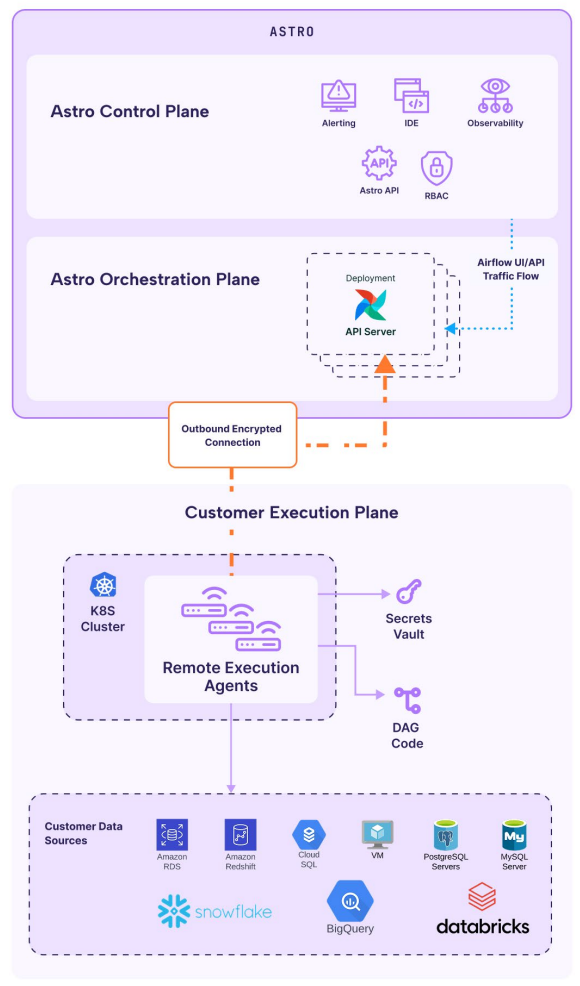
Figure 1: Stepping through Remote Execution’s architecture and traffic flow
Remote Execution uses a three-plane architecture:
- The control plane manages users and metadata but never sees your data.
- The orchestration plane schedules workflows in a single-tenant environment.
- The execution plane (fully yours) runs the tasks using your infra, secrets, and permissions.
Remote Execution Agents connect outbound over encrypted channels. Studios avoid inbound firewall exceptions while keeping data and compute inside their boundary. Result: managed orchestration with control over residency, permissions, and blast radius.
You can learn more by downloading our whitepaper: Remote Execution: Powering Hybrid Orchestration Without Compromise.
Conclusion: Orchestration as the Control Plane for Gaming
Each initiative in this guide shares the same requirements:
- Clean, timely, governed data
- Operational speed that matches LiveOps reality
- Reliable, observable pipelines across systems and regions
- Security and privacy controls built into execution
That is the role of orchestration. Studios that win will treat orchestration as the control plane for LiveOps, integrity, AI, and player experience, operationalizing it with platforms like Astro.
Build a trusted, future-ready data stack today
Run an Astro TCO analysis and get in touch with our experts today to get results faster.
Get the Full Guide
Keep reading to explore how data orchestration is at the center of the top five data-driven investment areas in the gaming industry.
By proceeding you agree to our Privacy Policy, our Website Terms and to receive emails from Astronomer.