ORCHESTRATING THE FUTURE OF Fintech
Building a Trusted Data Stack for AI, Risk, and PLG
Introduction
Fintechs no longer win on features alone. They win on how quickly they convert data into trusted, revenue-generating products, under relentless regulatory scrutiny and margin pressure. Three data and AI investments will separate the leaders from the laggards over the next three years.
- Productionizing AI and agentic automation
- Real-time fraud, financial crime, and risk intelligence
- Product-led growth and usage-based monetization
Each depends on the same foundation: reliable, governed, observable data pipelines that move the right data to the right place at the right time. A model is only as good as the data feeding it. A fraud score is only as fast as the pipeline behind it. A usage-based invoice is only as accurate as the metering data underneath it. Orchestration, powered by Airflow and Astro, is the control plane that makes all three executable.
WHY AIRFLOW AND ASTRO?
Apache Airflow has grown to become the industry’s most widely used system for orchestrating data workflows, as well as being one of the world’s most active open source projects.
Astro, Astronomer’s unified orchestration platform, elevates Airflow into an enterprise-grade control plane purpose-built for high-scale AI and data-driven environments.
INITIATIVE ONE Productionizing AI and agentic automation
Fintechs are putting AI to work across high-value workflows: underwriting, support, collections, and back-office decisioning, with agents that act and remediate rather than only answer. As risk-aware operators, they adopt it where outcomes can be governed, traced, and explained, which is exactly why execution, not ambition, is the hard part.
As industry research shows, fintechs already lead the sector, outpacing incumbents in advanced AI adoption (47% to 30%) and agentic AI (57% to 45%), yet only 14% of financial firms call AI transformational to their strategy today. The prize is durable margin and speed, with teams discovering that moving from impressive pilots to production AI is the defining competitive line.
Why this is hard today
AI rarely fails in production because of the model; it fails because of the data workflows. Training and inference run on fragmented, stale data stitched together by cron jobs and one-off scripts. Retraining, evaluation, and rollout lack a repeatable pipeline, so behavior that held up in a sandbox breaks under live traffic. Inference pipelines carry no lineage, making a bad output impossible to trace or explain to a regulator, and pipelines can fail outright, disrupting the business.
Without orchestration, fintechs ship demos, not durable capabilities, and every AI incident erodes hard-won customer trust.
Priority use cases
- Agentic underwriting and onboarding that ingests applicant and broker documents, enriches with third-party data, and routes decisions for human review.
- Real-time credit and risk scoring triggered by transaction events and refreshed continuously as new behavioral data arrives.
- GenAI support and collections copilots grounded in live account data rather than stale knowledge bases.
- LLM-powered document processing for KYC, statements, and disclosures at scale.
All of these use cases demand automated model retraining, evaluation, and staged rollout pipelines with built-in rollback when performance drifts.
From pilot to production: what it takes to run AI as a capability
| What You Need | How Astro Helps |
|---|---|
| Orchestrate multi-step AI and agent workflows | The Airflow Common AI Provider runs end-to-end LLM and agent pipelines with branching logic, tool calls, and production-grade retries. |
| Keep sensitive data and models in your environment | Remote Execution separates orchestration from execution, so PII, proprietary models, and code never leave your VPC. |
| Real-time, parallel inference on product events | Event-driven scheduling and parallel task execution trigger inference on user actions; autoscaling absorbs usage spikes. Astro Runtime delivers 100x lower task scheduling latency under load than self-managed Airflow. |
| Trace bad model outputs back to their data | Astro Observe links native pipeline data quality checks, anomalies, and SLA breaches to AI pipelines with end-to-end lineage. |
| Diagnose AI pipeline failures in minutes | Otto, the data engineering agent for Astro, pulls the logs, analyzes the failure, and proposes a fix. Get to the root cause in minutes instead of hours, without manually digging through code and logs. Otto sets the foundation for self-healing pipelines. |
| Recover long-running agent and training jobs without restarting from scratch | The task state store persists external job IDs and checkpoints across task retries, so a failed agent step or model fine-tuning run reconnects to its still-active job instead of resubmitting a duplicate and burning expensive GPUs |
| Ship and roll back AI changes safely | Astro Runtime, IDE, and CI/CD provide a hardened Airflow distribution, browser-based Dag development with AI-pair programming, and Git-driven deployment to ship AI changes quickly with rollbacks. |
| Flexible and future-proof | Building on Apache Airflow, engineering teams can integrate any model, harness, or training and inference platform without re-architecting their workflows, ensuring long-term flexibility as AI use cases evolve. |
Airflow and Astro in Action
Airflow is already used by some of the most demanding AI companies and agentic workloads on the planet:
- OpenAI has standardized on Airflow across its business with over 7,000 pipelines spanning research, operations, and finance, all while providing a foundation for 10x growth. Read more.
- GitHub relies on Airflow to process billions of developer events per day, orchestrating the feedback loops used to continuously improve Copilot. Read more.
- Red Hat runs production AI agents on trusted, governed data orchestrated by Astro. Use cases span a natural-language analytics agent that gives executives real-time access to sales and pipeline data and a Privacy Impact Assessment agent that turns week-long compliance reviews into a fast, auditable process. Read more.
The fintech industry is following suit. Stripe processes PBs of payments data every day with Airflow for AI and analytics use cases. As discussed later in this guide, companies like Ramp are using Airflow and Astro in their AI-driven Product-Led Growth (PLG) initiatives.
Janus Henderson Investors, a global asset manager with ~$480B under management, runs 130+ overnight pipelines feeding quantitative signals to investment teams less than an hour before market open, so a 3 AM failure became a business problem by 7 AM. After migrating from AutoSys and self-hosted Airflow to Astro on Azure, the firm paired Astro Observe with Otto, Astronomer's AI data engineering agent, to diagnose every Fixed Income failure instantly and route it for automated remediation, achieving a 95% faster MTTR and a 20% TCO reduction. The same platform is set to underpin the firm's growing AI model deployment. Learn more from our case study.
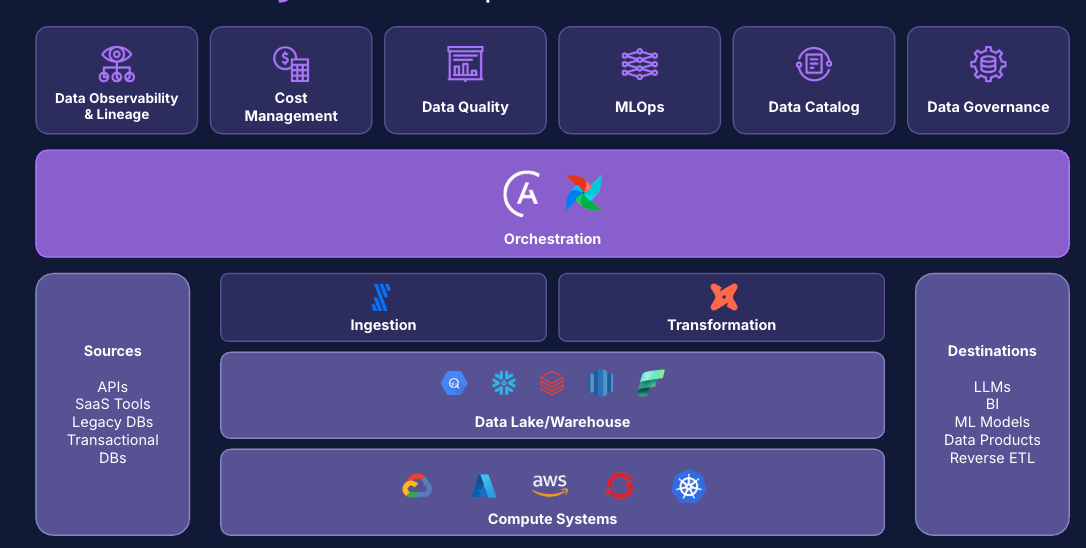
Figure 1: With the Astro platform, data teams work with a unified orchestration platform to build, run, and observe all of their critical data pipelines and workflows.
INITIATIVE TWO Real-time fraud, financial crime, and risk intelligence
Fraud is now an industrialized, AI-powered threat, and stopping it in real time protects both customers and the license to operate. Industry findings show bank fraud and scams drove $579.4 billion in global losses in 2025, with 90% of financial-crime professionals reporting more AI-driven attacks over two years.
Regulation is tightening in parallel: the EU AI Act classifies fraud detection and credit scoring as high-risk, with obligations enforceable over the next several years. Accuracy, speed, and explainability are now survival requirements.
Why this is hard today
Static, rule-based systems cannot keep pace with synthetic identities, mule networks, and deepfake-enabled scams. The deeper failure is operational. Fraud signals live in disconnected systems, enrichment pipelines run on batch delays, and models retrain too slowly to catch new patterns.
When pipelines are fragile or opaque, fraud slips through, false positives bury investigators, and teams cannot prove to a regulator how a decision was reached. The cost is direct loss, customer attrition, and compliance exposure.
Priority use cases
- Real-time transaction scoring that blocks or challenges suspicious payments before settlement.
- Agentic AML and case investigation that gathers evidence, drafts narratives, and routes only enriched alerts to investigators.
- Synthetic-identity and account-takeover detection using graph and behavioral signals across channels.
- Explainable decisioning pipelines that log full lineage for every high-risk model output.
Continuous model retraining on fresh fraud data is essential to counter fast-evolving attack patterns.
Stopping fraud without slowing the customer
| What You Need | How Astro Helps |
|---|---|
| Enforce fraud and AML controls in code | Pipelines are defined in code and deployed via CI/CD, embedding sanctions screening, validation, and audit logging as enforced steps, so the same controls apply to every transaction. |
| Trigger scoring instantly on payment events | Event-driven scheduling launches fraud pipelines from transaction events; parallel execution scales under attack surges. Astro Runtime delivers 100x lower task scheduling latency under load than self-managed Airflow. |
| Run detection on regulated data in place | Remote Execution keeps customer PII and proprietary fraud models inside your compliance boundary using outbound-only, zero-trust connections. |
| Enrich and route alerts without manual glue | Astro orchestrates ingestion and enrichment across 2,100+ connectors, feeding clean, high-quality signals to investigator queues. |
| Prove every decision to a regulator | Astro Observe provides end-to-end lineage and audit trails for high-risk model outputs. |
| Automated compliance monitoring | With centralized metadata and usage dashboards, Astro helps detect failures, SLA breaches, or anomalies, surfacing deviations in pipeline behavior that impact sensitive processes. |
| Keep the fraud platform hardened and patched | Astro Runtime delivers a security-hardened Airflow distribution with a custom security manager, enforced RBAC, and timely patches, cutting exposure to known vulnerabilities in systems processing sensitive financial data. |
Airflow and Astro in Action
Thousands of dbt models behind Wise’s analytics and reporting depend on a small set of critical financial datasets, so a single pipeline failure spreads across the business. Wise orchestrates those datasets with Airflow, sending memory-intensive work to AWS EMR and SageMaker and grading every pipeline through a central tiering system. The result is one standard deployment across Airflow instances, a visible path to production trust, and a foundation for AI: LLM-drafted variance commentary that Airflow validates against source data before analysts rely on it. Read more in our Airflow in Action blog post.
A leading U.S. neobank serving 22M+ members ran fraud detection, compliance, and risk assessment across fragmented Amazon MWAA, Glue, and Snowflake jobs, with no unified visibility and 6+ months plus 3 engineers consumed by every Airflow upgrade. By migrating to Astro on a Kubernetes executor and consolidating onto a single orchestration layer, the team eliminated 6+ months of upgrade time, put 850+ Dags live in production, and completed the migration with zero business disruption as they accelerated product growth.
A global payments leader processing ~$2.2T annually across 146 countries needed to stand up a new Airflow platform fast, while preserving CI/CD and Snowflake connectivity and enforcing a governed, federated model. By building a payments-grade orchestration layer on Astro with Airflow 3, the team centralized governance and alerting, preserved CI/CD, delivered the platform on time, and cut infrastructure costs through non-production hibernation, all with event-driven scheduling enabling faster federated delivery.
Remote Execution: secure, cloud-native orchestration
For fintechs, moving sensitive data into a vendor's infrastructure can breach security policy, regulatory obligations, or both. Astro solves this with Remote Execution, an Airflow 3 architecture that separates orchestration from execution: you get a fully managed control plane while every task runs inside your own cloud or on-premises environment, so customer PII, transaction records, and proprietary credit and fraud models never leave your compliance boundary. Communication is outbound-only and encrypted with no inbound firewall exceptions, the control plane sees only operational metadata, and agents authenticate under your own IAM identities, aligning with zero-trust.
The result is the agility and reduced ops burden of managed orchestration without ceding control over sensitive data or compute. Learn more in our whitepaper, Remote Execution: Powering Hybrid Orchestration Without Compromise.
INITIATIVE THREE Product-led growth and usage-based monetization
Investors have lost patience with growth-at-any-cost; fintechs now win on unit economics and durable expansion. Product-led, usage-based pricing is the lever: 64% of Forbes' Next Billion-Dollar Startups already price on usage, with adoption highest in fintech and AI. Done right, consumption pricing lowers entry barriers, aligns price to value, and compounds expansion revenue.
Why this is hard today
Growth stalls when the data behind it is late or wrong. Usage, billing, CRM, and support signals sit in disconnected systems, and brittle metering and reverse-ETL jobs fail silently, so invoices misfire and product-qualified-lead and churn models run on unreliable telemetry. Fintech is among the highest-churn B2B categories, so a missed retention trigger or an inaccurate usage charge burns revenue directly.
Without dependable pipelines, personalization stays a slogan and pricing experiments destabilize the core data teams depend on.
Priority use cases
- Accurate usage metering and rating pipelines that feed billing and entitlement checks in near real time.
- Event-driven onboarding, upsell, and retention workflows triggered when usage crosses defined thresholds.
- Trusted PQL, health-score, and churn models built on validated product and billing data.
- Agentic customer-success workflows that detect at-risk accounts and assemble tailored save-offer actions.
- Safe pricing and paywall experiments deployed without destabilizing production data.
Turning usage into durable revenue
| What You Need | How Astro Helps |
|---|---|
| Unify product, billing, CRM, and support data | Astro orchestrates ingestion and syncs across 2,100+ connectors into a single, managed pipeline layer. |
| Integrate orchestration and transformation to manage complex analytics | Orchestrate, run, and observe dbt workflows with Cosmos, the open-source standard for seamless dbt orchestration and model-level visibility in Apache Airflow. |
| Reliable metering for usage-based billing | Airflow Dags on Astro run metering, aggregation, and rating pipelines that feed billing systems with accurate, timely consumption data. |
| Trust the signals behind growth models | Astro Observe and native pipeline checks enforces schema, volume, and freshness checks on the pipelines powering PQLs, health scores, and churn. |
| Act the moment usage changes | Event-driven scheduling triggers onboarding, upsell, and retention workflows when usage thresholds or patterns shift. Astro Runtime delivers 100x lower task scheduling latency under load than self-managed Airflow. |
| Let teams experiment without breaking core data | Blueprint lets non-engineers build governed Dags via the Astro IDE no-code canvas, while workspace isolation, CI/CD, and rollback keep experiments off production-critical pipelines. |
Astro in Action
Ramp chose Astro for its maturity and off-the-shelf integrations to turn raw data signals into reliable business leverage across growth, product, risk, and strategic finance. Running on Astro, Airflow acts as Ramp's central nervous system, coordinating ingestion, dbt transformations, and cross-dag dependencies. Beyond analytics, the team extended Airflow into AI/ML to productionize machine learning inference, training, and feature pipelines, while also powering lead scoring, churn reduction, and customer-facing data integrations. Learn more from the Data Flowcast: Powering Finance With Advanced Data Solutions at Ramp.
A leading UK credit and consumer-financing provider serving 5M customers needed to scale to millions of new cardholders and launch new credit-card products faster, but cost overruns, inefficient Dags, and rising compute were slowing delivery. By unifying its platform on Astro, the team boosted task concurrency by 70%, consolidated 2,000+ pipelines under secure multi-tenant governance, and saved $100K+ annually through pod downsizing and cluster merges, enabling faster onboarding of new, monetizable credit-card use cases.
Conclusion: orchestration as the control plane
From productionizing AI and stopping financial crime in real time, to monetizing usage and retaining customers, each priority in this guide shares the same foundational requirements:
- Clean, timely, governed data.
- Reliable, self-healing, and observable pipelines across systems and clouds.
- Security, compliance, and cost control built into how workflows are defined and run.
That is the role of orchestration. The fintechs that win the next three years will treat orchestration as the control plane for their AI, risk, and growth strategies, and they will operationalize it with platforms like Astro.
Build a trusted, future-ready data stack today.
Run an Astro TCO analysis and get in touch with our experts today to get results faster.
Get the Full Guide
Keep reading to learn more about the five data-driven investment priorities defining travel and hospitality over the next three years, and how fully managed Apache Airflow® provides the orchestration foundation each one requires.
By proceeding you agree to our Privacy Policy, our Website Terms and to receive emails from Astronomer.