The Customer
GEODIS is a leading global logistics provider acknowledged for its expertise across all aspects of the supply chain. As a growth partner to its clients, GEODIS specializes in four lines of business: Global Freight Forwarding, Global Contract Logistics, Distribution & Express Transport, and European Road Network. The Group operates a global network spanning nearly 170 countries and 48,000 employees. In 2025, GEODIS generated €10.6 billion in revenue. GEODIS is a company owned by SNCF group.
Delio Amato, who has worked at GEODIS for more than two decades, holds the title of Chief Data Officer and Chief Architect. He describes the company's data challenge in terms any enterprise architect would recognize: dozens of countries, six business lines, and a different set of operational systems behind each one. "We have several different business lines across different regions," Delio says. "We operate across the globe, and delivering all those activities relies on several and different operational systems. All of that is where the complexity of our data ecosystem comes from."
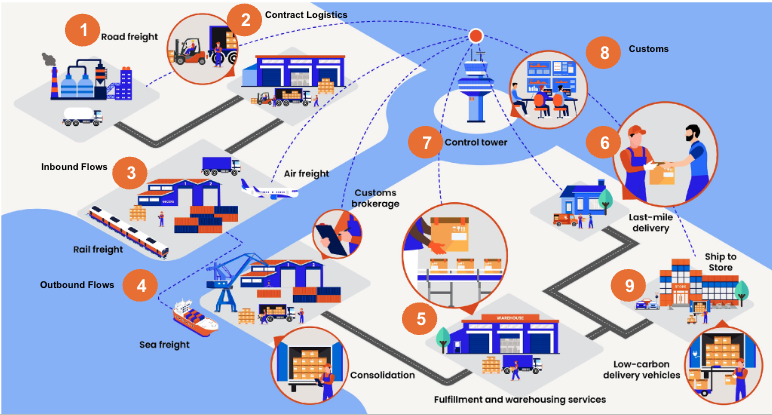
A complex supply chain leads to a complex data ecosystem.
For a company where late deliveries, missed SLAs, and undetected fraud all carry direct financial consequences, that complexity is not just a technology problem. Getting data right, at GEODIS's scale, is a prerequisite for running the business at all.
The Challenge
Six years ago, GEODIS's data lived in silos, organized by business line, region, and operational system. The company needed to make data self-service across an organization that was never going to centralize. Rather than forcing a top-down consolidation, Delio's team took a different path: standardize the technology layer, then let each business line operate autonomously within it. The mechanism for doing that was the data product.
For Delio, a data product is more than a dataset. It is a structured, documented, and contractually reliable data asset, built so that any consumer, in any business line, can understand what the data means, trust that it is current, and use it with confidence. "The most important thing for a data product is to bring data to consumers in a way that is easily consumable and understandable," he explains, "including the contracts that tell you what to expect and the context that tells you whether you can trust it today." That framework, applied consistently across business lines, became the foundation of GEODIS's data mesh.
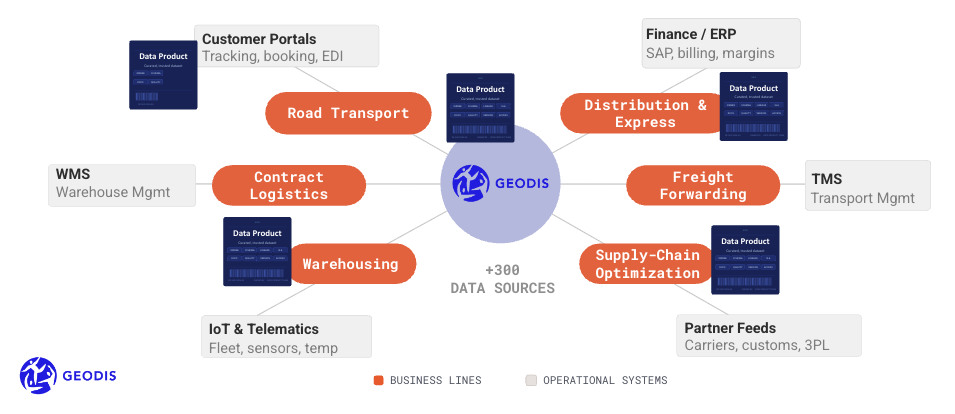
Data products are the building blocks of a data mesh.
But as GEODIS moved from building the data platform to actually using it for AI, new constraints surfaced. The Cloudera-based orchestration layer that powered the pipelines was tightly coupled to Cloudera's own execution environment, limiting GEODIS's ability to evolve its stack as tools like Databricks and Starburst came into play, while also running on an outdated version of Airflow that blocked access to newer capabilities and integrations. Data quality was measured statically, at pipeline creation time, rather than tracked dynamically through the pipeline lifecycle. And the data product framework, while sound in principle, lacked the observability to tell downstream consumers, or AI models, whether the data arriving at their doorstep was actually fresh, complete, and trustworthy.
"We have been testing hundreds of AI use cases across all our business lines, with real successes. But scaling them is not obvious. It is quite difficult, for many reasons: organizational and technical. And much of it comes back to whether the data beneath those models can actually be trusted." Delio Amato Chief Data Officer & Chief Architect, GEODIS
The Solution
The answer to the orchestration question, for Delio, was always going to be Airflow. GEODIS's pipeline architecture is intentionally decoupled: each step in the pipeline, capture, ingest, lake, processing, data access, is kept independent of the others so that no single tool owns the end-to-end flow. "Orchestration is key because we are building all those data products with end-to-end orchestrated pipelines," Delio explains. "We don't want to rely on one provider in the stack to manage our pipelines. The limits between each step are quite strict, and the orchestrator sits on top of all of it."
Airflow's open, Python-native model is precisely that kind of neutral layer.
What GEODIS needed beyond open-source Airflow was an enterprise platform that could manage that infrastructure at scale, accelerate the migration off Cloudera, and add the native observability that data products require. That is where Astronomer came in. GEODIS engaged Astronomer's Center of Excellence team for an intensive migration sprint through December 2025, moving 100+ DAGs from Cloudera to Astro with minimal refactoring in the first phase and a deeper rearchitecting pass to follow. Crucially, Astronomer's services team didn't just convert DAGs — they also converted the underlying queries from Apache Impala to Starburst, handling the full migration of both orchestration logic and query layer in a single engagement. The team worked alongside GEODIS engineers on Cloudera operator compatibility, CI/CD strategy, multi-repo deployments, and integrations with Databricks, Starburst, OpCon, and ServiceNow.
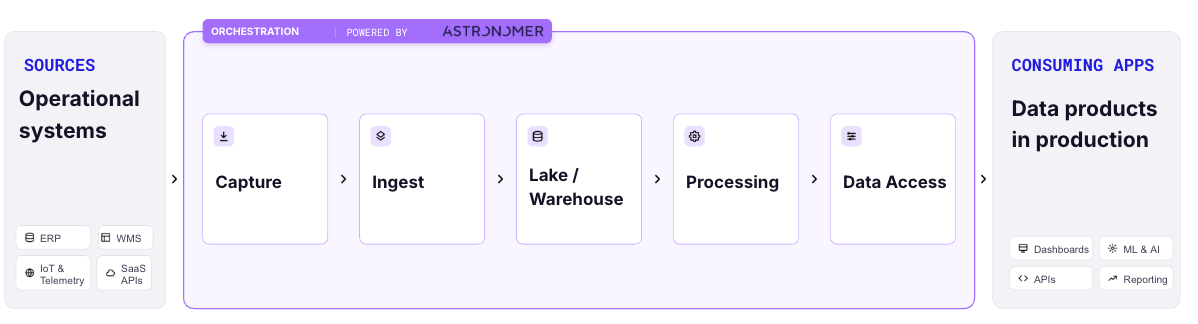
Orchestration is what makes data products reliable.
GEODIS runs Astro on Azure, with production deployments across a corporate data workspace and a data engineering workspace.
Alongside the migration, the team adopted Astro Observe, a decision driven from the top. When Delio's manager saw Observe in action, they called it a must-have: not just for pipeline monitoring, but specifically for data quality management. For a team running significant compute on Databricks, knowing what pipelines are consuming, when, and whether the output is trustworthy closed a gap no other tool had addressed.
"Orchestration is key because the way to build data products is with end-to-end orchestrated pipelines. The orchestrator is the connective layer that makes the whole system work, regardless of which tools sit inside it." Delio Amato Chief Data Officer & Chief Architect, GEODIS
The Results
GEODIS migrated 100+ DAGs from Cloudera to Astro in the initial engagement phase, with 38 production deployments now running on Azure across multiple workspaces and business domains. Astro Observe added a dynamic quality layer to GEODIS's data product framework, automatically capturing freshness, lineage, and quality metrics that were previously measured statically or not tracked at all.
The payoff is most visible in GEODIS's ability to industrialize AI use cases that had previously stalled at the pilot stage. A machine learning model for weight fraud detection in last-mile parcel delivery is one concrete example: the model identifies packages declared at the wrong weight, so warehouses can focus physical weighing on the likeliest offenders. The result is measurable revenue recovery and a working proof point that AI delivers when the data beneath it is governed and trustworthy.
"What we have seen with Astro is that observability has been added to our metadata management in a really easy way, giving us the capability to add more data quality metrics on top of what we were able to measure statically. The orchestrator now contributes not just to producing the dataset, but to enriching the data product itself and making it more efficient for any consumer downstream." Delio Amato Chief Data Officer & Chief Architect, GEODIS
What's Next
GEODIS is continuing to deepen the platform, with SLA monitoring, data lineage tracking, and new quality monitors rolling out across workspaces. A second migration wave is also in planning: moving the orchestration DAGs that previously ran against Apache Impala, a distributed query engine in GEODIS's legacy Cloudera estate, over to Starburst, as GEODIS continues to modernize its query layer on Astro.
The longer-term ambition is a data platform where every data product arrives not just with the right data, but with the quality guarantees that allow any consumer, human or AI, to act on it without hesitation.
"Models need context, and data products bring context to the data. With Astro, we can now provide not just functional context but technical context too: how the data was built, how fresh it is, what the quality level is. All of that metadata is what makes a data product genuinely ready for AI." Delio Amato Chief Data Officer & Chief Architect, GEODIS