Airflow in Action: Running Critical Financial Data Workflows and Agentic AI at Wise
4 min read |
On the Data Flowcast episode Managing Financial Datasets with Airflow at Wise, Astronomer's Kenten Danas talks with Antonello Benedetto, Staff Data Engineer at Wise, about how his team orchestrates critical financial datasets with Apache Airflow®. Listeners will learn the three design principles behind Wise's reliable pipelines, how a tiering system decides which pipelines earn production trust, and how Wise validates non-deterministic LLM output.
$240 billion and 19 million customers, no margin for bad data
Wise helps customers move money across borders and hold it in 40 currencies, and sells the same infrastructure to banks and large enterprises through Wise Platform. In fiscal year 2026, Wise supported 19 million customers who moved $240 billion across borders and saved roughly $3 billion in fees.
Antonello sits on the central data and analytics engineering team. There he coordinates projects with platform engineering and security engineering, after previously leading data engineering for Wise's finance and treasury teams.
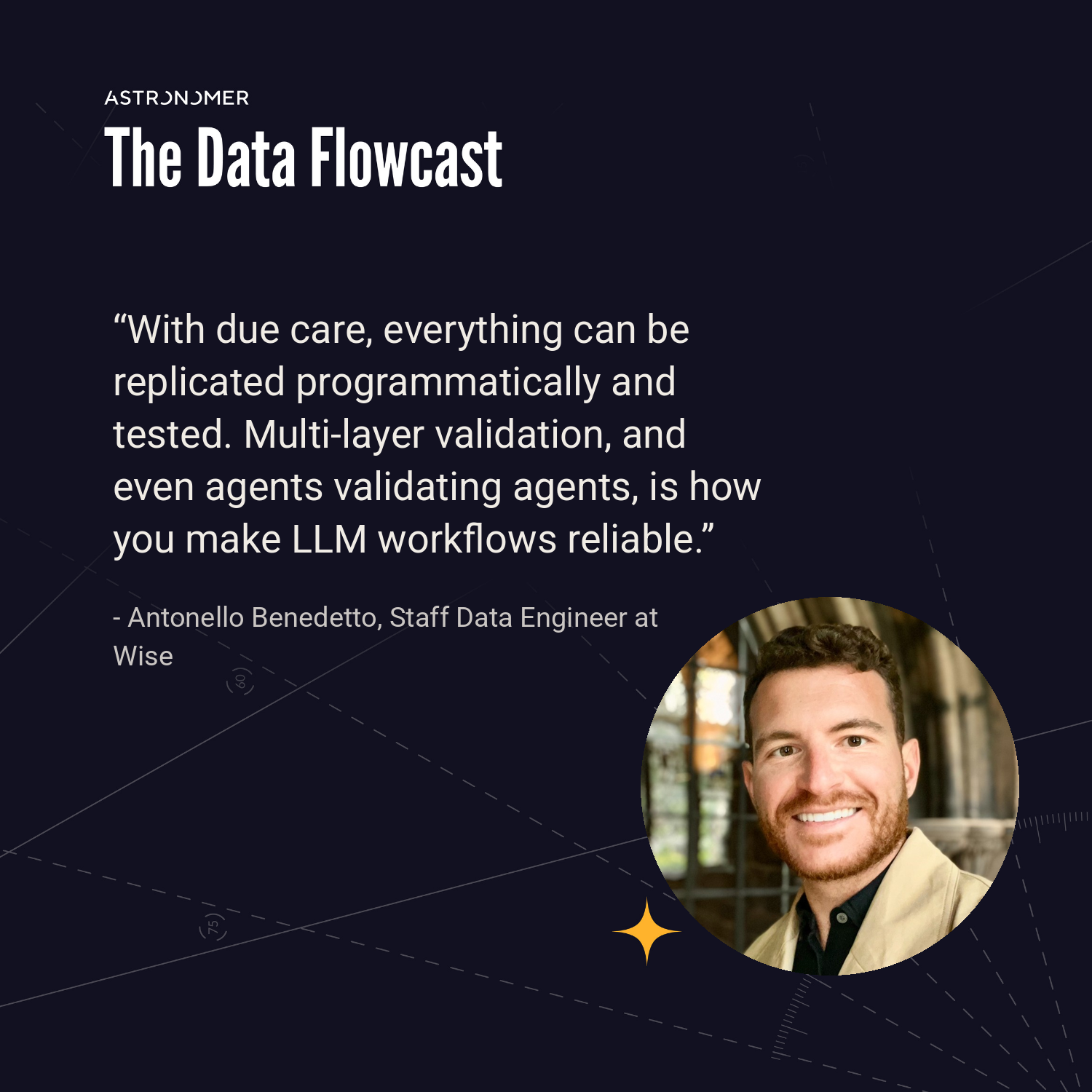
Listen: Antonello Benedetto of Wise on managing financial datasets with Airflow.
The interface between platform engineering and analytics.
The Data and Analytics team runs as a hybrid. It owns Wise's dbt and BI infrastructure and now offers analytics MCPs as a service so employees can use AI locally. Its analytics engineers can also be assigned to other teams such as finance and treasury to build ETL pipelines.
Airflow orchestrates the critical datasets that thousands of downstream dbt models rely on, so one failure in those datasets cascades across the business.
Data reliability starts in pipeline design
With that much depending on them, and with Wise operating as a regulated fintech, these pipelines have to be maintainable and reliable from the start. Three principles guide how the team designs them:
- Orchestration stays separate from computation. Dag structure lives apart from the Python logic it runs, so engineers fix a bug by touching the fewest possible files.
- Airflow sends heavy work to the right engine. At Wise's scale, the team routes memory-intensive tasks to AWS EMR or SageMaker and keeps Airflow tasks light. Airflow's integrations with those services make the handoff simple to build, so each layer does the job it is built for.
- Deployment is standard, and environments are flexible. Upgrades used to take significant effort because teams ran different Docker images. The PythonVirtualenvOperator now lets Wise deploy one standard image everywhere while analysts pick their own packages in isolated environments.
Platform engineering gets consistent infrastructure, and stakeholders still control their own dependencies.
Trust is earned one tier at a time
Wise uses a central tiering system to separate proven pipelines from ones still in development. Tiers grade the pipeline rather than the data: whether it has sufficient controls, ownership metadata, committed SLAs, documentation, and production track record.
Top-tier pipelines face the strictest observability. Wise publishes the promotion criteria, so any analyst can see what a pipeline needs to move up. Downstream requirements usually speed promotion, and some pipelines never need the top tier. Top-tier pipelines also show the team where trustworthy data lives as it builds a semantic layer for dbt models and LLM applications.
Your LLM pipeline is not idempotent. Plan for it.
Antonello's example is variance analysis commentary, which analysts write on a recurring basis, often monthly. An Airflow pipeline collects the data, passes it to an LLM with instructions, and returns a draft for analysts to work from.
On the surface, the LLM Dag looks like any other Airflow pipeline, but unit and integration tests are not enough. LLM output is not idempotent and can hallucinate, so Wise adds a validation layer for each use case, plus observability and evaluation platforms that track model performance across runs. While the wording can vary between runs, the figures, percentages, and direction of each variance must match the source data, and the pipeline checks that in code.
Wise is also building agents that validate other agents. A second agent reviews the output of the first LLM call before it moves downstream, much as teams already use agents in CI/CD to check pull requests for bugs. In Antonello's view, careful design lets teams test LLM workflows programmatically, just like any other pipeline.
Three lessons from Wise you can apply this quarter
Keep Airflow focused on orchestration and push compute to the services built for it. Tier pipelines on their controls so trust is visible and earnable. Treat LLM output as unverified until it matches the source data.
Listen to the full Data Flowcast episode to hear Antonello walk through each pattern. Then download the guide to AI orchestration with Apache Airflow to build the same safeguards into your own AI workflows.