ORCHESTRATING THE FUTURE OF Travel and Hospitality
Top data trends: AI, personalized experiences, and modernization
Introduction
Travel and hospitality has never had more technology ambition, or more structural barriers standing in the way. Airlines and hotels are investing aggressively in AI, personalization, and real-time operations. But thin margins, chronic labor shortages, legacy infrastructure, and fragmented data mean most companies can't execute at the pace the market demands.
The gap between ambition and execution is a workflow and data orchestration problem. Every strategic priority in this industry, from deploying AI agents, to modernizing legacy platforms, and personalizing the guest journey depends on the same hard requirement: reliable, governed, observable data pipelines connecting dozens of fragmented systems in real time.
This guide profiles the five data-driven investment priorities that will define travel and hospitality over the next three years:
- Make every journey AI-native
- Modernize the stack
- Personalize traveler experiences
- Implement dynamic, smarter pricing
- Unlock operational efficiency and agility
For each, we outline the business objective, the challenges holding companies back, the priority use cases, and the capabilities required to succeed, showing how the Astro platform built on Apache Airflow® supports them.
Why Airflow and Astro?
- Apache Airflow has grown to become the industry's most widely used system for orchestrating data workflows, as well as being one of the world's most active open source projects.
- Astro, Astronomer's unified orchestration platform, elevates Airflow into an enterprise-grade control plane purpose-built for high-scale AI and data driven environments.
INITIATIVE ONE Make every journey AI-native
Travel companies want AI embedded in every customer interaction, operational decision, and revenue optimization cycle. They don’t want bolt-on experiments, but durable, production-grade infrastructure. The ambition is real: 90% of travel executives say their organizations already use generative AI in some capacity, yet only 2% have deployed agentic AI at scale.
The gap exists because the industry's data foundations aren't ready. Guest, operational, and revenue data is fragmented across dozens of disconnected systems with no centralized ownership, and only 12.5% of travel brands feel prepared to scale AI as a result.
The shift from advisory AI (suggestions a human acts on) to agentic AI (autonomous multi-step execution with branching, tool calls, and real-time decision-making) is where the industry is headed. Getting there requires orchestration that connects siloed systems, delivers clean data to models in real time, and governs every AI decision with full observability.
Priority use cases to tackle
- Agentic disruption management where multi-agent systems autonomously rebook passengers, reschedule crew, re-route baggage, and arrange accommodations in parallel.
- Agentic AI concierge and virtual travel agents that research, plan, book, and manage multi-modal travel end-to-end.
- Predictive maintenance for fleet and facilities ingesting 500+ GB per flight (Boeing 787) or 28 TB monthly from 3,500 rail sensors (Deutsche Bahn) to predict component failures before service impact.
- AI-driven continuous pricing and marketing campaigns replacing static fare classes with dynamic pricing engines, supported with targeted marketing promotions.
| What you need | How Astro helps |
|---|---|
| Model lifecycle automation | Astro automates data preparation, model retraining, and inference pipelines with built-in retries, logging, and SLA monitoring. |
| Multi-step agentic workflow orchestration | The Airflow Common AI Provider orchestrates end-to-end agentic workflows—disruption recovery, document processing, pricing optimization—with branching, tool calls, retries, and human-in-the-loop checkpoints. |
| Real-time event-driven AI pipeline triggers | Airflow 3.0+ event-driven scheduling fires AI pipelines instantly when weather alerts, flight status changes, sensor readings, or customer actions arrive, eliminating polling lag that costs minutes in disruption response. Astro Runtime delivers 100x lower task scheduling latency under load than self-managed Airflow. |
| Secure execution for sensitive AI models and training data | Remote Execution keeps proprietary models, PII, and training data inside the customer environment. Only orchestration metadata reaches Astro's control plane aligning with zero-trust principles and AI governance requirements. |
| AI pipeline observability linking model behavior to data quality | Astro Observe and native pipeline tasks tie data quality checks, anomaly detection, and SLA monitoring directly to AI pipelines. Teams trace bad model outputs to specific upstream data issues through complete lineage. |
| Recover long-running agent and training jobs without restarting from scratch | The task state store persists external job IDs and checkpoints across task retries, so a failed agent step or model fine-tuning run reconnects to its still-active job instead of resubmitting a duplicate and burning expensive GPUs |
| Fast iteration on AI workflows without destabilizing production | Astro IDE with AI-assisted development, CI/CD integration, and workspace isolation lets teams build, test, and deploy new AI pipelines safely with rollback and version control. |
| Hybrid and future-proof architecture | Airflow with 2,100+ integrations supports any model, framework, or data platform without lock-in, allowing teams to quickly tap into latest SotA advancements |
Astro in Action
Airflow is already used by some of the most demanding AI companies and agentic workloads on the planet:
- OpenAI has standardized on Airflow across its business with over 7,000 pipelines spanning research to operations and finance, all while providing a foundation for 10x growth. You can read more in our Airflow in Action blog post.
- GitHub relies on Airflow to process billions of developer events per day, orchestrating feedback loops and detecting usage patterns that are used to continuously improve Copilot. The Airflow in Action post has more detail.
The travel and hospitality industry has followed suit, adopting Airflow and Astro to support its AI use cases.
- Booking.com runs one of Europe's largest data and AI platforms, powering its AI Trip Planner, Smart Messenger, and agentic Auto-Reply tools across 200+ countries. Legacy Hadoop infrastructure and self-managed Airflow couldn't scale to support real-time ML and AI workloads during its cloud migration. Booking.com standardized on Astro to orchestrate every stage of its AI pipelines, from PySpark feature engineering to SageMaker embeddings, RAG retrieval, and closed-loop LLM evaluation. Astro now runs hundreds of AI pipelines generating billions of daily predictions, with near-zero scheduler downtime, giving Booking.com the reliability to scale agentic AI across its entire travel platform. Learn more from the case study.
- A leading international travel provider for ages 50+ faced orchestration gaps and limited bandwidth during their Oracle-to-Snowflake migration. Azure Data Factory and Amazon’s MWAA Airflow service couldn't scale to support their AI/ML workloads ahead of peak season. By selecting Astro the company accelerated its AI/ML rollout by 8 months and eliminated $125K per day in outage risk. The solution unifies data workflows, removes infrastructure management overhead, and enables seamless dbt integration. The company projects $100K+ in savings from sunsetting legacy cloud infrastructure while maintaining velocity for AI-driven analytics and personalization initiatives.
INITIATIVE TWO Modernize the stack
Engineering leaders want a composable, cloud-native data architecture where operational, customer, and analytical data flows seamlessly across the enterprise. This modernized architecture replaces monolithic legacy systems that block every downstream investment. Today airlines still operate core reservation and crew management systems approaching 60 years of age, and 93% of hotel leaders name system integration their top technology challenge .
But modernization stalls when data is fragmented and migration risk is high. Only 3% of travel and hospitality brands have fully integrated customer data, and companies cannot afford downtime during migration because there is no maintenance window for a global operation running 24/7/365.
The path forward is not a big-bang replacement. It is a phased modernization with an orchestration layer that bridges legacy and cloud systems, synchronizes data flows during transition, and provides the stable foundation that AI, personalization, and dynamic pricing all depend on.
| What you need | How Astro helps |
|---|---|
| Hybrid orchestration spanning legacy and cloud systems during multi-year migrations | Astro consolidates workflows from legacy schedulers and scattered Airflow instances into a single managed control plane with uptime SLAs. Phased migration pipelines synchronize old and new systems until cutover is complete. |
| Pre-built connectivity to both legacy and modern platforms | 2,100+ integrations bridge legacy databases (JDBC/ODBC), mainframe data stores, cloud warehouses, SaaS platforms, and cloud services, eliminating months of custom integration per system. |
| Secure execution across on-prem and cloud during transition | Remote Execution separates orchestration from execution so sensitive legacy workloads run securely in on-premise or private cloud environments while Astro manages workflows centrally. No data movement required to gain modern orchestration. |
| Plan Airflow upgrades with confidence | Otto, the data engineering agent for Astro, turns a multi-sprint project into a repeatable, agent-assisted process. It analyzes your entire Dag fleet against Astronomer’s knowledge base, identifying what breaks, proposing specific code changes, and producing a prioritized plan. |
| Fast pipeline development to compress migration timelines | Astro IDE enables browser-based DAG authoring with context-aware AI pair programming, zero local setup, and one-click deploy. Teams rebuilding hundreds of legacy scheduler jobs ship pipelines 10x faster. |
| CI/CD and version control for safe, repeatable deployments | Git-driven workflows with GitHub Actions, GitLab CI/CD, and Jenkins integration ensure every pipeline change is version-controlled, tested, and safely deployable with rollback. |
| Production-grade reliability from day one | Autoscaling, cross-region DR, and zero-downtime updates deliver a 99.9% uptime SLA replacing the significant operational overhead of self-managing Airflow clusters. |
| Expert support to de-risk migration | Astronomer's Professional Services team builds operational frameworks to migrate workloads safely, with proven results including 300+ pipelines migrated in under 30 days and entire ecosystems cut over in a single quarter. |
Astro in Action
Data teams in travel and hospitality adopt Astro to retire the legacy schedulers that block their ability to ship new data products and workflows. Moving from legacy orchestration systems such as AutoSys, Control-M, Informatica, or Apache Oozie to Astro unlocks strategic and operational gains:
- Cut costs by up to 75%. Organizations moving to Astro typically realize major savings through reduced infrastructure, licensing, and operational overhead, freeing budget for innovation.
- Unblock agility and scale with cloud-native orchestration. Astro gives teams the flexibility, resilience, and scalability needed to support fast-moving data and AI initiatives without the constraints of legacy tooling.
- Attract and retain top engineering talent. Airflow embodies code-first and open source philosophies. Data teams recruit top talent more easily, onboard faster, and avoid lock-in to proprietary technology.
No matter what workload or legacy orchestration tool your organization is using, Astronomer's Professional Services team can help. The company's experts can build an operational framework to smoothly and safely migrate your workloads to Astro.
Global hospitality brand modernizes enterprise workflows with Astro
The hotel group faced mounting pressure to modernize orchestration across critical systems including loyalty, HR, and finance. Legacy tools like Oozie and Tivoli lacked scalability, visibility, and resilience, slowing operations and exposing compliance risk in data transfers and financial reconciliation across 10K+ properties.
The company standardized on Astro as their enterprise orchestration platform, modernizing 2K+ legacy file transfers and migrating 1K+ workflows. Astro delivered automated scaling, CI/CD, RBAC, and real-time observability. The platform now executes 200K+ pipelines monthly, improves compliance controls, reduces MTTR, and de-risks financial and regulatory data flows. The company uploads loyalty program data 7x faster and replaces multiple legacy orchestration tools with lower overhead and enterprise-wide standardization.
Global travel leader unifies data and AI pipelines with 20% faster delivery
A global leader in travel reviews and experiences struggled to scale their homegrown orchestration tool to support 40 data engineers. The legacy system caused onboarding delays, data quality issues, and lacked support for AI/ML workloads. MWAA couldn't deliver key capabilities like dbt integration, backfilling, and lineage tracking.
The company adopted Astro + Observe to modernize orchestration and unify Airflow 3 + dbt workflows. The platform delivered CI/CD automation, backfilling, and observability for SLAs, cutting development time by 20% and enabling scalable data and AI pipelines across teams. Engineer onboarding accelerated 3x, and the company consolidated its legacy ETL tool and orchestrator onto one platform.
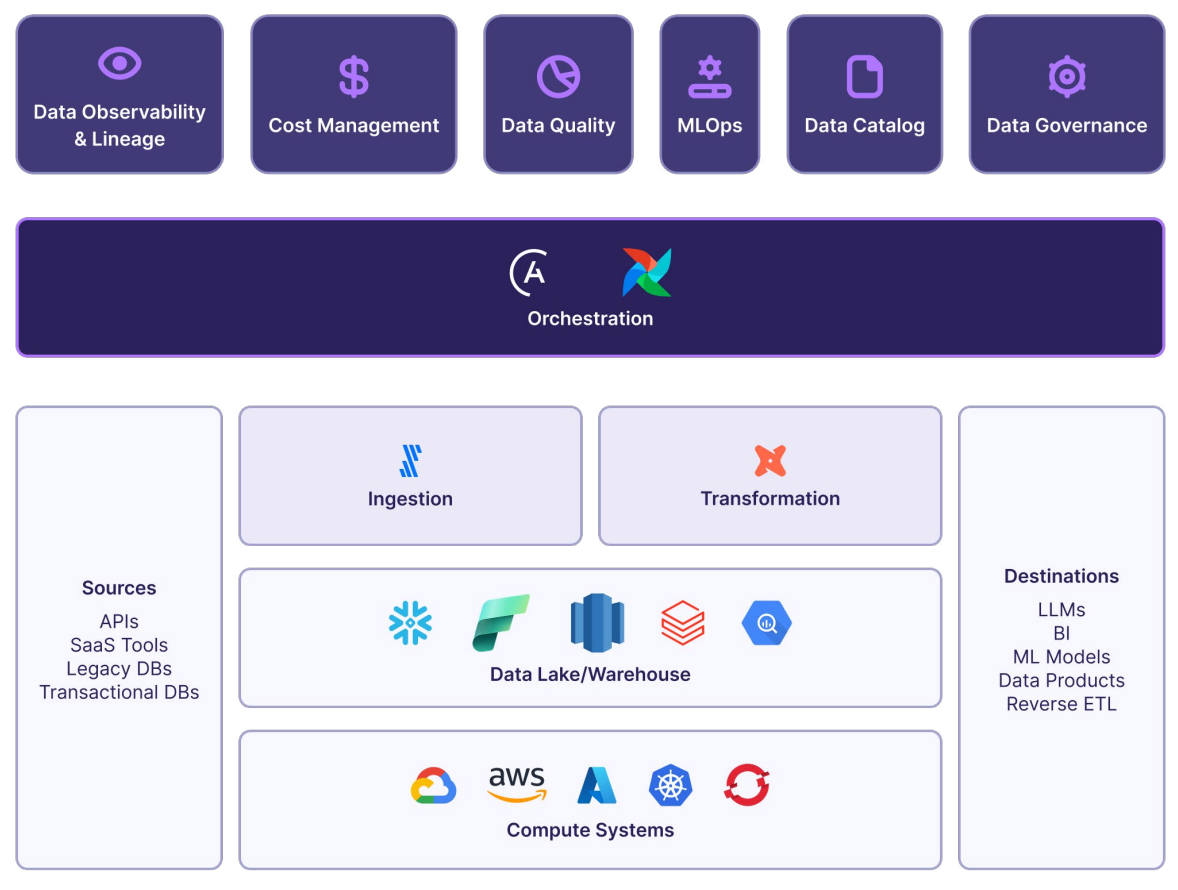
Figure 1: With the Astro platform, data teams work with a unified data stack to build, run, and observe all of their critical data pipelines across AI, app, and analytics workflows.
INITIATIVE THREE Personalized Traveler Experience
Every travel and hospitality company wants segment-of-one recognition: every traveler known across every channel, with offers tailored to individual behavior and context in real time.
The business case is proven. Companies that achieve this generate 40% more revenue than those that don't prioritize personalization. But delivering it requires solving a data unification problem most companies haven't cracked. Guest and traveler data is scattered across 4–6+ disconnected systems per company with conflicting records and no common identity, and only 36% of travel companies sustain personalization across all touchpoints
The consequence is measurable: cart abandonment rates as high as 98%, airlines losing out on repeat bookings due to poor customer experience, and consumers getting frustrated when personalization is missing. Closing this gap demands orchestration that unifies fragmented data sources into persistent traveler profiles, triggers personalized actions from real-time signals, and enforces data quality before insights ever reach the guest.
| What you need | How Astro helps |
|---|---|
| Unified data ingestion from fragmented guest and traveler systems | The industry’s widest range of connectors integrate PMS, CRS, CRM, loyalty platforms, OTA partners, mobile apps, and cloud warehouses into orchestrated pipelines without custom development per system. |
| Real-time event processing to act on customer signals as they happen | Event-driven scheduling triggers personalization workflows the moment a guest checks in, a flight status changes, or browsing behavior reveals purchase intent, eliminating batch-processing lag. Astro Runtime delivers 100x lower task scheduling latency under load than self-managed Airflow. |
| Complex data transformation for identity resolution and profile enrichment | Astronomer’s Cosmos orchestrates dbt transformations as first-class Airflow tasks with model-level visibility and smart retries powering the deduplication, matching, and feature engineering that unified profiles require. |
| Data quality enforcement before insights reach customers | Astro Observe and native pipeline tasks monitor freshness, completeness, and schema consistency across personalization pipelines. Proactive SLA alerting catches issues before stale or incorrect data reaches the guest. |
| Elastic scaling for seasonal and event-driven demand | Autoscaling ensures personalization pipelines handle Black Friday, holiday surges, and major event spikes without degradation or over-provisioned infrastructure. |
Uber runs 250K+ daily workflows on Airflow to power global operations
Uber operates one of the world's largest Airflow deployments, executing over 250,000 workflows daily across 4,000+ data pipelines to power payments, pricing, fraud detection, and marketplace optimization. The platform orchestrates data pipelines processing trillions of events, enabling real-time decision-making for millions of trips worldwide.
Airflow underpins Uber’s data stack to automate ETL, train ML models, and deliver analytics that personalize rider experiences and driver allocation. With Airflow, Uber reduces time to production while maintaining operational excellence at massive scale. Learn more from our Airflow in Action blog post.
Luxury hospitality and gaming company accelerates personalized marketing with Astro
The company needed to modernize their marketing technology platform to deliver personalized player offers, faster campaign launches, and improved customer experiences. Custom tools and self-hosted open source Airflow instances slowed innovation and consumed excessive time on infrastructure management instead of business logic.
The company adopted Astro to centralize data orchestration across their marketing technology ecosystem. Astro became the backbone of their modern data platform, powering ingestion, transformation, and curation for customer data and personalization pipelines. The team automated Dag creation through a custom metadata layer, introduced advanced monitoring and observability, and integrated with Snowflake, Databricks, and other systems to streamline player segmentation and offer delivery. Results include reducing marketing offer delivery from 3 weeks to under 1 hour and stabilizing 54K+ monthly tasks powering customer engagement and personalization at scale.
INITIATIVE FOUR Dynamic, Smarter Pricing
The objective is continuous, AI-driven pricing that captures maximum willingness-to-pay across every customer, channel, and moment, replacing the rigid fare buckets and manually managed rates that leave billions on the table. Airlines could unlock up to $45 billion in additional value over five years through modern retailing, and hotels switching to AI-powered revenue management see 7–20% increases in RevPAR. But legacy pricing infrastructure cannot support this shift. Airlines still price on 26 rigid booking classes designed in the 1990s, and 98% of hotel revenue managers report losing revenue to rate leakage.
Modern pricing demands sub-second response times, ingestion of alternative data signals like weather and events, and metasearch shopping ratios of 1:20,000 that legacy systems simply cannot sustain. Key use cases include:
- Agentic autonomous revenue optimization where AI agents monitor demand and automatically adjust rates, create bundles, and implement changes within configurable guardrails.
- NDC offer-and-order transformation enabling personalized, dynamically priced bundles across distribution channels.
- Demand forecasting with alternative data signals ingesting events, weather, social sentiment, and search volumes to uplift Average Daily Rates and reduce last-minute revenue leakage.
Capturing the value of these use cases requires orchestration that delivers real-time data to pricing engines, scales elastically under extreme computational load, and maintains the audit trails that emerging regulatory scrutiny of AI-driven pricing demands.
| What you need | How Astro helps |
|---|---|
| Real-time data ingestion from competitor feeds, demand signals, and booking velocity | Event-driven scheduling fires pricing pipeline refreshes the moment new data arrives via messaging topics, eliminating batch delays that cost revenue on every stale price. Astro Runtime delivers 10x higher concurrency than self-managed Airflow. |
| Elastic compute for extreme shopping and pricing volumes | Autoscaling handles metasearch look-to-book ratios of 1:20,000 and holiday demand spikes without over-provisioning infrastructure or degrading throughput. |
| Crash-safe recovery for long-running pricing analysis | The task state store checkpoints external job IDs and progress markers, like a Spark application ID or last offset processed, so a retry reconnects to a running job or resumes from its last checkpoint instead of reprocessing the full dataset. |
| Pipeline SLA enforcement protecting pricing accuracy | Astro Observe and native pipeline tasks monitor data freshness, detects anomalies in competitor rate feeds, and alerts before stale data reaches pricing engines |
| Governance and audit trails for pricing decisions | RBAC, audit logging, and end-to-end lineage via Astro Observe support the explainability and regulatory compliance increasingly required for AI-driven pricing. |
| Safe experimentation | Astro IDE, CI/CD, and workspace isolation support pricing and customer experience experimentation with rollback. |
Hospitality group scales orchestration for pricing and hotel operations
One of Europe’s largest hotel, resort and vacation property groups needed to migrate from legacy scheduling tools to a scalable orchestration platform for pipelines powering critical pricing, marketing, and operational decisions. They required a partner to support platform-level deployment and rollout across 10+ data engineering teams in the EMEA region.
The company adopted Astro to centralize Airflow orchestration, delivering seamless Snowflake and GitLab integration, simplified local installation, and visibility into task execution. Astro's UI, observability, and control capabilities enable the company to roll out the platform across multiple engineering teams with confidence. The solution delivers real-time orchestration for pricing algorithms and operational metrics that drive revenue optimization and business decisions across the organization.
Ride Sharing: When Growth Depends on Real-Time Data
As the business grew, a leading ride-sharing service needed to scale real-time services including dynamic ride pricing, driver proximity matching, driver and rider profile data, and automated driver payouts. Managing this at scale meant migrating 4,000+ pipelines in under a year, something self-managed orchestration could no longer support without slowing teams down.
By standardizing on Astro, the company unified orchestration across mission-critical workflows, freed engineering time, and identified $2,800 per day in infrastructure cost savings during migration while retiring multiple legacy tools.
INITIATIVE FIVE Operational Efficiency and Agility
Operators want a data-driven operational model that deploys the workforce intelligently, automates routine processes, and prevents disruptions before they cascade. The urgency is structural: the global hospitality sector will be short 8.6 million workers by 2035 and flight disruptions cost the airline ecosystem over $60 billion annually. Hotels cannot hire their way out of a labor shortage that has left employment 10% below pre-pandemic levels. Airlines cannot absorb IROPS costs that consume close to 10 percent of total revenue while margins sit at around 3.5%
The systems that could solve these problems include predictive maintenance, AI crew and housekeeping scheduling, building automation with smart energy management. All depend on real-time data integration across IoT sensors, operational platforms, and external signals. Without reliable orchestration connecting these sources and triggering automated action, operational intelligence stays trapped in dashboards.
| What you need | How Astro helps |
|---|---|
| Policy-as-code for operational and compliance governance | Pipelines are defined in code and deployed through CI/CD. Teams embed PCI tokenization rules, PII masking, crew duty-limit validations, and audit logging as enforced steps, codifying regulatory and safety controls directly into operational workflows rather than relying on manual checks. |
| Real-time ingestion from sensors, operational systems, and external data | Event-driven scheduling triggers operational pipelines the moment sensor readings deviate, weather threatens a hub, or occupancy shifts, enabling intervention before failure, not after. |
| Multi-agent orchestration for autonomous disruption recovery | The Common AI Provider’s decorators coordinate rebooking, crew, baggage, and accommodation agents in a single workflow with branching, retries, and full observability. |
| Edge-to-cloud orchestration across distributed properties and airports | Remote Execution agents run in property-level or airport infrastructure, processing data on-site while the orchestration plane manages workflows centrally. Data stays local; intelligence flows to dashboards. |
| Diagnose pipeline failures in minutes | Otto, the data engineering agent for Astro, pulls the logs, analyzes the failure, and proposes a fix. Get to the root cause in minutes instead of hours, without manually digging through code and logs. |
| Always-on resilience for 24/7 operations | Autoscaling and cross-region DR ensure crew scheduling, maintenance prediction, and disruption management pipelines remain available during infrastructure degradation and outages, matching the round-the-clock reality of travel. |
| Expert support for mission-critical operational workflows | 24x7 support from Astronomer's Airflow engineers, backed by commercial SLAs, ensures mission-critical operational pipelines stay reliable. |
WeWork achieves 10x faster deployment with Astro
WeWork needed to modernize data infrastructure to support rapid business growth and enable self-service analytics. Legacy orchestration tools couldn't scale, creating bottlenecks in pipeline development.
Astro reduces deployment times from hours to minutes, achieves 10x faster release cycles and accelerates time to market for new analytics capabilities. The managed platform eliminates infrastructure overhead, allowing the data team to focus on business logic. Astro's observability, CI/CD integration, and RBAC enables governance at scale while maintaining agility, orchestrating critical workflows powering operational dashboards, financial reporting, and member experience optimization globally. You can get more detail from the Astronomer and WeWork case study
Expedia orchestrates 200+ Airflow clusters with multi-tenant platform
Expedia shifted from fragmented team-by-team Airflow deployments to a platform-engineered, multi-tenant model that now runs 200+ isolated clusters supporting 180+ engineering teams. The platform orchestrates 14,000+ unique pipelines executing approximately 1.5 million tasks monthly.
Fully automated CI/CD through GitHub Actions handles testing, vulnerability scanning, and deployment, reducing Dag deployment time from 15 minutes to under 5 minutes. The platform cut cluster setup effort by 50%, dropping from a full week to roughly two days. Teams adopt 20+ new pipelines monthly through templates while maintaining flexibility to run different Airflow versions side-by-side. You can learn more from our Airflow in Action blog post.
Conclusion: Orchestration as the Control Plane for Travel and Hospitality’s Next Decade
Each initiative in this guide shares the same requirements:
- Clean, timely, governed data
- Reliable, observable pipelines across systems and environments
- Security, compliance, and cost control built into execution
That is the role of orchestration. The travel and hospitality companies that win the next decade will treat orchestration as the control plane for AI, modernization, and traveler experience, and they will operationalize it with platforms like Astro.
Build a trusted, future-ready data stack today
Run an Astro TCO analysis and get in touch with our experts today to get results faster.
Get the Full Guide
Keep reading to learn more about the five data-driven investment priorities defining travel and hospitality over the next three years, and how fully managed Apache Airflow® provides the orchestration foundation each one requires.
By proceeding you agree to our Privacy Policy, our Website Terms and to receive emails from Astronomer.