ORCHESTRATING THE FUTURE OF Professional Sports
Introduction
Professional sports organizations are converging on four data and AI investment priorities that will define competitive and commercial success through the end of the decade:
- AI-powered performance
- Personalized fan experiences
- Event monetization
- Lean operations
Each priority rests on the same foundation: clean, timely, governed data moving through reliable, observable workflows that span wearables, venues, apps, and clouds. When that foundation is fragile, models train on stale data, personalization collapses into generic batch campaigns, and a live feed that drops mid-match erodes partner trust.
This guide defines what each priority requires and shows how Apache Airflow® and Astro make them executable.
WHY AIRFLOW AND ASTRO?
Apache Airflow has grown to become the industry’s most widely used system for orchestrating data workflows, as well as being one of the world’s most active open source projects.
Astro, Astronomer’s unified orchestration platform, elevates Airflow into an enterprise-grade control plane purpose-built for high-scale AI and data-driven environments.
INITIATIVE ONE AI-powered performance
AI is no longer experimental in sport. Research from SportsPro shows that more than 80% of sports organizations now use it, and roughly three-quarters report it has already delivered tangible value, with 72% naming it the technology most likely to transform their organization. The mandate has shifted from running pilots to operationalizing data and AI as durable capabilities that provide competitive and commercial advantages.
Digging in to where investments are being made, industry research reveals that performance improvement is already the single largest category of AI spend at roughly 32% of the market in 2025, while injury-prevention analytics is the fastest-growing segment at a projected 33% CAGR.
Priority use cases
- AI-driven scouting uses video and event data to surface undervalued talent in lower leagues and overlooked markets.
- Predictive injury and workload models combining wearable telemetry with computer vision to flag fatigue and degradation before a tear.
- Computer-vision player tracking and automated event tagging for tactical analysis and opponent scouting.
- In-game decision support that adjusts tactics, workload, and substitutions from second-by-second tracking data.
- Agentic AI assistants that retrieve, summarize, and contextualize performance and opposition data for coaches on demand.
Why this is hard today
Performance data arrives from wearables, optical tracking, video, and third-party providers in incompatible formats, and most teams stitch it together with manual scripts and notebooks. When those pipelines lag or break, models train on stale or incomplete data, injury flags arrive too late, and a recruitment decision worth millions rests on numbers no one can fully trace.
The cost of failure is concrete: a sidelined star, a missed signing, and a tactical edge handed to a better-instrumented opponent.
From data to competitive edge: the pipeline layer that makes it work
| Required capability | How Astro helps |
|---|---|
| Orchestrate multi-step performance, scouting, and injury models | The Airflow Common AI Provider runs end-to-end model workflows, including feature engineering, training, scoring, and retraining, with branching logic, tool calls, and production-grade retries. |
| Keep biometric, medical, and proprietary model data in your environment | Remote Execution separates orchestration from execution, so sensitive health data, athlete PII, and proprietary models never leave your VPC or on-prem environment. |
| Real-time, parallel inference on live game and training events | Event-driven scheduling and parallel task execution trigger inference on tracking and telemetry events; autoscaling absorbs match-day and tournament spikes. |
| Trace a flawed model output back to its source data | Astro Observe and native pipeline tasks link data quality checks, anomalies, and SLA breaches to performance pipelines with end-to-end lineage. |
| Diagnose pipeline failures in minutes, not hours | Otto, the data engineering agent for Astro, pulls the logs, analyzes the failure, and proposes a fix, reaching root cause without manually digging through code. |
| Ship and roll back AI changes safely | Astro Runtime, IDE, and CI/CD provide a hardened Airflow distribution, browser-based Dag development with AI-pair programming, and Git-driven deployment to ship AI changes quickly with rollbacks. |
| Recover long-running agent and training jobs without restarting from scratch | The task state store persists external job IDs and checkpoints across task retries, so a failed agent step or model fine-tuning run reconnects to its still-active job instead of resubmitting a duplicate and burning expensive GPUs |
| Integrate any model, wearable, or tracking source without re-architecting | Building on Apache Airflow, teams integrate any model, harness, or tracking platform, ensuring long-term flexibility as AI and analytics methods evolve. |
Airflow and Astro in Action
Airflow is already used by some of the most demanding AI companies and agentic workloads on the planet:
- OpenAI has standardized on Airflow across its business with over 7,000 data pipelines spanning research, operations, and finance, all while providing a foundation for 10x growth. Read more.
- GitHub Copilot relies on Airflow to process billions of developer events per day, orchestrating the feedback loops used to continuously improve the company’s assistant and agents. Read more.
The professional sports industry is following suit:
- Two Major League Baseball franchises use Airflow to turn data into on-field advantage. The Texas Rangers, 2023 World Series champions, replaced brittle cron jobs with Airflow-orchestrated pipelines running on Astro to ingest player biomechanics, sensor, and weather data across Databricks, cutting pipeline processing times by 80% and delivering trusted analytics and AI to scouts, coaches, and players. The Philadelphia Phillies rebuilt their ML lifecycle around Airflow, integrating MLflow, dbt, and BigQuery behind an internal platform for player evaluation, acquisition, and development. The result: analysts ship models without writing pipeline code, saving weeks of development time, with scalable multi-model retraining that adapts automatically. Read more in our Airflow in Action at MLB blog post.
- A leading Formula 1 (F1) team ran its AI/ML training pipelines on brittle, ad hoc scripts that bottlenecked engineers during critical race-data windows. Standardizing on Astro automated those pipelines through a hybrid deployment, with cloud orchestration managing GPU-based on-premises workloads. The result: a 20% cut in manual orchestration overhead, reliable performance through 3x annual data-influx peaks, and RBAC for multi-tenant security that scaled access across every team, all without added IT overhead.
INITIATIVE TWO Personalized engagement
Organizations are building direct, data-rich relationships with fans to grow lifetime value and own revenue that no longer depends on third-party platforms. The payoff is well-documented: research from PwC and Adobe shows that businesses that lead on customer experience grow revenue 1.7 times faster and customer lifetime value 2.3 times faster than peers. Adoption is already widespread, with around 68% of tier-one sports organizations deploying AI-powered fan personalization tools in 2025 according to research.
Priority use cases
- AI-personalized highlight reels and content feeds tailored to each fan’s favorite players and moments.
- Dynamic ticket and merchandise pricing with offers triggered by attendance history, behavior, and live demand.
- Direct-to-consumer streaming and owned apps that convert viewing into first-party data and incremental revenue.
- Churn and propensity models that trigger retention and upsell campaigns at the right moment.
- Agentic fan-service assistants that answer queries and surface relevant offers in real time across app and venue.
Why this is hard today
Fan signals live in disconnected silos: ticketing, merchandise, the app, the streaming platform, CRM, and social. When those systems do not talk to each other, personalization collapses into generic batch campaigns, sponsorship inventory cannot be backed by verified first-party data, and brittle metering pipelines feed streaming and billing systems numbers they cannot trust.
The result is lower retention, undervalued sponsorship, and a fan relationship rented from platforms that own the data. First-party data is the asset; without reliable pipelines, it stays trapped.
From clicks to relationships: the pipeline layer that makes it work
| Required capability | How Astro helps |
|---|---|
| Unify fan data across ticketing, app, streaming, merchandise, CRM, and social | Astro orchestrates ingestion and syncs across 2,100+ connectors into a single, managed pipeline layer. |
| Act the moment fan behavior changes | Event-driven scheduling triggers onboarding, retention, and upsell workflows when behavior or usage thresholds shift. |
| Reliable metering and aggregation for subscriptions and usage-based offers | Airflow Dags on Astro run metering, aggregation, and rating pipelines that feed billing and entitlement systems with accurate, timely data. |
| Trust the signals behind personalization, churn, and propensity models | Astro Observe and native pipeline tasks enforce schema, volume, and freshness checks on the pipelines powering recommendations, health scores, and churn. |
| Unify orchestration and transformation for fan analytics | Orchestrate, run, and observe dbt workflows with Cosmos, the open-source standard for dbt orchestration and task-level visibility in Apache Airflow. |
| Let commercial teams experiment without breaking core data | Blueprint lets data analysts and scientists build and test governed Dags via a drag-and-drop canvas. It fits into existing CI/CD and deployment processes. Rollbacks keep experiments off production-critical pipelines. |
Astro in Action
A global retailer that manufactures and resells official team merchandise worldwide runs the analytics powering its merchandising. Its 250 Airflow users faced high worker idle time, weak governance, and poor cost attribution when running Airflow on Amazon MWAA. Migrating to Astro on AWS delivered true autoscaling and enterprise-grade observability. The results: 4,000 production pipelines migrated, 400K monthly runs orchestrated, and 50–70% worker idle time eliminated through autoscaling, growing data engineering and analytics affordably.
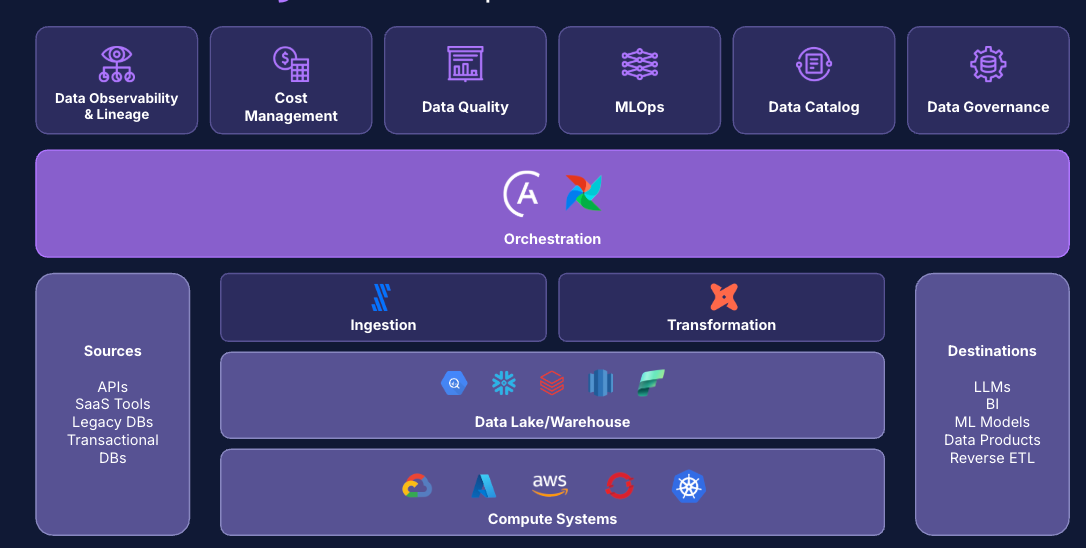
Figure 1: With the Astro platform, data teams work with a unified orchestration platform to build, run, and observe all of their critical data pipelines and workflows.
INITIATIVE THREE Event monetization
Leagues, federations, and teams are treating live event data as a strategic revenue asset, monetizing it through gaming feeds, broadcast augmentation, and sponsorship while protecting competition integrity. Real-time data has shifted from operational input to strategic asset, with data-rights holders now capturing between 2% and 25% of gross gaming revenue depending on how actively they manage it, according to BCG.
Priority use cases
- Low-latency live data feeds powering in-play betting markets and odds for sportsbook partners.
- AI-enhanced broadcast overlays and altcasts with real-time stats, win probabilities, and tracking graphics.
- Sponsorship valuation and activation backed by verified first-party audience and exposure data.
- Automated content and highlight generation distributed to broadcasters and publishers within seconds.
- Agentic integrity and anomaly monitoring that flags suspicious betting or officiating patterns in real time.
Why this is hard today
Live data has zero tolerance for failure: a feed that lags or drops during a match instantly erodes betting-partner trust, breaks broadcast graphics, and exposes the rights holder to integrity risk.
Most organizations run this on fragmented schedulers and ad hoc scripts that cannot guarantee uptime or trace where a number came from, so revenue leaks, partners churn, and a single unexplained anomaly can call a result into question. At scale, that fragmented orchestration also inflates infrastructure cost.
From the field of play to revenue: the pipeline layer that makes it work
| Required capability | How Astro helps |
|---|---|
| Real-time integration of live event, tracking, and stats data | Astro supports event-driven scheduling, triggering pipelines the moment data arrives (plays, scores, market events) without polling or batch delays. |
| Production-grade reliability for mission-critical live windows | Autoscaling, cross-region DR, and zero-downtime updates deliver a 99.9% uptime SLA, replacing the overhead of self-managing Airflow during peak events. |
| A unified platform across tracking, stats, and commercial systems | With 2,100+ connectors and flexible orchestration, Astro integrates siloed systems into a single pipeline layer feeding betting, broadcast, and BI partners. |
| Governance, lineage, and auditability for data rights and integrity | Astro enforces RBAC and logs every task execution and data movement, providing a traceable path from source to output for integrity and audit readiness. |
| Diagnose failures fast during live events | Otto, the data engineering agent for Astro, pulls the logs, analyzes the failure, and proposes a fix, reaching root cause in minutes instead of hours. |
Astro in Action
One of the world's largest international football governing bodies runs the data behind its global tournaments, including event ticketing, across a complex dbt, Airflow, Snowflake, and Postgres stack delivering at all hours worldwide. With little time for infrastructure maintenance, the team moved its dbt jobs to Astro using Cosmos, with Observe. The results: a 25% reduction in troubleshooting time, proactive alerting for mission-critical match events, and avoided dbt Cloud spend plus one full-time engineer previously needed from an outsourcer.\
INITIATIVE FOUR Run leaner
As private equity and institutional capital flood into sport, owners are applying a portfolio lens that demands margin growth, not just revenue. This makes operational efficiency the defining driver of future profitability and positioning leaner operations to unlock significant profit growth over the next few years.
The pressure is intensifying: according to the CFA Institute, sports-related M&A rose 19% in 2025, with private-equity-backed deals taking a large share. Multi-team ownership groups are consolidating shared HR, marketing, and data infrastructure to unlock cross-franchise efficiencies.
Priority use cases
- Consolidating fragmented scheduling, finance, and operational systems across departments and franchises into a single data backbone.
- AI-driven scheduling and logistics optimization for travel, venue turnaround, and game-day operations.
- Automated finance, ticketing, and reconciliation pipelines that close the books faster and feed investor-grade reporting.
- Shared services across multi-team ownership groups, unifying HR, marketing, and data for cross-franchise synergies.
- Agentic back-office assistants that automate routine reporting, reconciliation, and operational tasks across the front office.
Why this is hard today
Front-office data is scattered across legacy systems, spreadsheets, and team-specific tools, so finance closes late, investor reporting is manual, and no one holds a single view of cost and performance. When orchestration is fragmented across cron jobs and ad hoc scripts, infrastructure spend balloons, errors creep into financial and operational reporting, and the margin discipline investors expect becomes impossible to demonstrate. The consequence is eroded investor confidence and profit left on the table.
From fragmented to lean: the pipeline layer that makes it work
| Required capability | How Astro helps |
|---|---|
| Accelerate, derisk, and consolidate migrations from legacy schedulers. | Otto converts legacy scheduler definitions into production-ready Dags, mapping job dependencies as it goes to eliminate the #1 source of migration surprises. It carries Airflow best practices and your team's conventions, producing deterministic output 10x faster than mechanical translation, all backed by a full suite of Astronomer professional services. Astro then consolidates those workflows, alongside scattered cron and Airflow instances, into a single managed control plane backed by uptime SLAs. |
| Bridge legacy front-office and modern cloud systems | Astro connects to legacy systems via JDBC/ODBC or custom hooks and orchestrates phased migrations with synchronized ETL, enabling stepwise modernization without big-bang risk. |
| Cost-aware, scalable execution to control infrastructure spend | Autoscaling and high availability scale workers up at peak and down when idle, delivering 2x faster execution versus self-managed Airflow while reducing infrastructure waste. |
| Reliable finance, ticketing, and reporting pipelines | Airflow Dags on Astro run reconciliation, aggregation, and reporting pipelines; Astro Observe surfaces failures, SLA breaches, and anomalies in financial and operational processes. |
| Multi-tenant, governed environments for shared services | Workspace isolation and RBAC let a central platform team offer shared, governed orchestration to multiple teams or franchises with clear boundaries. |
| Crash-safe recovery for long-running distributed jobs | The task state store checkpoints external job IDs and progress markers, like a Spark application ID or last offset processed, so a retry reconnects to a running job or resumes from its last checkpoint instead of reprocessing the full dataset. |
| Cost visibility across data and AI workloads | Astro links pipeline execution to computeusage, so teams see which workloads drive cost spikes and optimize accordingly. |
Astro in Action
A leading North American online sportsbook ran its distributed data operations, including regulatory and executive reporting, on open-source Airflow that lacked autoscaling, strained resources, and drove high infrastructure and monitoring costs. The team modernized to Astro with deferrable operators and Astro Alerts replacing a separate monitoring tool. The results: $300K annual infrastructure savings plus $150K in retired tooling costs, a 305% increase in average tasks per worker, and improved stability for mission-critical pipelines.
CONCLUSION Next Steps
From players and fans to the back-office, each of the investment priorities profiled in this guide shares the same foundational requirements:
- Clean, timely, governed data.
- Reliable, observable pipelines across systems, venues, and clouds.
- Scalability and cost efficiency that absorbs unpredictable match-day, tournament, and audience spikes.
That is the role of orchestration. The sports organizations that win the next decade will treat orchestration as the control plane for AI performance, fan engagement, and commercial strategy, and they will operationalize it with Astro.
Build a trusted, future-ready data stack today.
Run an Astro TCO analysis and get in touch with our experts today to get results faster.
Get the Full Guide
Keep reading to learn more about the four data and AI investment priorities that will define competitive and commercial success in Professional Sports, and how fully managed Apache Airflow® provides the orchestration foundation each one requires.
By proceeding you agree to our Privacy Policy, our Website Terms and to receive emails from Astronomer.