Pricing
Compare astro plans
Select the right plan for your team with our complete feature comparison and detailed pricing breakdown.
Plan Features
Developer
Team
Business
Enterprise
Enterprise Business Critical
| Developer | Team | Business | Enterprise | Enterprise Business Critical | |
|---|---|---|---|---|---|
Security & Governance | |||||
Google/GitHub IdP Auth | Supported | Supported | Supported | Supported | Supported |
SAML-based SSO | Supported | Supported | Supported | Supported | Supported |
Private NetworkingPrivateLink, VPC Peering, Transit Gateway, Site-to-Site VPN, etc. | Not supported | Supported | Supported | Supported | Supported |
Non-Owner Roles | SupportedUp to 2 | SupportedUnlimited | SupportedUnlimited | SupportedUnlimited | SupportedUnlimited |
Astro Teams/Groups | Not supported | SupportedUp to 2 | Supported | Supported | Supported |
Audit Logging (Astro + Airflow) | Not supported | Supported7 days retention | Supported90 days retention | Supported90 days retention | Supported90 days retention |
Dedicated Cluster | Not supported | Supported | Supported | Supported | Supported |
Deployment Roles | Not supported | Supported | Supported | Supported | Supported |
CI/CD Enforcement | Not supported | Not supported | Supported | Supported | Supported |
SSO Enforcement | Not supported | Not supported | Supported | Supported | Supported |
HIPAA / PII BAA Agreement | Not supported | Not supported | Supported | Supported | Supported |
Workspace Authorization for Clusters | Not supported | Not supported | Not supported | Supported | Supported |
Custom RBAC Roles | Not supported | Not supported | Not supported | Supported | Supported |
IP Access List | Not supported | Not supported | Not supported | Supported | Supported |
Scale & Operational Efficiency | |||||
Hibernating Deployments | Supported | Supported | Supported | Supported | Supported |
Astro API Access | Supported | Supported | Supported | Supported | Supported |
Airflow API Access | Supported | Supported | Supported | Supported | Supported |
Connection Management | Supported | Supported | Supported | Supported | Supported |
Deploy Rollbacks | Supported | Supported | Supported | Supported | Supported |
High Availability | Not supported | Supported | Supported | Supported | Supported |
Remote Execution Agents | Not supported | Not supported | Not supported | Supported | Supported |
SCIM Provisioning | Not supported | Not supported | Not supported | Supported | Supported |
Org-level Dashboards | Not supported | Not supported | Not supported | Supported | Supported |
Cross-Region Disaster RecoverySecondary cluster for regional failover billed at dedicated cluster rate | Not supported | Not supported | Not supported | Not supported | Supported |
Monitoring & Alerting | |||||
Astro ObserveLineage, data product SLAs, data quality monitoring, AI-assisted RCA | Not supported | Supported | Supported | Supported | Supported |
Alerting | Supported | Supported | Supported | Supported | Supported |
Metrics Forwarding | Not supported | Supported | Supported | Supported | Supported |
Log Forwarding | Not supported | Supported | Supported | Supported | Supported |
Support | |||||
Support Availability | SupportedNot Included | Supported24x5 Availability | Supported24x7 Availability | Supported24x7 Availability | Supported24x7 Availability |
SLA Response for P1 Tickets | Not supported | Supported6 Hour Initial Response SLA | Supported1 Hour Initial Response SLA | Supported1 Hour Initial Response SLA | Supported30 Min Initial Response SLA |
Security & Governance
Google/GitHub IdP Auth
SAML-based SSO
Private Networking
PrivateLink, VPC Peering, Transit Gateway, Site-to-Site VPN, etc.
Non-Owner Roles
Astro Teams/Groups
Audit Logging (Astro + Airflow)
Dedicated Cluster
Deployment Roles
CI/CD Enforcement
SSO Enforcement
HIPAA / PII BAA Agreement
Workspace Authorization for Clusters
Custom RBAC Roles
IP Access List
Scale & Operational Efficiency
Hibernating Deployments
Astro API Access
Airflow API Access
Connection Management
Deploy Rollbacks
High Availability
SCIM Provisioning
Org-level Dashboards
Cross-Region Disaster Recovery
Secondary cluster for regional failover billed at dedicated cluster rate
Monitoring & Alerting
Astro Observe
Lineage, data product SLAs, data quality monitoring, AI-assisted RCA
Alerting
Metrics Forwarding
Log Forwarding
Support
Support Availability
SLA Response for P1 Tickets
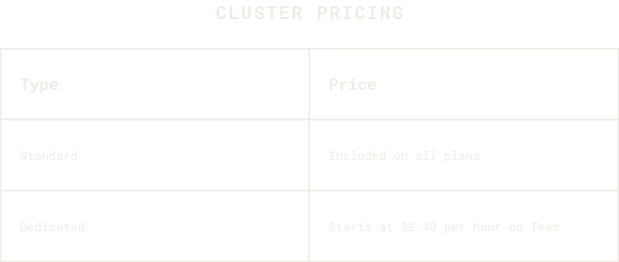
Component Pricing
Prices listed below are reflective of AWS us-east-1, Azure eastus, GCP us-east1.
Learn more about Astro’s architecture ➔
FAQs
What if I need to run individual tasks on bigger workers?
You might have a large number of tasks that require low amounts of CPU and memory, but a small number of tasks that are resource intensive — e.g., machine learning tasks.
To address this use case, we recommend using worker queues. Worker queues allow you to configure different groups of workers for different groups of tasks. That way, you’ll only be charged for the larger worker type if and when a task that requires that worker type actually runs.
Specifically, you can:
- Create a default queue with a small worker type. For example, A5.
- Create a second queue called
large-taskwith a larger worker type. For example, A10. - Set the Minimum Worker Count for the
large-taskqueue to 0 if your resource-intensive tasks run infrequently. - In your DAG, assign the larger task to the “large-task” queue.
To learn more about worker queues, see Worker queues in Astronomer documentation.
What if I need additional ephemeral storage for workers?
All Astro workers include an amount of ephemeral storage by default: 10 GiB of for Celery workers, and 0.25 GiB for Kubenetes Executor and Kubernetes Pod Operator workers. You can configure additional ephemeral storage at a rate of $0.0002 per GiB per hour.
How will I be charged for the Kubernetes Executor and Kubernetes Pod Operator?
In Airflow, the Kubernetes Executor (KE) and the KubernetesPodOperator (KPO) allow you to run a single task in an isolated Kubernetes Pod. Astro measures the total amount of CPU and Memory allocated across your KE/KPO infrastructure at any given time. Astro bills for the number of A5 workers necessary to accommodate the total amount of CPU and Memory rounded up to the nearest A5. One A5 worker corresponds to 1 CPU and 2 GiB Memory.
For example:
If you are running 4 tasks concurrently, with each being allocated 0.25 cpu and 0.5 GiB memory, then you will be charged for 1 A5 for the duration of the infrastructure running those tasks.
Similarly, if you are running 3 tasks concurrently, with each being allocated 0.25 cpu and 0.5 GiB memory, then you would still be charged for 1 A5. In this case the total amount allocated is 0.75 cpu and 1.5 GiB memory which rounds up to single A5.
If you have 5 concurrent tasks that are each allocated 2 CPU and 4 GiB memory, that is a total of 10 CPU cores and 20 GiB memory and maps to 10 A5s.
In order to ensure reliability Astro will allocate the limit requested by each task. If a task has not specified limits then the Deployment defaults will be used.
In addition, ephemeral storage limits of greater than 0.25 GiB per pod will be charged at a rate of $0.0002 per GiB per hour.
What networking costs are passed through from the Cloud Provider?
This varies slightly by cloud:
AWS: Data Transfer within and between AWS regions, and out to the Internet (inclusive of Data Processing by NAT Gateway and PrivateLink VPC Endpoints). Includes Site-to-Site VPN uptime charges if configured for private connectivity to data sources.
GCP: Data Transfer within and between GCP regions, and out to the Internet (inclusive of Data Processing). Includes Cloud VPN and Private Service Connect endpoint uptime charges if configured for private connectivity to data sources.
Azure: Azure: Peered and Non-Peered Data Transfer within and between Azure regions, and out to the Internet (inclusive of Data Processing by Load Balancer and Private Link). Includes VPN Gateway uptime charges if configured for private connectivity to data sources.