The Airflow Build vs. Buy Question We See Data Leaders Get Wrong
6 min read |
Apache Airflow is the standard for data orchestration for a reason. It's open-source, highly extensible, and proven to work at a large scale. For engineering leaders evaluating where to run it, self-managed may look like the obvious default due to the impression that there are no licensing costs.
What's harder to see is what "running it yourself" actually costs, not in compute, but in engineering time spent babysitting infrastructure.
"We were managing the infrastructure ourselves, and whenever something went wrong, it could take days or even weeks to resolve. That's time we're not building data pipelines." — Gonzalo Pena, Senior Data Engineer, Everlane
At Astronomer, we talk to data engineering leaders every day. Some are managing thousands of pipelines, others are just starting to feel the strain of infrastructure they didn't plan to own this deeply. The build vs. buy question comes up constantly, and it gets answered the wrong way more often than it should.
To be clear, teams absolutely can self-manage Airflow at serious scale. Uber runs 200,000 pipelines on it, Stripe processes petabytes of data daily. These organizations made a deliberate decision to build the infrastructure, the dedicated platform teams, and the operational playbooks to own this fully. For them, it makes sense.
For most organizations, the question worth asking is whether building that same organizational muscle is where their best engineers should be spending their time.
What Self-Management Actually Costs at Scale
The infrastructure line items are visible: compute, storage, database hosting. Those appear in budgets. What doesn't appear anywhere is the engineering time that disappears into the platform week after week.
At scale, self-managed Airflow becomes its own product. Someone has to tune schedulers as Dag counts grow, manage metadata database bloat, coordinate version upgrades across distributed teams, and maintain a monitoring stack assembled from Prometheus, Grafana, and several other tools that all need to stay in sync. This work doesn't grow linearly with your deployment. Moving from hundreds to thousands of Dags introduces far more than 10x the complexity. The scaling walls usually show up in ways teams don't anticipate and grow in magnitude the larger your team is.
"We did not see a path forward for scalability. We were running into moments where contributors were worried about stomping on each other's work. In the local development environment, when someone would make a change, it would take five to ten minutes to run, and could create issues if workstreams had dependencies that spanned different teams." — Rob Joseph, VP of Infrastructure, Foursquare
Deep Airflow expertise also tends to concentrate in one or two engineers who accumulated it over years. When they're unavailable, response times on complex issues slow. When they leave, institutional knowledge leaves with them, and rebuilding it takes months of hands-on experience from someone else.
The largest cost is the work that doesn't happen because platform engineers are occupied with infrastructure. Every hour spent scaling clusters or debugging schedulers is an hour not spent on data quality frameworks, self-service tooling for analysts, or the AI and ML integrations the business is waiting on. For teams managing dozens of Dags, this tradeoff is manageable. For teams managing thousands, the math looks different.
Organizations moving off self-managed Airflow typically see infrastructure cost reductions of 25% or more, before accounting for the engineering time recaptured.
Why Cloud Managed Services Trade One Problem for Another
When organizations recognize the self-management burden, the natural move is toward a hyperscaler: AWS MWAA, Google Managed Service for Apache Airflow (formerly known as Cloud Composer), or Azure. Offload the infrastructure, keep writing Dags. In practice, what you gain and what you give up don't balance out the way the pitch suggests.
The most consequential constraint we see is lock-in. These services are deeply embedded in their cloud provider's ecosystem: secret stores, monitoring, networking. As your architecture evolves through acquisitions, data residency requirements, or multi-cloud strategy, an infrastructure that can't span environments becomes a liability.
The cost structure also creates its own problems. Always-on infrastructure charges regardless of usage means paying for dev and staging environments around the clock. That pushes teams toward fewer, less isolated environments than they'd want if cost weren't a factor.
And then there's support. Cloud providers cover their infrastructure, not Airflow. When a scheduler degrades or Dags break in unexpected ways, your team is still debugging internals on their own, without anyone who's seen the problem before. The managed service reduces your infrastructure bill. It doesn't reduce your on-call burden.
Whether teams are coming off self-managed Airflow or a cloud-managed service, the pains we hear most often look similar:
- Infrastructure overhead is consuming engineering time that should be going toward pipelines
- Upgrade cycles that take weeks and keep getting deprioritized
- No backend access when something breaks — support that covers the cloud, not Airflow
- Always-on costs for environments that sit idle most of the day
- Environments that became too fragile to touch — teams afraid to restart or upgrade
Why Leading Teams Choose Astro
We built Astro because we kept watching the same pattern. Strong engineering teams spending their best hours on infrastructure that wasn't their competitive advantage. We've worked through this problem across hundreds of enterprise deployments, which is why the platform looks the way it does.
"Having Astro is the equivalent of having one or two engineers that are solely focused on maintenance and upgrades, that are now able to spend their time working exclusively on roadmap items." — Ankush Gautam, Data Engineering and Platform Leader, Datastax
The difference is in how Astro runs Airflow, allowing teams to focus on building pipelines instead of maintaining the infrastructure. With Astro, workers scale to zero during idle periods so you're paying for actual compute consumption, not always-on overhead. Upgrades are zero-downtime with one-click rollbacks. Lineage, SLA monitoring, and observability are built in with no custom tooling required. Enterprise security comes standard: SOC 2 Type II, HIPAA, GDPR compliance, RBAC, OAuth, and SAML.
For organizations where data residency is non-negotiable, Astro's hybrid architecture allows you to keep task execution inside your own infrastructure while Astronomer manages the control plane. And because we've driven every Airflow release since 2018, if production issues arise you're working with engineers who wrote the code to help you resolve issues fast.
The teams that feel this most clearly are the ones who spent years maintaining their own infrastructure before moving.
- After migrating 536 business-critical workflows in 12 weeks, Autodesk's platform engineers stopped fixing outages and redirected toward product work.
- WeWork cut infrastructure management time by 67% and troubleshooting time by 60%.
What the Transition Actually Looks Like
Moving an existing deployment isn't trivial, and we won't pretend otherwise. But it's a problem we've worked through many times across large enterprises with thousands of existing Dags, and we've built tooling to make the process even easier. Our AI-assisted migration capability handles the translation work that typically stalls every project, backed by a Professional Services team who bring that accumulated experience directly to the process to help you navigate the path forward.
The Honest Question You Should Be Asking
Self-management of Airflow is the right call for organizations that have made the deliberate investment to own it. But even teams that have built genuine operational capability often underestimate one dimension: enterprise governance. The compliance tooling, audit logging, and access controls that regulated environments require are a real and recurring engineering cost to build on self-managed Airflow and come standard with Astro.
For most organizations, the more useful question is specific — how much engineering capacity is going into operating Airflow today, what is that actually costing in deferred work, and does the total justify continuing to own it? That's a calculation worth running with real numbers rather than instinct.
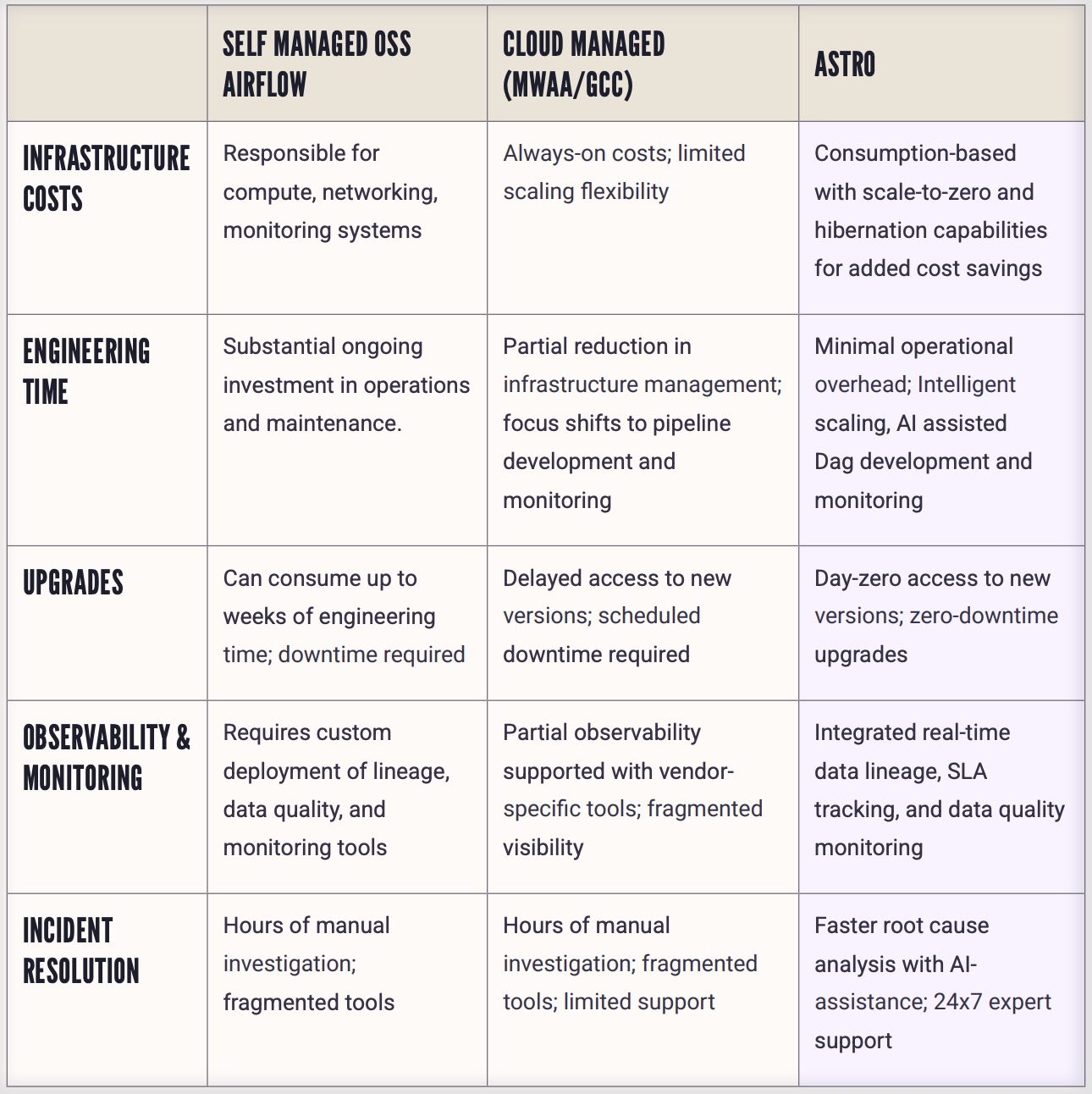
Our full TCO analysis covers exactly that: self-managed Airflow, hyperscaler managed services, and Astro across every cost dimension, with a framework for assessing your specific situation.
Want to talk to our team? Book a demo to discuss your orchestration strategy →