Orchestrating the Future of Telecommunications
Introduction
Telecommunications providers (telcos) across the globe are entering a decisive period. Core connectivity revenues are flat, operating costs are rising, and customer expectations are set by digital-native companies, not traditional operators. As a result, telcos are concentrating IT spend on a small number of strategic initiatives that directly impact cost structure, customer experience, and future growth:
- Productizing AI to automate operations and personalize customer interactions.
- Digital and IT modernization to escape legacy OSS/BSS constraints.
- Customer experience transformation to reduce churn and improve lifetime value.
- Operational efficiency and automation to protect margins under flat revenue growth.
- New digital services and revenue streams beyond core connectivity.
Across all of these initiatives, success depends on the same foundation: reliable, secure, and observable orchestration of data and AI workflows at telecom scale.
Apache Airflow® has become the industry standard for data and AI orchestration. Astro, Astronomer’s unified orchestration platform, elevates Airflow into an telco-grade control plane purpose-built for regulated, hybrid, and high-scale environments.
INITIATIVE ONE Productizing AI
Telcos are investing in AI to simultaneously move both margin and differentiation. In NVIDIA’s State of AI in Telecommunications survey, 77% of telecom respondents said AI helped reduce annual operating costs and 84% said it helped increase annual revenue. At the same time, generative AI is moving from experimentation into productized use: 49% of respondents reported they are actively adopting or assessing genAI, and among that group 84% plan to offer genAI services to customers.
Targeted AI use cases include
- AI-driven customer service: virtual agents, agent assist, and automated issue resolution.
- Network optimization: predictive maintenance, capacity planning, and self-optimizing networks.
- Fraud detection: real-time identification of SIM, subscription, and payment fraud.
- Personalization and churn prediction: targeted offers, dynamic pricing, and retention modeling.
- Internal automation: AI-assisted IT operations, field service, and back-office workflows.
The strategic aim is clear: use AI to automate assurance and operations (toward autonomous networks), and to transform customer service, sales, and marketing through personalization and natural-language experiences.
What Telcos Need and How Astro Helps
Despite strong executive intent, most telcos struggle to operationalize AI at scale. Skills shortages remain acute, with over half citing lack of AI expertise as a top barrier. Many pilots stall in production due to fragmented OSS/BSS data, inconsistent pipelines, and limited visibility once models are live.
Roughly one-third of IT leaders report that poor data quality and availability block AI value realization, even with massive data volumes . Regulatory and data sovereignty constraints further complicate execution, making ad hoc scripts and siloed ML tooling untenable for production use.
| What You Need | How Astro Helps |
|---|---|
| End-to-end orchestration of AI workflows | The Airflow Common AI Provider orchestrates feature engineering, training, evaluation, deployment, and retraining as version-controlled pipelines with retries and branching logic. |
| Real-time and parallel AI workloads for telecom-grade scale | Event-driven scheduling and parallel task execution enable real-time inference on events such as user actions, service interactions, or network updates. Astro auto-scales to handle spikes in usage. |
| Secure, compliant execution for sensitive data | Remote Execution keeps all data and model execution inside the telco’s environment while Astro manages orchestration, aligning with sovereignty and zero-trust requirements. |
| Reliable data inputs for AI models | Astro Observe and native pipeline tasks enforce schema, freshness, and volume checks, preventing bad data from silently degrading model performance. |
| Visibility across AI pipelines | Pipeline and data product-aware monitoring, lineage, and SLA tracking link AI outputs back to specific data and workflow steps. |
| Fast, safe iteration on AI workflows | Astro Runtime, IDE, and CI/CD provide a hardened Airflow distribution, browser-based Dag development with AI-pair programming, and Git-driven deployment to ship AI changes quickly with rollbacks for safe experimentation |
| Recover long-running agent and training jobs without restarting from scratch | The task state store persists external job IDs and checkpoints across task retries, so a failed agent step or model fine-tuning run reconnects to its still-active job instead of resubmitting a duplicate and burning expensive GPUs |
| Hybrid and future-proof architecture | Airflow with 2,100+ integrations supports any model, framework, or data platform without lock-in, allowing teams to quickly tap into latest SotA advancements |
Airflow and Astro in Action
Based on the State of Airflow 2026 survey, AI and ML are the fastest growing workloads, now driving nearly a third of total Airflow usage. On Astro it’s even higher: 62% of Astro customers run AI/ML use cases on the platform, rising to 83% with data teams that have been using Astro since 2022.
Airflow is used by some of the most demanding AI companies and workloads on the planet:
- OpenAI has standardized on Airflow across its business with over 7,000 pipelines spanning research, operations, and finance, all while providing a foundation for 10x growth. Read more.
- GitHub relies on Airflow to process billions of developer events per day, orchestrating the feedback loops used to continuously improve Copilot. Read more.
- Apple uses Airflow to streamline experimentation with Jupyter Notebooks, boost productivity, and support large-scale, distributed ML workflows. Watch Apple’s session from the Airflow Summit to learn more.
The telecoms industry is following the same path:
A global provider of AI-powered cloud communications and contact centre solutions had relied on Control-M for orchestration, but high costs, limited flexibility, and constrained scalability were stalling cloud and AI/ML initiatives. As the company accelerated its AI transformation, legacy orchestration became a bottleneck it could no longer afford. The provider selected Astro with Observe, along with Astronomer Professional Services including a Center of Excellence, and a Kickstarter package, to migrate off Control-M and modernise its orchestration foundation.
The result was a step-change in performance and cost efficiency: 30% faster job runtimes and a 50% reduction in TCO, freeing the team to focus on AI/ML delivery rather than infrastructure management.
INITIATIVE TWO Digital and IT Modernization
Telcos are modernizing IT and network architectures to increase delivery speed, reduce integration cost, and support automation and AI at scale. Legacy OSS/BSS systems were not designed for continuous change, hybrid execution, or real-time services. Modernization enables telcos to move toward cloud-native, API-driven operating models that support faster service launches and more efficient operations.
Industry studies found that only 22% of telcos have successfully delivered a digital transformation to date (well below the cross-industry average), yet 90% of them plan to invest heavily in infrastructure, cloud enablement, AI, big data, and modernizing their tech architecture going forward.
What Telcos Need and How Astro Helps
Most operators remain constrained by heavily customized OSS/BSS stacks and brittle point-to-point integrations. Change cycles are slow, upgrades are risky, and parallel transformation programs introduce duplicated data pipelines and inconsistent definitions. Hybrid environments further fragment execution and security controls. Without a unifying orchestration layer, modernization efforts stall under operational complexity rather than delivering speed.
| What You Need | How Astro Helps |
|---|---|
| A single orchestration standard | Astro standardizes workflow definition and dependency management across OSS/BSS, data platforms, and cloud services. |
| Plan Airflow upgrades with confidence | Otto, the data engineering agent for Astro, turns a multi-sprint project into a repeatable, agent-assisted process. It analyzes your entire Dag fleet against Astronomer’s knowledge base, identifying what breaks, proposing specific code changes, and producing a prioritized plan. |
| Data migration and integration from legacy systems | Astro connects to legacy OSS/BSS platforms, network management systems, mediation and billing engines, and on-prem databases as easily as to modern cloud warehouses and lakehouses. It orchestrates phased, synchronized migration pipelines so telcos can modernize safely without disrupting network operations, customer care, or revenue-critical workflows. |
| Production-grade runtime and patching | Astro Runtime delivers 2x the performance of other Airflow services, tested releases, controlled image updates, and timely security patches. |
| Security and compliance by design | Telco-grade governance and observability. Astro enforces role-based access control, audit logging, and data lineage tracking across all pipelines. These capabilities maintain compliance during and after modernization, providing continuous visibility into where data moves and who accesses it. |
| Reliability during transformation | Autoscaling and high availability maintain performance as workloads migrate and scale. |
Astro in Action
Telco data teams adopt Astro to eliminate the legacy schedulers that often cripple the ability to ship new data products and workflows. Moving from legacy orchestration systems such as AutoSys, Control-M, Informatica or Apache Oozie to Astro unlocks strategic and operational gains:
- Cut costs by up to 75%. Organizations moving to Astro typically realize major savings through reduced infrastructure, licensing, and operational overhead, freeing budget for innovation.
- Unblock agility and scale with cloud-native orchestration. As a modern orchestration platform, Astro gives teams the flexibility, resilience, and scalability needed to support fast-moving data and AI initiatives without the constraints of legacy tooling and manual overhead.
- Attract and retain top engineering talent. Code-first and open source, by using Airflow data teams recruit top talent more easily and onboard faster, while avoiding lock-in to niche or proprietary tech.
Commonly migrated workloads include ETL jobs, data warehouse loads and refreshes, report generation and distribution, batch file transfers (FTP/SFTP jobs), data validations and quality checks, time- or event-triggered job dependencies across systems, and mainframe and SAP job coordination.
No matter what workload or legacy orchestration tool your organization is using, Astronomer’s Professional Services team can help. The company’s experts can build an operational framework to smoothly and safely migrate your workloads to Astro.
Rapid Stand-Up of an Enterprise Orchestration Platform During Large-Scale Modernization
One of the largest broadband communications providers in the United States launched a managed Airflow platform as part of a broader modernization initiative. The challenge was platform readiness at telco scale: accelerating onboarding and standardizing operational foundations, including SSO integration, DNS and networking setup, and consistent workspace hygiene across teams and environments.
The provider selected Astro, using Astronomer's structured onboarding to stand up a governed, production-grade orchestration control plane quickly. The result was a faster path to a telco-ready platform and a materially lower ongoing management burden, freeing the team to focus on modernization priorities.
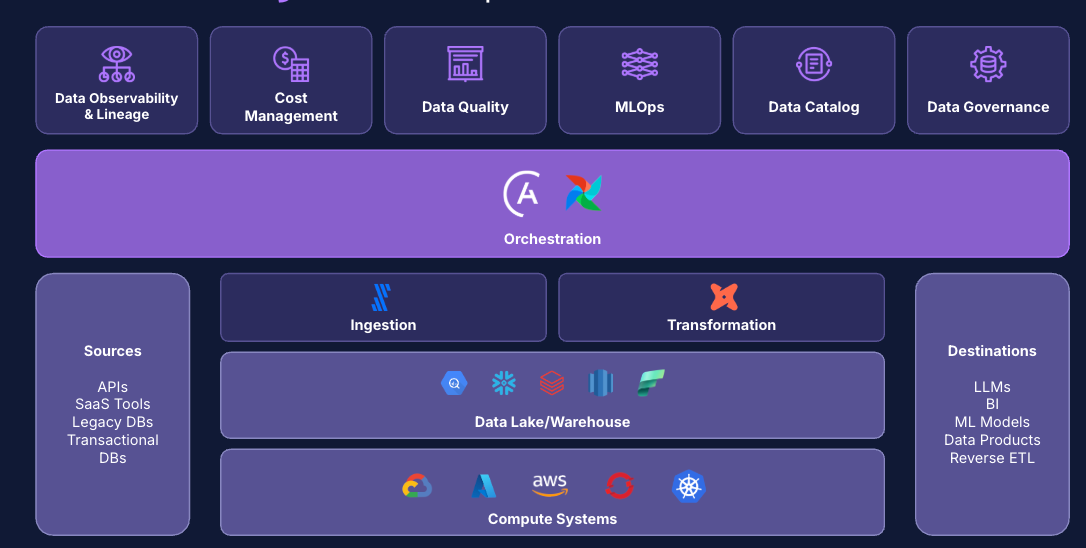
Figure 1: With the Astro platform, data teams work with a unified data stack to build, run, and observe all of their critical data pipelines across AI, app, and analytics workflows.
INITIATIVE THREE Customer Experience Transformation
Customer experience has become a primary competitive battleground for telcos, directly impacting churn, lifetime value, and brand trust. According to industry research, 54% of telecommunications decision-makers say that improving customer experience is a top transformation initiative for their organization.
Operators are investing to shift from reactive, siloed service models to proactive, data-driven customer journeys that span digital and assisted channels. With limited pricing power in core connectivity, improving retention and cost-to-serve is one of the fastest ways to protect margins and stabilize revenue.
CX investments concentrate on proactive service assurance, personalized next-best-action journeys, AI-assisted customer care, customer 360 views, and churn prediction with automated intervention.
What Telcos Need and How Astro Helps
Customer data is fragmented across CRM, billing, provisioning, network assurance, and digital channels, making it difficult to act on real-time signals. Many CX initiatives rely on delayed or unreliable data pipelines, undermining trust in “customer health” metrics. Journey orchestration breaks down when workflows span multiple systems without consistent execution or observability. When incidents occur, poor coordination amplifies customer frustration and drives churn.
| What You Need | How Astro Helps |
|---|---|
| Cross-system journey orchestration | Astro orchestrates workflows across CRM, billing, provisioning, assurance, and digital platforms. |
| Event-driven customer actions | Dataset-aware and event-based scheduling triggers workflows when experience thresholds are crossed. |
| Unify orchestration and transformation to manage complex analytics | Orchestrate, run and observe dbt workflows with Cosmos, the open-source standard for seamless dbt orchestration and model-level visibility in Apache Airflow |
| Reliable metering and usage aggregation for pricing | Airflow Dags on Astro implement metering, aggregation, and rating pipelines that feed billing systems and entitlement checks with accurate, timely consumption data. |
| Trusted CX data | Astro Observe and native pipeline tasks enforce freshness, schema, and volume checks on CX pipelines, improving the quality of analytics and actions. Pipeline-aware lineage links customer actions back to source data and workflow steps. |
| Crash-safe recovery for long-running analytics jobs | The task state store checkpoints external job IDs and progress markers, like a Spark application ID or last offset processed, so a retry reconnects to a running job or resumes from its last checkpoint instead of reprocessing the full dataset. |
| Safe experimentation | Astro IDE, CI/CD, and workspace isolation support CX experimentation with rollback. |
Astro in Action
One of the largest global internet backbone providers, operating dense networks across North America and Western Europe, needed reliable, timely data to power a customer-facing portal. The challenge was turning orchestration into dependable production infrastructure: scaling workflow execution, maintaining uptime, and ensuring visibility to protect the customer experience.
The team evaluated alternatives including Amazon MWAA and Azure Data Factory before prioritising a platform offering telco-grade operations and pipeline-aware observability without long-term maintenance burden. They adopted Astro for production orchestration and added Astro Observe to monitor pipeline health, SLAs, and data quality end-to-end. The result is a high-quality customer experience powered by fresh data, with improved operational visibility for the data team.
INITIATIVE FOUR Operational Efficiency and Automation
With flat revenue growth and rising infrastructure costs, telcos are prioritizing operational efficiency through automation. The goal is to reduce manual effort, minimize incidents, and run networks and IT systems more predictably at scale. Notably, efficiency is no longer just about cost-cutting: 61% of telcos are pursuing efficiency and new service development in parallel, using AI and digital transformation as links between the two goals. In other words, telcos see efficient operations as a foundation that frees up resources for innovation.
Automation efforts focus on standardized operational runbooks, coordinated batch and streaming execution, cost-aware scheduling, SLA enforcement, and incident response automation.
What Telcos Need and How Astro Helps
Operational workflows are often fragmented across schedulers, scripts, and domain-specific tools, creating inconsistent execution and limited visibility. Manual handoffs slow response times and increase error rates. Cost drivers across compute, storage, and energy are difficult to attribute to specific workflows, making optimization reactive rather than systematic.
Without centralized orchestration, automation efforts remain localized and fail to scale.
| What You Need | How Astro Helps |
|---|---|
| Code-defined unified orchestration across domains | Astro consolidates fragmented schedulers and scripts into a single Airflow-based control plane with pipelines defined in code |
| Diagnose pipeline failures in minutes | Otto, the data engineering agent for Astro, pulls the logs, analyzes the failure, and proposes a fix. Get to the root cause in minutes instead of hours, without manually digging through code and logs. |
| Cost attribution across AI and data pipelines | Astro Observe links pipeline execution to compute, warehouse, and CPU/GPU usage, enabling platform teams to see which data and AI workloads drive cost spikes, and optimize accordingly. |
| Visibility into data product health | Telemetry from Astro Observe links pipeline performance to failures, SLAs, and anomalies, detecting errors early to avoid wasting time and expensive system resources on inaccurate data . |
| 24x7 support. commercially-backed SLAs | Airflow experts on call provided by the engineers that build it. With Astronomer’s team you accelerate adoption, resolve issues faster, and keep mission-critical pipelines running. |
Astro in Action
A leading Western European telecommunications provider launched a cross-company data mesh program requiring secure, self-service orchestration across hundreds of teams without creating a centralised bottleneck. Their existing mix of Azure-native scheduling and fragmented Airflow footprints lacked telco-mandated controls — consistent RBAC, private connectivity, and repeatable deployment hygiene — slowing provisioning and increasing overhead.
The provider standardized on Astro and engaged Astronomer’s Center of Excellence (CoE) to deliver multi-tenant Airflow at scale, adding SSO/SCIM, private endpoints, and fully automated provisioning via API/CLI and Terraform. The result was a step-change in operational efficiency: 2,000+ Dags and 43K tasks migrated off legacy tooling, 250+ deployments unified under a governed platform, and environment provisioning cut from weeks to hours.
INITIATIVE FIVE New Digital Services and Revenue Streams
To offset stagnation in core connectivity, telcos are investing in new digital services. These services aim to reposition telcos as platform providers to enterprises and developers, monetizing network capabilities in programmable, productized ways. Use cases include:
- Private 5G delivery: automated provisioning, monitoring, and reporting.
- Edge and MEC solutions: low-latency analytics and vertical-specific applications.
- Network APIs: identity, quality-on-demand, and location services for developers.
- Partner ecosystems: onboarding, entitlements, revenue sharing.
- Vertical solutions: bundled connectivity, security, and analytics offerings.
What Telcos Need and How Astro Helps
Delivering digital services requires coordination across provisioning, assurance, billing, and partner systems, often across cloud, edge, and on-prem environments. Monetization depends on accurate usage metering, entitlement enforcement, and SLA reporting. Many telcos lack the operational workflows and observability needed to run these services reliably at scale, slowing go-to-market and eroding enterprise trust.
| What You Need | How Astro Helps |
|---|---|
| Provisioning and assurance as code | Airflow Dags encode repeatable provisioning, validation, and assurance workflows. |
| Hybrid orchestration | Remote Execution supports cloud-managed orchestration with execution at the edge or on-prem. |
| Always-on resilience for 24/7 operations | Autoscaling and cross-region DR ensure critical services remain available during infrastructure degradation and outages, matching the round-the-clock reality of telecoms. |
| Reliable usage metering | Astro pipelines aggregate and rate usage data for billing and entitlements. |
| SLA monitoring and reporting | Astro Observe tracks SLAs and pipeline health for telco-grade reporting. |
| Multi-tenant operations | RBAC and workspace isolation support multiple customers and partners safely. |
| Platform extensibility | Airflow and Astro integrate with any data platform, API, or service without lock-in. |
Astro in Action
A European provider of fixed and mobile services launched a new Snowflake data platform to support faster delivery of customer-facing and revenue-critical digital services. The team faced a common constraint: tight timelines and a relatively immature platform function, with the internal default standard (Azure Data Factory plus ad hoc tooling) likely to increase operational burden and slow iteration just as the business needed rapid delivery.
They selected Astro to provide a production-grade orchestration control plane for ingestion, transformation with dbt and downstream activation workflows, all without building and maintaining Airflow infrastructure themselves. The result is a faster path to a reliable, scalable data platform with materially lower operational overhead than alternative approaches, enabling the organization to standardize on Astro as new digital service requirements expand.
CONCLUSION Orchestration as the Control Plane for Telco’s Next Decade
Each initiative in this guide shares the same requirements:
- Clean, timely, governed data
- Reliable, observable pipelines across systems and environments
- Security, compliance, and cost control built into execution
That is the role of orchestration. The telcos that win the next decade will treat orchestration as the control plane for AI, modernization, and service expansion, and they will operationalize it with platforms like Astro.
→ Build a trusted, future-ready data stack today
Run an Astro TCO analysis and get in touch with our experts today to get results faster.
GET THE FULL GUIDE
Keep reading to see which strategic initiatives telecommunications companies are focusing on that directly impact cost structure, customer experience, and future growth.
By proceeding you agree to our Privacy Policy, our Website Terms and to receive emails from Astronomer.