Monitors in Astro Observe

Public Preview
This feature is in Public Preview.

Astro Observe uses monitors to continuously assess the health of your data products and pipelines. When a monitor detects a failure, it can automatically alert your team through your notification channels such as email or Slack. Monitors help you rapidly identify and resolve operational issues in your data workflows.

Data product monitors

Only one Data Product monitor can be created per data product.

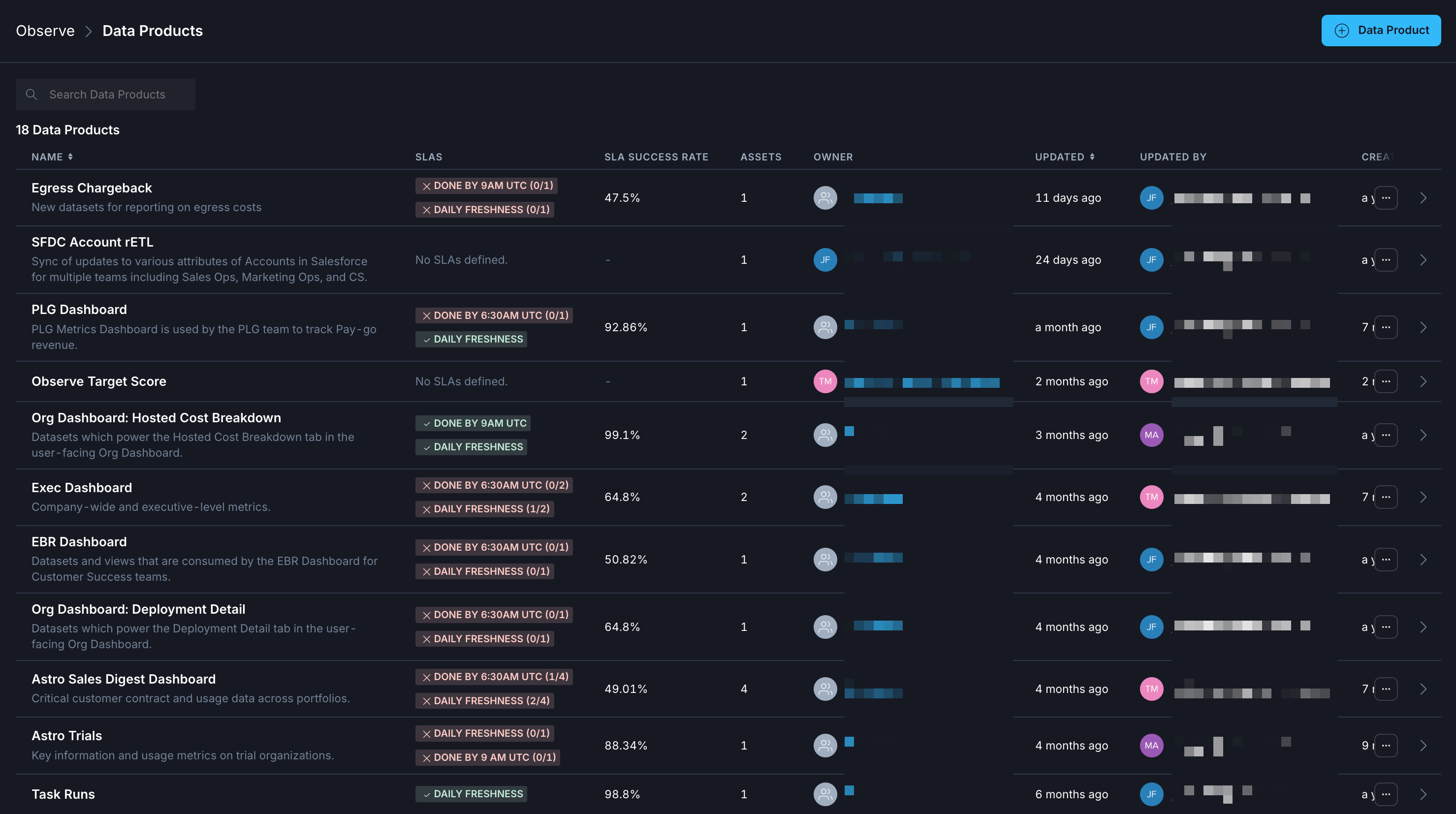
The Proactive Failure Monitor monitors a specific data product and sends an alert when any upstream or final dag in the specified data product fails. This enables you to quickly respond to failures, address the root cause, and understand the downstream impact.

When a monitored failure occurs, the alert:

  • Provides a direct link to a lineage view, showing the failing DAG and its failing task.
  • Identifies all downstream data products impacted by the failure.

Create a data product monitor

1

Start monitor creation

You will be automatically prompted to create a Proactive Failure Monitor as the fourth step in the Data Product creation process. Configure the monitor by selecting a severity level and notification channel(s) to receive alerts as described in the following steps.

2

Name and describe the monitor

  • A suggested name is auto-generated, but you can edit it as needed.
  • Optionally, add a description to clarify this monitor’s purpose for your team.
3

Failure detection behavior

  • If: Any upstream or final DAG in the data product fails, an alert will be triggered automatically. This failure condition is managed by Observe and will update dynamically if your pipeline changes.
  • Then: Select alert severity level: Info, Warning, or Critical.
  • And: Choose one or more notification channels to receive the alerts. Supported channels include email, Slack, and custom integrations. For more on configuration, see Alert Notification Channels.
4

Create monitor

Click Create Monitor to create and enable the configured monitor.

Data quality monitors

Data quality monitors help you track the health and integrity of your data assets. You can create monitors for tables and columns to detect anomalies in data volume, completeness, and schema changes. To learn more about data quality and configure a connection, see Data Quality.

Data quality monitor creation

Create a data quality monitor

Follow these steps to create a monitor for a table or column.

1

Select a table

In the Asset Catalog, find the table you want to monitor. Filter the catalog to the table type you want to see (for example, Snowflake tables).

Tables are sorted by popularity to help you find the most relevant tables to monitor. Popularity rankings are based on query frequency and the number of unique users accessing each table.

2

Open monitors

Select the table you want to monitor and click the Monitors tab.

3

Create a monitor

Click + Monitor and select the monitor type: Column Null Percentage, Row Volume Change, Schema Change, or Custom SQL. Details about each monitor type are in the section below.

4

Define monitor settings

Set alert thresholds and notification preferences.

5

Create monitor

Click Create Monitor to activate the monitor.

Row Volume Change

The Row Volume Change monitor tracks changes in table row counts over time to identify unexpected fluctuations in data volume.

When configuring this monitor:

  • Specify thresholds based on percentage changes or absolute row-count changes.
  • Monitors execute checks according to the schedule you define. If you set the monitor to run every 6 hours, it evaluates whether row counts exceed the configured thresholds within that interval.

Column Null Percentage

The Column Null Percentage monitor tracks the percentage of null values in a specific column to surface completeness problems.

When configuring this monitor:

  • Select the column to monitor and define the null percentage threshold.
  • The monitor evaluates the column at the interval you specify. If the null percentage exceeds the threshold, the monitor triggers.

Table Schema Change

The Table Schema Change monitor detects when the structure of a table changes, such as when columns are added, removed, or modified. This helps you identify unexpected schema changes that could impact downstream processes.

Custom SQL

The Custom SQL monitor compares the numeric output of a SQL query to a defined threshold. Using this monitor, you can define data quality checks specific to your business requirements (for example, checking for missing records, duplicates, broken joins, or invalid values). Custom SQL monitors can be triggered on a set schedule, manually, or programmatically.

When configuring this monitor:

1

Select connection

Select the data warehouse connection (for example, Snowflake) that the query will run against.

2

Write SQL query

Write your SQL query. The SQL can query multiple tables and columns but must return one row and one column with a numeric (scalar) value. Example SQL queries are in the section below.

Custom SQL monitor configuration

3

Define alert condition

Define the numeric threshold of the returned value that triggers an alert (for example, missing_orders > 10).

4

Test query

Test the query before creating the monitor to verify that the SQL works as expected.

Common use cases include:

  • Flagging duplicate records
  • Checking for foreign key violations
  • Validating business rules (for example, order amount cannot be negative)
  • Ensuring data freshness (for example, last update within 1 hour)

Example SQL queries

1-- Missing data
2SELECT COUNT(*) FROM orders WHERE order_id IS NULL
3
4-- Duplicates
5SELECT COUNT(*) FROM (
6 SELECT order_id, COUNT(*)
7 FROM orders
8 GROUP BY order_id
9 HAVING COUNT(*) > 1
10)
11
12-- Invalid values
13SELECT COUNT(*) FROM orders WHERE total_amount < 0
14
15-- Orphaned rows
16SELECT COUNT(*)
17FROM orders o
18LEFT JOIN customers c ON o.customer_id = c.customer_id
19WHERE c.customer_id IS NULL
20
21-- Staleness
22SELECT DATEDIFF('hour', MAX(updated_at), CURRENT_TIMESTAMP())
23FROM orders

Trigger Custom SQL monitors with events

In addition to a fixed schedule, Custom SQL monitors can be triggered by events. For example, when a specific Airflow dag completes successfully or when data lands in a Snowflake table. This ensures that checks are evaluated immediately after new data lands, allowing downstream consumers to be notified of data quality issues immediately rather than waiting for the next scheduled check.

You can trigger a Custom SQL monitor by calling the following API endpoint:

$POST https://api.astronomer.io/v1alpha1/organizations/{ORG_ID}/observability/monitors/{MONITOR_ID}/trigger

When triggered, Observe:

  1. Runs the configured SQL monitor immediately against the connected data warehouse.
  2. Evaluates the result against the monitor’s condition (for example, invalid_rows > 0).
  3. Logs the result in the monitor timeline.
  4. Sends alerts through configured channels if thresholds are breached.

Example: Airflow DAG trigger

You can include this API call directly in your Airflow dag to trigger validation right after a load completes:

1trigger_sql_monitor = PythonOperator(
2 task_id="trigger_sql_monitor",
3 python_callable=lambda: requests.post(
4 f"https://api.astronomer.io/v1alpha1/organizations/{ORG_ID}/observability/monitors/{MONITOR_ID}/trigger",
5 headers={
6 "Content-Type": "application/json",
7 "Authorization": f"Bearer {API_TOKEN}",
8 },
9 timeout=30,
10 )
11)

Chain this operator after your load task:

1load_data_to_snowflake >> trigger_sql_monitor

to ensure that quality checks run immediately after data load, enabling faster issue detection and downstream notification.

Custom SQL requirements and limitations

  • Read-only queries: Only read queries are allowed. Write queries will return an error.
  • Query format: Queries must return a single row and a single column. Otherwise, Observe returns an error.
  • Numeric output: Query output must be a numeric value.
  • Table references: Tables in queries must use the format <database>.<schema>.<table> since the default database and schema might not be set.
  • Joins: You can perform multiple join queries as long as they meet the above criteria.
  • Rate limits: To prevent system abuse, the following limitations apply:
    • You cannot test the same query more than 3 times in a minute.
    • You cannot test more than 10 queries in a minute.
    • You cannot manually re-trigger the monitor for the next 5 minutes after a trigger request is initiated.
  • Initial trigger: Wait at least 1 minute before manually triggering the Custom SQL monitor after the monitor is created.