Cross-Region Disaster Recovery on Astro: Enterprise Resilience, Without the Engineering Project
7 min read |
Today, we are announcing the public preview of cross-region Disaster Recovery on Astro, now available on AWS. Astro is the first managed Airflow platform to offer built-in, one-click cross-region failover as a platform capability, with no custom architecture to build, no replication logic to write, and no runbook to execute under pressure. For data and engineering leaders running business-critical pipelines on Airflow, this is the resilience capability you have been asking for. It is designed to help meet information security, compliance, and regulatory requirements alongside enterprise reliability standards.
Airflow is running the data stack. When a region goes down, everything stops.
Apache Airflow is the open-source standard for data orchestration. With over 30 million monthly downloads, and adoption at enterprise scale, it is the orchestration layer at the center of modern data and AI platforms. When organizations run Airflow in production, they are not running a single pipeline. They are running the workflows that power their analytics dashboards, feed their ML models, and drive their operational systems. Airflow is the backbone. That centrality is exactly what makes a regional outage so damaging.
In October 2025, a DNS failure in AWS's US-East-1 region took down 141 AWS services for over 15 hours, impacting more than 3,500 companies worldwide. Netflix, Slack, Coinbase, and Atlassian were among the services affected. It was the third major outage tied to that single AWS region in five years. For any team running Airflow in US-East-1 without cross-region protection, every downstream pipeline stopped: analytics, AI, operational workflows, all of it.
The financial cost of moments like this is well established. A 2024 study by Splunk and Oxford Economics found that unplanned downtime costs Global 2000 companies $400 billion annually, roughly $200 million per company each year. That figure accounts for both direct revenue loss and the harder-to-measure costs: delayed innovation, eroded customer trust, and reputational damage that takes an average of 79 days to recover from.
For teams running Airflow at enterprise scale, the question is not whether a region will fail. It is whether your platform is built to handle it when one does.
Built on high availability. Now protected across regions too.
Astro has always prioritized reliability. High availability on Astro protects production deployments from disruptions within a cloud region by running redundant schedulers and core infrastructure components across multiple availability zones. If a single zone fails, your pipelines continue running without interruption. Cross-region Disaster Recovery (DR) extends that protection to a different failure boundary entirely. Where high availability addresses zone-level disruptions within a region, DR addresses the scenario where the primary region itself becomes unavailable. The two capabilities are complementary: together they define what enterprise-grade reliability looks like for a managed Airflow platform. Before today, the only way to get cross-region DR for Airflow was to build it yourself. That means 3 to 6 months of engineering to design the architecture, build custom database replication, automate failover, provision secondary infrastructure, and document a runbook that your team can actually execute under pressure at 3am. And once built, it requires ongoing maintenance. On Astro, it is a toggle.
What customers told us they needed
In building this feature, we talked with enterprise customers across financial services, healthcare, and other regulated industries who had identified cross-region DR as a hard requirement for running Airflow in production. The ask was consistent across the board: they needed a managed failover capability that could meet an RTO under 1 hour and an RPO under 15 minutes, with flexibility to choose their own region pairs rather than having them prescribed. And critically, they needed Astronomer to do the heavy lifting on replication and restoration, so that recovering to the secondary environment meant landing in a mirror-like copy of their primary, not rebuilding from scratch.
"This is critical to our financial operations. Not just reporting and analytics, but business operations that depend on this data being up to date. If we suffer an outage, there is an impact on our end consumers as well."Director of Data Platform at a Financial Technology Company
Disaster Recovery on Astro: built in, not bolted on
Cross-region Disaster Recovery is built directly into Astro. It continuously replicates your metadata database and task logs to a secondary cluster in a separate AWS region of your choosing. Your deployment configurations, environment variables, connections, and run state are all mirrored in real time. When a failover is needed, you initiate it from the Astro UI with a single click.
The feature is designed to meet RTO under 1 hour and RPO under 15 minutes. We validated these targets through benchmarking on a production-scale cluster running 80 Airflow deployments with over 1,200 concurrent task runs. Full workload recovery came in well within our RTO target, with a small number of in-flight tasks affected during the transition window, expected behavior for any active-passive failover architecture, and recoverable through standard Airflow retry configuration.
From setup to recovery in four steps
- Setup at cluster creation. When creating a new dedicated AWS cluster, enable Disaster Recovery by toggling it on and selecting your secondary region. Astro provisions and configures secondary infrastructure automatically. For existing clusters, DR can be enabled through a guided in-product support request.
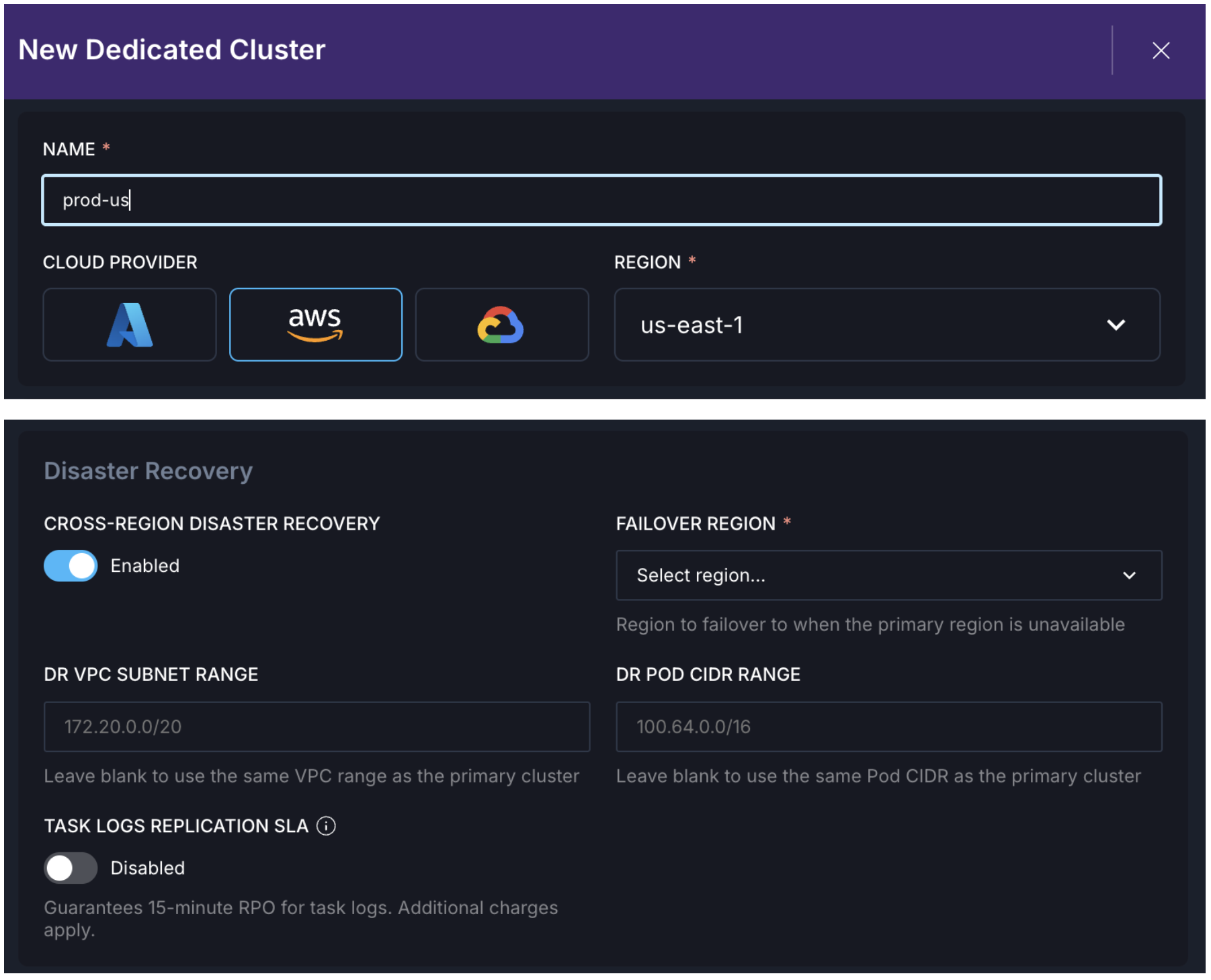
- Continuous, automatic replication. Astro keeps your metadata database and task logs synchronized across primary and secondary regions at all times. There is no scheduled sync window and no replication job to manage.
- One-click failover when you need it. From the Cluster details page in the Astro UI, initiate failover to your secondary region with a single action. Initial workloads begin resuming within 15 minutes, with full recovery within the hour.
- Mirror-like recovery, every time. The secondary environment restores as an exact replica of your primary: same deployment names, configurations, namespaces, and run history. When your primary region is restored, failback uses the same one-click experience.
Protected business. Recovered faster. No engineering project required.
Keep pipelines running when it matters most. With RTO under 1 hour and RPO under 15 minutes, business-critical workflows resume quickly after a regional outage. The downstream impact to analytics, AI pipelines, and operational systems is minimized.
Recover months of engineering capacity. Building cross-region DR for Airflow from scratch requires 3 to 6 months of focused engineering effort and sustained investment to maintain. Astro delivers it as a managed capability so your teams stay focused on delivering data products, not managing infrastructure.
Meet enterprise reliability requirements. Large enterprises require documented DR capabilities with defined RTO and RPO targets. Astro provides both, with benchmarked performance data to support internal reviews, audit requirements, and business continuity planning.
The only managed Airflow platform with native DR. No other managed Airflow service offers cross-region disaster recovery as a built-in platform feature. If business continuity for your Airflow environment is a requirement, Astro is the only managed solution that delivers it without a multi-month engineering project.
Available now on AWS
Cross-region Disaster Recovery is available in public preview on Astro for AWS today, with GCP and Azure support planned over the next two to three quarters. You can enable it on a new dedicated cluster directly through the Astro UI, or request it for an existing cluster through our in-product support form. Support for additional cloud providers is on our roadmap.
Ready to explore? Read the docs or talk to our team to learn how cross-region DR fits into your data platform strategy.

Get started free.
OR
By proceeding you agree to our Privacy Policy, our Website Terms and to receive emails from Astronomer.