

params parameter.
Params are ideal to store information that is specific to individual DAG runs like changing dates, file paths or ML model configurations. Params aren’t encrypted and therefore not suitable to pass secrets. See also Best practices for storing information in Airflow.
This guide covers:
- How to pass params to a DAG at runtime.
- How to define DAG-level param defaults which are rendered in the Trigger DAG UI.
- How to access params in an Airflow task.
- The hierarchy of params in Airflow.
Assumed knowledge
To get the most out of this guide, you should have an understanding of:- Airflow DAGs. See Introduction to Airflow DAGs.
- Airflow operators. See Operators 101.
- Airflow context. See Access the Apache Airflow context.
Pass params to a DAG run at runtime
Params can be passed to a DAG at runtime in four different ways:- In the Airflow UI by using the Trigger DAG form. This form appears when you click the Play button in the Airflow UI only for DAGs that have at least one param defined at the DAG level, see Define DAG-level param defaults.
- Running a DAG with the
--confflag using the Airflow CLI (airflow dags trigger). - Using the
TriggerDagRunOperatorwith theconfparameter. - Making a POST request to the Airflow REST APIs Trigger a new DAG run endpoint and using the
confparameter.
dag_run_conf_overrides_params is set to True.
While it’s possible to pass non-JSON serializable params, this behavior is deprecated and will be removed in a future release. It is best practice to make sure your params are JSON serializable.
Trigger DAG form
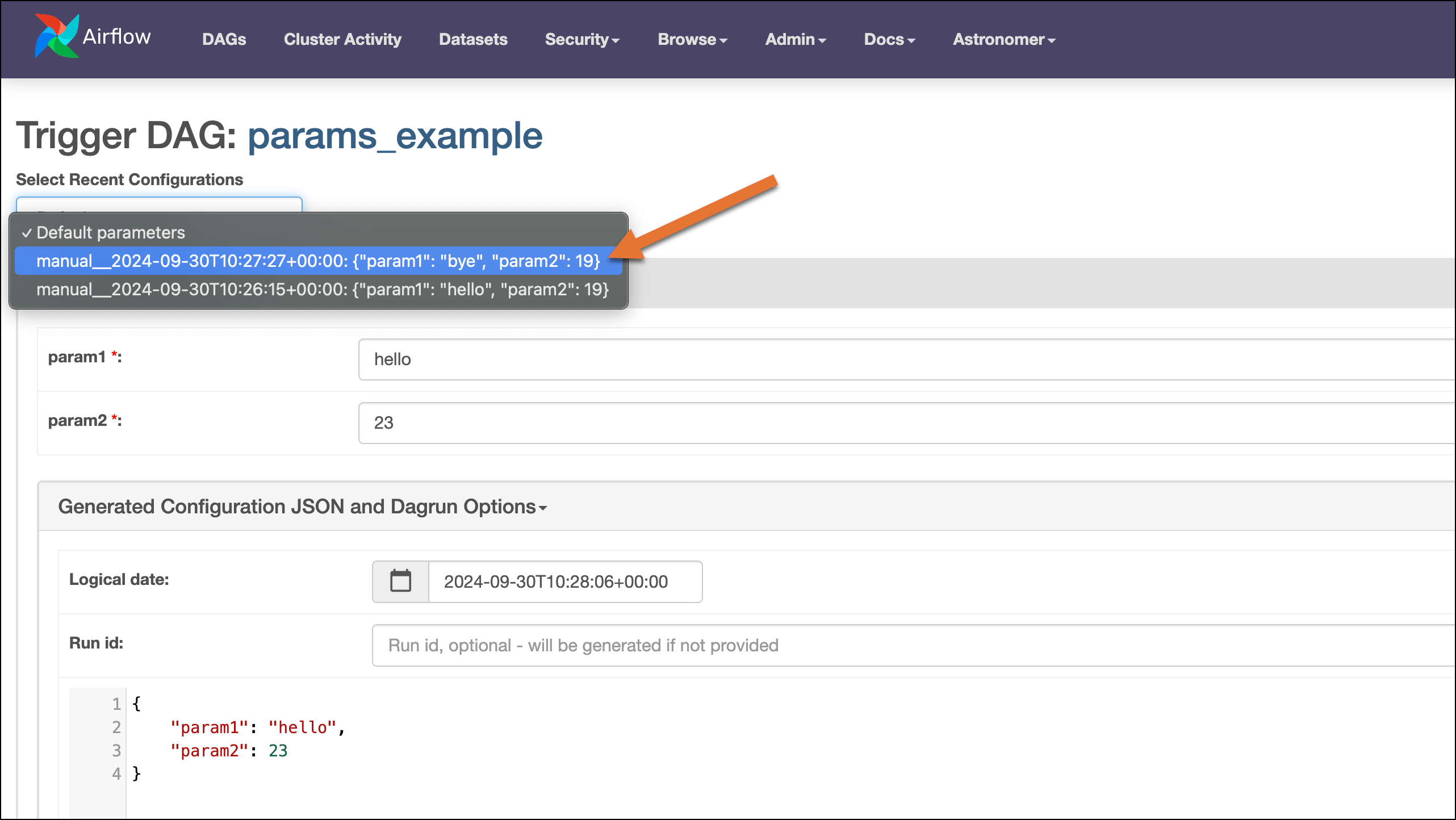
You can pass params to DAGs with pre-defined params from the Airflow UI by clicking the Play button.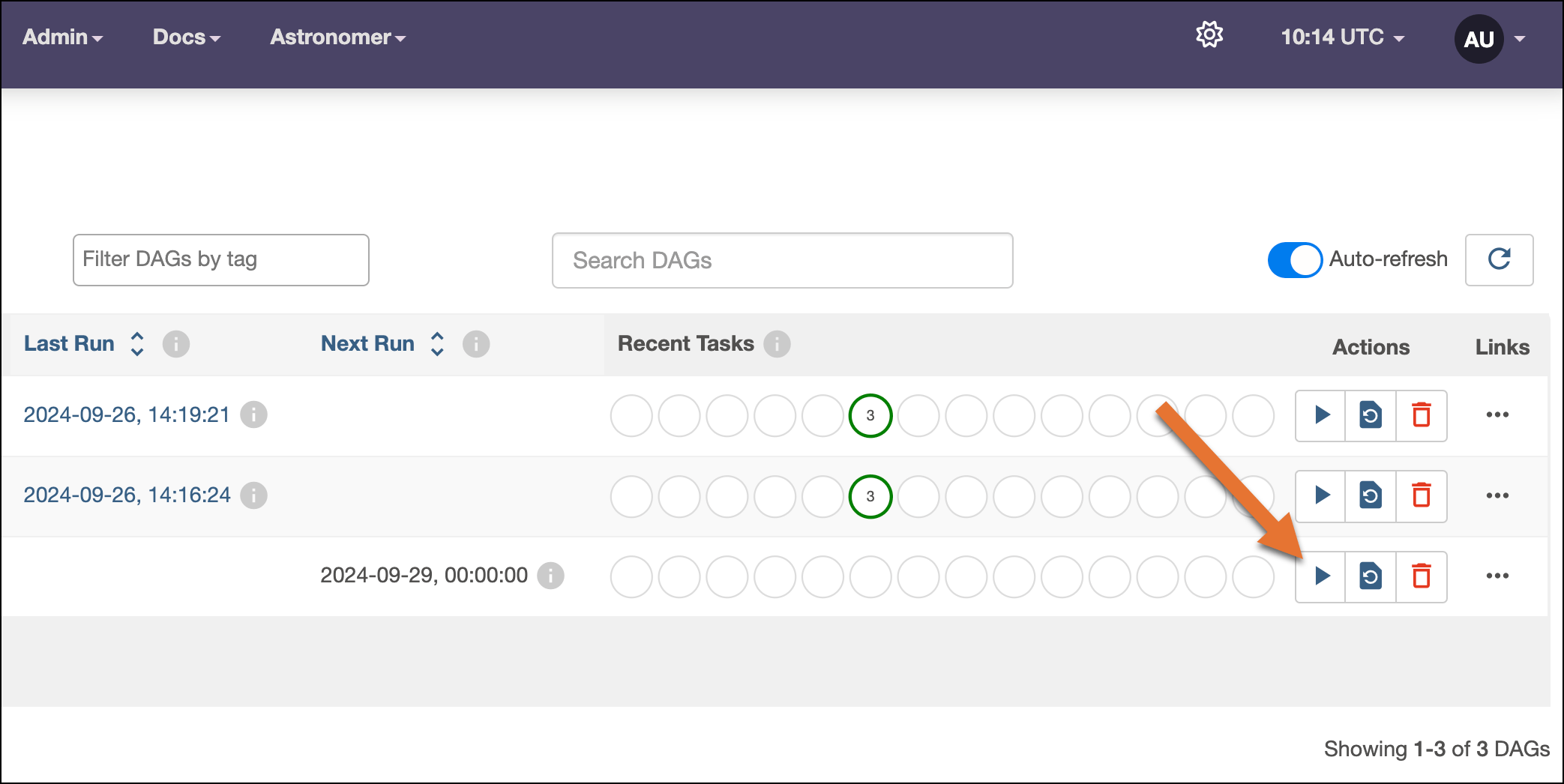
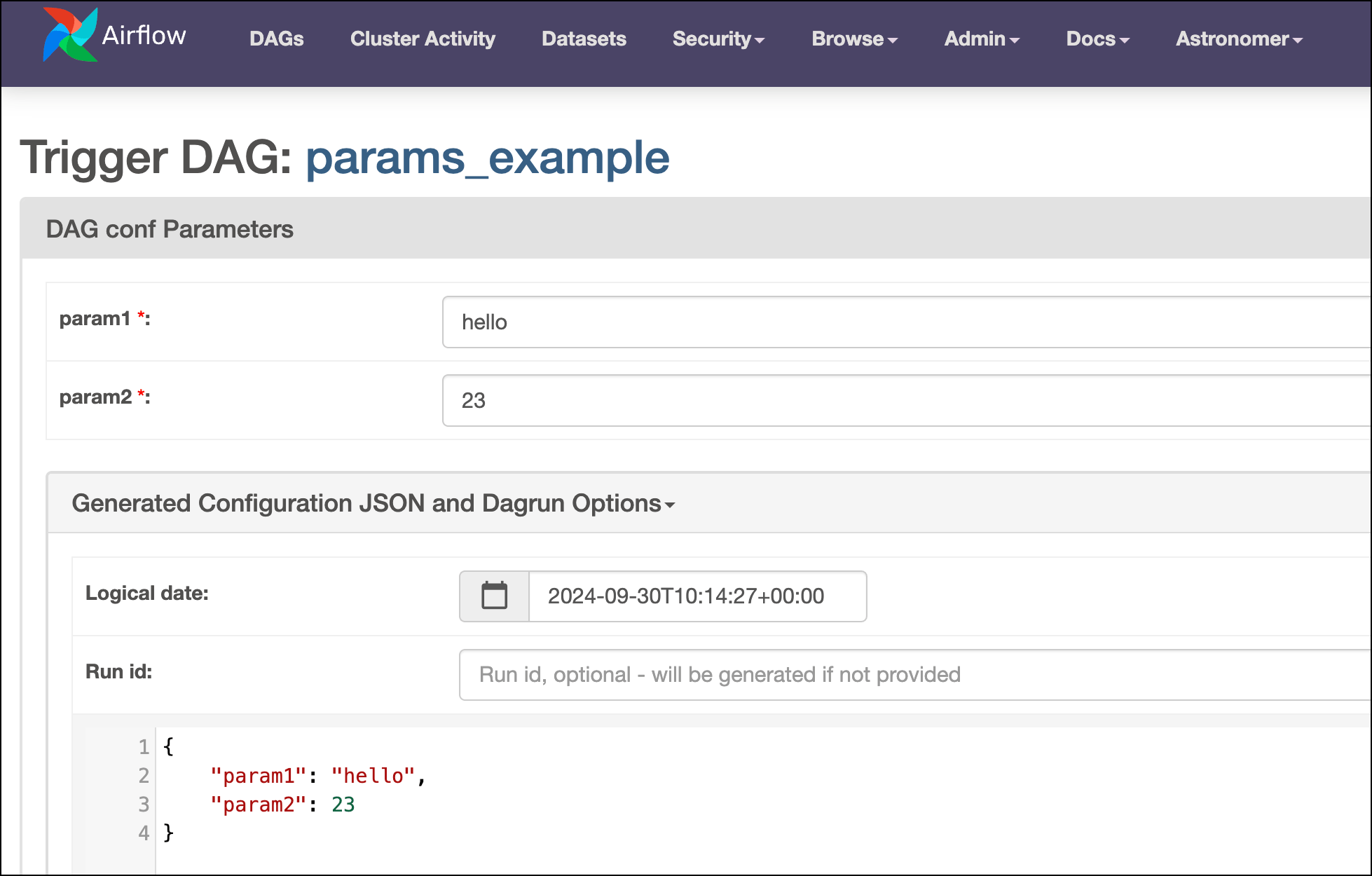
AIRFLOW__WEBSERVER__SHOW_TRIGGER_FORM_IF_NO_PARAMS=True.
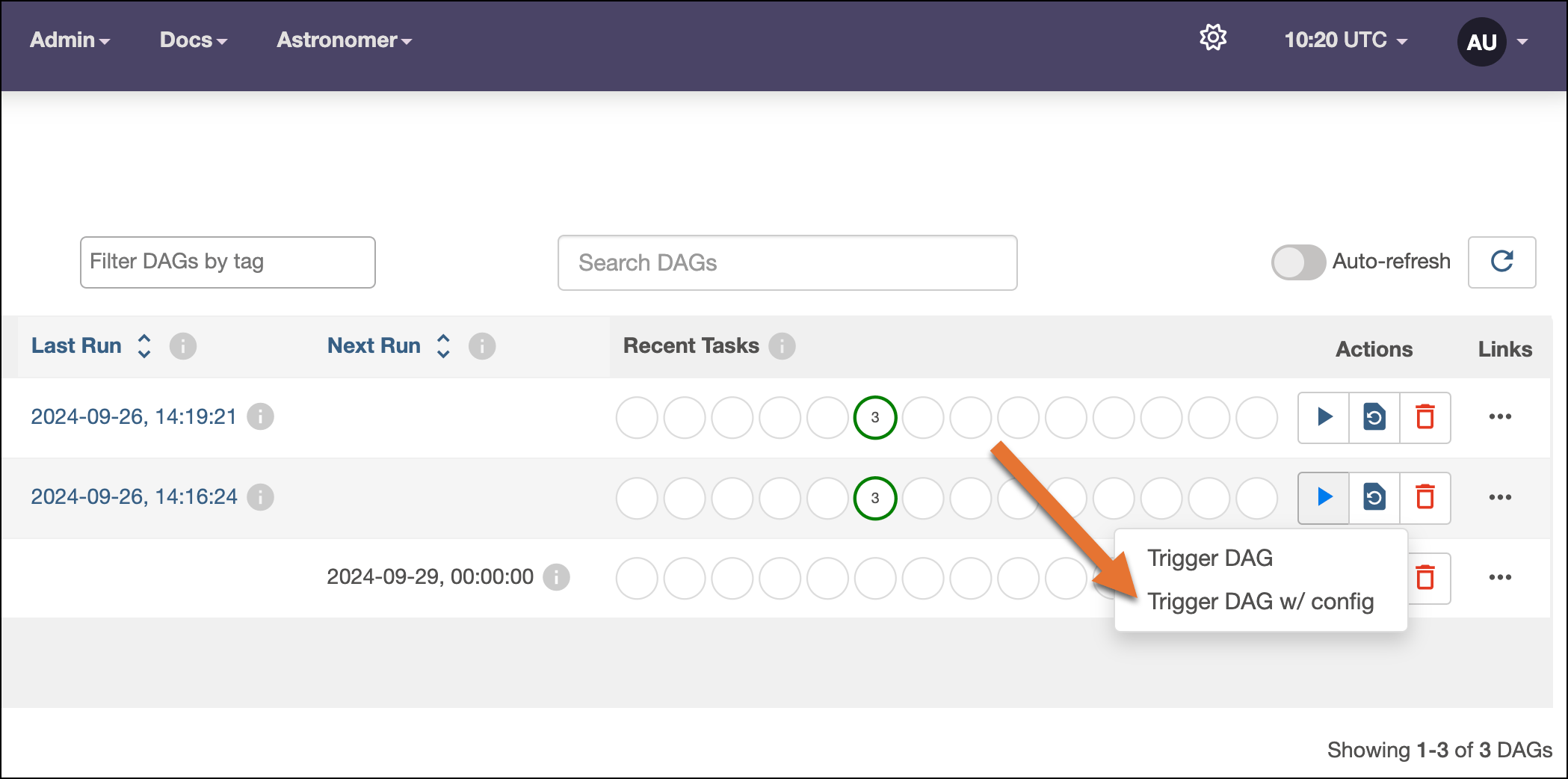
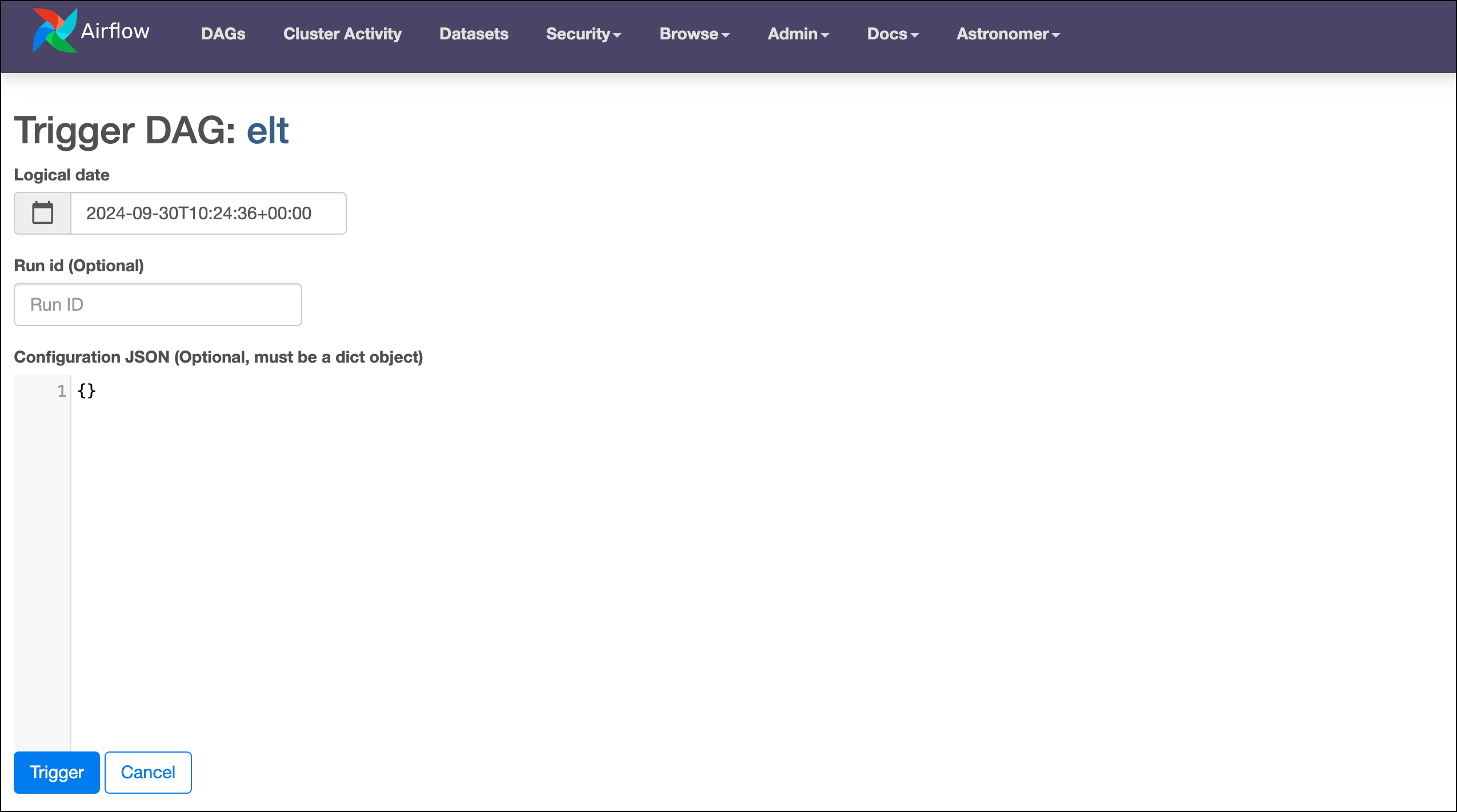
- You can set the Logical date of the DAG run to any date that is in between the
start_dateand theend_dateof the DAG to create DAG runs in the past or future. - You can set the Run id to any string. If no run ID is specified, Airflow generates one based on the type of run (
scheduled,dataset_triggered,manualorbackfill) and the logical date (for example:manual__2023-06-16T08:03:45+00:00). - The Trigger DAG form will render a UI element for every DAG-level params you define with a default value. See also Define DAG-level param defaults.
- The information in the UI elements generates a Configuration JSON. You can directly edit the Generated Configuration JSON in the UI and add any additional params, whether a default has been defined for them or not.
CLI
When you run an Airflow DAG from the CLI, you can pass params to the DAG run by providing a JSON string to the--conf flag. For example, to trigger the params_default_example DAG with the value of Hello from the CLI for param1, run:
The CLI prints the configuration for the triggered run to the command line:

--conf flag with the following Airflow CLI sub-commands:
airflow dags backfillairflow dags testairflow dags trigger
TriggerDagRunOperator
The TriggerDagRunOperator is a core Airflow operator that allows you to start a DAG run from within another DAG. You can use the TriggerDAGRunOperator conf param to trigger the dependent DAG with a specific configuration.
The DAG below uses the TriggerDagRunOperator to trigger the tdro_example_downstream DAG while passing a dynamic value for the upstream_color param using the conf parameter. The value for upstream_color is passed using a Jinja template pulling the return value of an upstream task using XCom.
tdro_example_downstream DAG that are triggered by this upstream DAG will override the default value of the upstream_color param with the value passed using the conf parameter, which leads to the print_color task to print either red, green, blue or yellow.
Define DAG-level param defaults
To specify params for all runs of a given DAG, pass default values to theparam parameter of the @dag decorator or the DAG class in your DAG file. You can directly specify a default value or use the Param class to define a default value with additional attributes.
The DAG below has two DAG-level params with defaults: param1 and param2, the latter only accepting integers.
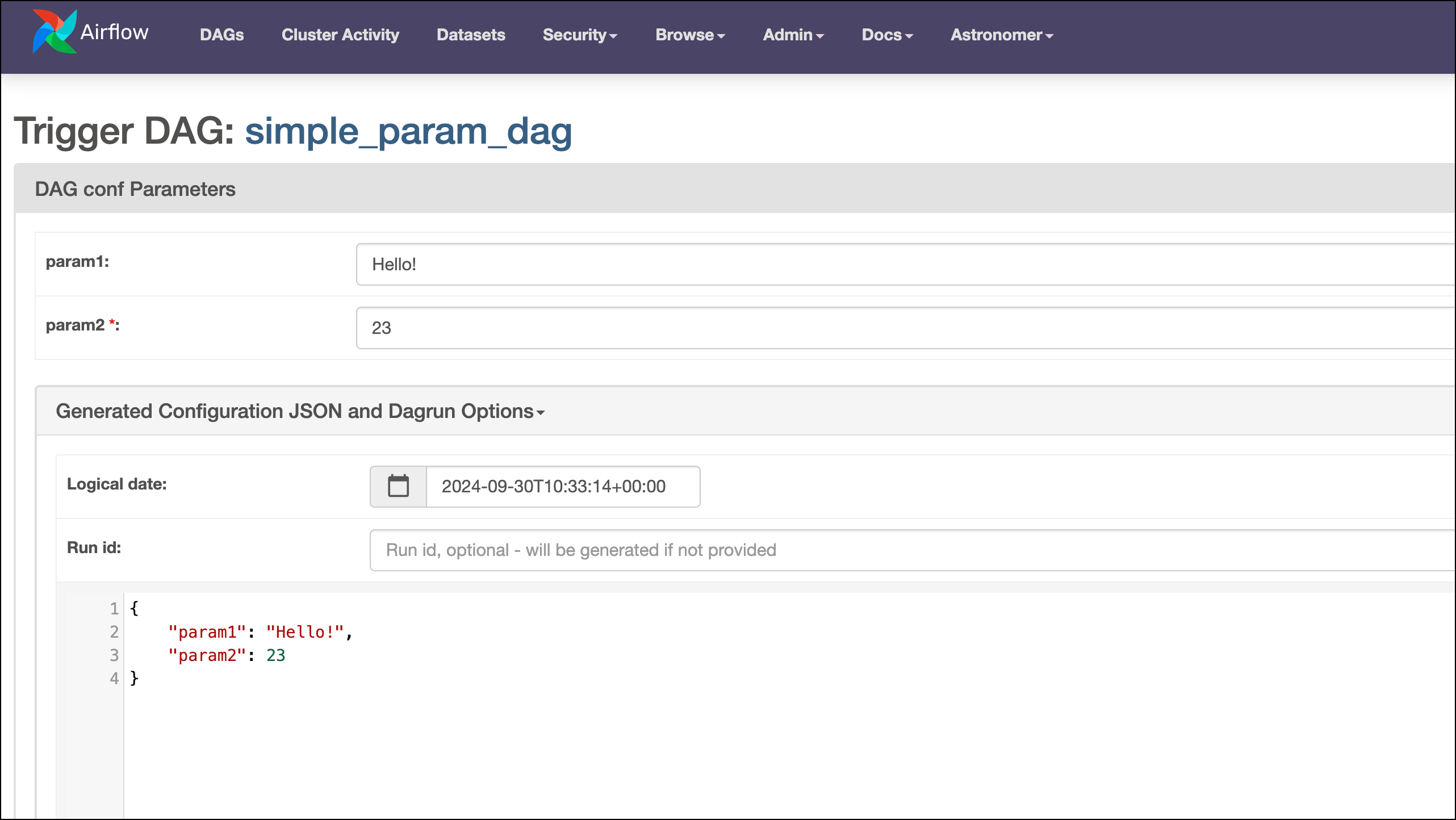
When you specify a required
type for a param, the field will be a required input by default because of JSON validation. To make a field optional but still require a specific input type, allow NULL values by setting the type to ["null", "<my_type>"].By default, Airflow assumes that the values provided to a keyword in the
params dictionary are strings. You can change this behavior by setting the DAG parameter render_template_as_native_obj=True. See Render native Python code.Param types
The following param types are supported:string: A string. This is the default type.null: Allows the param to be None by being left empty.integerornumber: An integer (floats aren’t supported).boolean:TrueorFalse.array: An HTML multi line text field, every line edited will be made into a string array as the value.object: A JSON entry field.
Param attributes
Aside from thetype attribute, the Param class has several other attributes that you can use to define how users interact with the param:
title: The title of the param that appears in the Trigger DAG UI.description: A description of the param.description_md: A description defined in Markdown that can contain links and other Markdown elements. In Airflow 2.8+, if you want to use HTML in the description, you need to set the Airflow configurationwebserver.allow_raw_html_descriptionstoTrue(AIRFLOW__WEBSERVER__ALLOW_RAW_HTML_DESCRIPTIONS=True). Note that HTML can introduce vulnerabilities and that adding invalid HTML might lead to the UI not rendering correctly.section: Creates a section under which the param will appear in the Trigger DAG UI. All params with no specified section will appear under the default section DAG conf Parameters.format: A JSON format that Airflow will validate a user’s input against.enum: A list of valid values for a param. Setting this attribute creates a dropdown menu in the UI.const: Defines a permanent default value and hides the param from the Trigger DAG UI. Note that you still need to provide adefaultvalue for the param.custom_html_form: Allows you to create custom HTML on top of the provided features. As of Airflow 2.8 this feature is deprecated and will be replaced by a new implementation in the future.
Param attributes are optional to set. For string type params, you can additionally set minLength and maxLength to define the minimum and maximum length of the input. Similarly, integer and number type params can have a minimum and maximum value.
Param examples in the Airflow UI
This section presents a few examples of params and how they are rendered in the Trigger DAG UI. The code snippet below defines a mandatory string param with a few UI elements to help users input a value.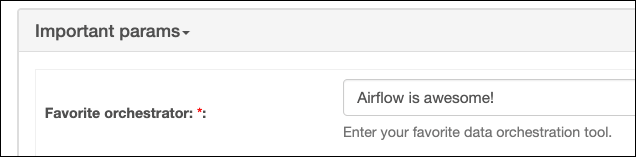
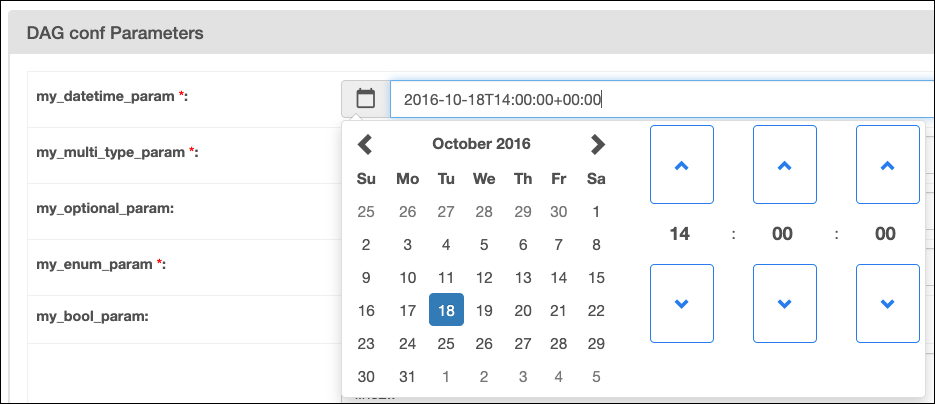
enum attribute will create a dropdown menu in the Trigger DAG UI. Note that the default value must also be in the list of valid values provided to enum. Due to JSON validation rules, a value has to be selected.
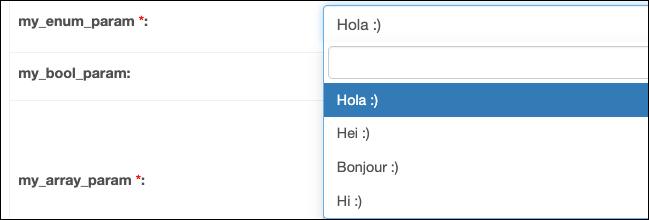

custom_html_form attribute, you can create more complex UI elements like a color picker. For sample code, see this example DAG in the Airflow documentation. Note that this feature is deprecated as of Airflow 2.8 and its implementation will change in the future.

Define task-level param defaults
You can set task-level param defaults in the same way as for DAG-level params. If a param of the same key is specified at both the DAG and task level, the DAG-level param will take precedence.Access params in a task
You can access params in an Airflow task like you can with other elements in the Airflow context.{{ params.my_param }} syntax.
If you try to access a param that hasn’t been specified for a specific DAG run, the task will fail with an exception.
Param precedence
The order of precedence for params, with the first item taking most precedence, is as follows:- Params that have been provided for a specific DAG run by a method detailed in pass params to a DAG run at runtime as long as the Airflow config core.
dag_run_conf_overrides_paramsis set toTrue. - Param defaults that have been defined at the DAG level.
- Param defaults that have been defined at the task level.