

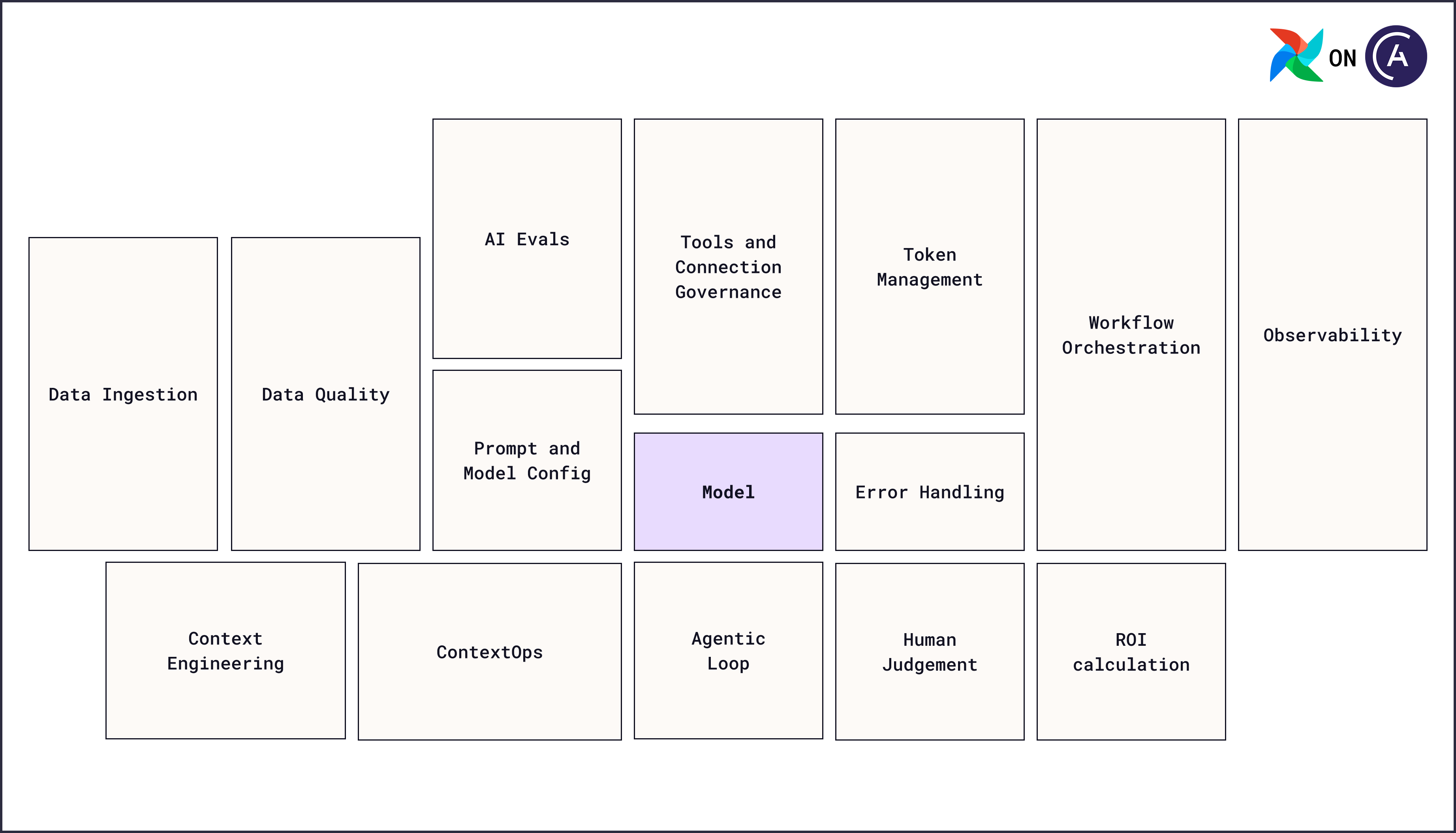
- Why Airflow for AI orchestration: The advantages of orchestrating AI tasks within Airflow Dags.
- Basic concepts in AI orchestration: The core terms, the micro and macro orchestration split, and how to choose between LLM, agent, and multi-agent orchestration.
- LLM orchestration with Apache Airflow®: How to run a single model inference as a task, with upstream tasks preparing the context and downstream tasks consuming the result.
- Agent orchestration: How to run a model in a tool-calling loop as a task, and how to govern the tools and connections that loop can reach.
- AI model evals: How to evaluate the AI output and store the model evaluation information alongside agent traces gathered from your micro orchestrator.
- AI product evals: How to gather downstream signals to evaluate whether an AI data product is useful.
- Orchestrate AI tasks with Apache Airflow® and the Common AI provider: The parameter reference for the decorators and operators the other pages use.
Why Airflow for AI orchestration
Using Airflow to orchestrate AI tasks offers many benefits:- Tool agnosticism: With Airflow you can orchestrate actions in any system that has an API. This means you can use any AI harness with Airflow, including popular harnesses like LangChain, CrewAI, or Temporal.
- Provider ecosystem: For many common data tools, pre-built provider packages are available to simplify and standardize your orchestration. Most providers contain Airflow hooks that can be turned into agent tools with the
HookToolsetof the Common AI provider. - Common AI provider: Airflow has a native LLM and agent harness built on PydanticAI, which connects to models from many different providers. To switch your model, for example from OpenAI to Anthropic, you can change the connection configuration without changing the task code.
- Durable execution: The task state store saves state at any point within a task, so a retry resumes from the last checkpoint. For agent tasks, setting
durable=Trueon the Common AI provider’s@task.agentcaches finished model and tool calls. See Durable execution and recoverability. - Connections: Airflow connections contain credentials to connect to other systems. When using Airflow to orchestrate AI tasks, your AI provider connection and HookToolset connections can be stored and governed in the same location as the connections to your databases.
- Task dependencies: Context engineering, the AI task, and the processing of AI output are tasks in one Dag, and Airflow allows you to define the dependencies between them. The AI task’s result is available downstream through XCom.
- Scheduling: Airflow has a wide variety of scheduling options. You can run your AI tasks on a time-based schedule, on an event-driven schedule when a message or a ticket arrives, or on an asset-driven schedule after the pipelines that produce the context complete.
- Dynamic task mapping: You can define tasks in Airflow so one AI task definition creates one mapped task instance per input at runtime, each with its own logs, retries, and result. See Create dynamic Airflow tasks.
- Retries: Rate limits, provider outages, and timeouts are transient failures that Airflow retries. Retry policies allow you to control the retry decision and delay per exception type or with custom rules. You can even use an LLM to make retry decisions at runtime with the
LLMRetryPolicyof the Common AI provider. - Human-in-the-loop: The Airflow standard provider has human-in-the-loop operators that allow you to add a task that waits for human input. You can approve, reject, and edit AI output directly in the Airflow UI or through the Airflow REST API endpoints. See Human-in-the-loop workflows with Apache Airflow®.
- Execution environments: AI tasks can run on Airflow workers, in isolated environments when a harness has conflicting dependencies, or on your own infrastructure with remote execution.
AI orchestration certification
AI Orchestration: Fundamentals certification
Explore AI orchestration first-hand with the AI Orchestration: Fundamentals learning path in the Astronomer Academy, a collection of free modules that teach everything a data engineer needs to orchestrate AI with Airflow. When you’re confident with AI orchestration, take the certification exam:
Basic concepts in AI orchestration
Core concepts to understand before you put a model call into a pipeline:- Model: The LLM itself, running with a model provider (for example, Claude Sonnet) or on your own infrastructure. It takes in context and produces output.
- Harness: The code around the model that builds the API request, parses the response, enforces the output schema, and, for agents, runs the tool-calling loop. Common harnesses are the Common AI provider, built on PydanticAI, LangChain, LangGraph, CrewAI, and Temporal, or one you write yourself around a provider’s API.
- Context window: The fixed maximum number of tokens one model call can hold, covering the system prompt, the user prompt, tool descriptions, tool results, and the model’s own response.
- Context: The data in the context window for one model call. Context engineering is filling that window with the right information for the next step, and AI context engineering with Apache Airflow® covers the pipeline patterns that produce it.
- Tools: Functions a model can call to read from or act on an external system. They separate an agent from a single model call, and they’re where most of the risk sits: a model that can call a tool can perform any action that tool allows.
- Agent: A system with a reasoning layer (the model, planning and deciding) and an action layer (the tools that act on real systems), running the model in a loop until it decides it’s finished. Unlike a single model call, an agent picks its own next step, so the sequence of calls isn’t known before the task runs.
- Human-in-the-loop (HITL): A step that pauses until a person approves, rejects, or edits an AI-generated output, available as human-in-the-loop operators in the standard provider and as parameters on several Common AI decorators.
- AI-as-a-judge: A step where an additional model call scores the output of a previous one, for example rating a drafted reply for accuracy and tone. Also called LLM- or agent-as-a-judge, it’s how you score criteria you can describe in plain language but can’t express as a deterministic check.
- Eval: A repeatable, scored test of AI output, run against fixed inputs so you can compare one prompt, model, or pipeline version against another. An eval scores the final output (end-to-end), a single step such as the model call that picked a tool (component-level), or the whole trace of reasoning and tool calls (trajectory). Those scopes stop at the output, and Airflow extends them to the business value delivered, because it already connects to the systems those signals live in.
Micro and macro orchestration
An AI pipeline has two layers of orchestration, and they belong to different tools:- Macro orchestration is what Airflow does around the model call: deciding when it runs, passing runtime context into the prompt, creating many parallel model calls from one task definition, retrying transient failures, governing the tools and connections the task can use, and routing the output.
- Micro orchestration is what the harness does inside the task: building the API request, parsing the response, enforcing the output schema, tracking token usage, and, for agents, running the tool-calling loop.
@task, because a @task is just Python. That holds for an agent loop as much as for a single model call. See Start with the harness you already have for the same single model call written in four frameworks, and Move tools between harnesses for using tools you already have with an agent task.
Astronomer recommends the Common AI provider, the Airflow-native harness, for new AI tasks. Credentials come from an Airflow connection, and output validation, spend limits, human review, and tracing are task parameters rather than framework code. Existing harness code keeps running in a plain
@task, so you can move over one task at a time.Choose between LLM, agent, and multi-agent orchestration
All three patterns call the same underlying models. The difference is how many times the model runs, whether it can act on its own, and how many specialized models are involved.
Start with an LLM task. A large share of AI use cases are single transformations that don’t need tools, and an LLM task is cheaper, faster, and far easier to reason about than an agent loop. Move to an agent task when the model needs to discover information at runtime that you can’t fetch deterministically in an upstream task, and to multiple agents when the work splits into roles that one agent’s context window can’t cover.
Review AI output
LLM tasks and agent tasks both produce output that downstream tasks process. You can add quality control steps directly in your pipeline.- AI-as-a-judge: one or more downstream tasks score the output with an additional model call. Use separate tasks when the criteria are independent, for example one scoring factual accuracy against a system of record and one scoring tone.
- Human-in-the-loop (HITL): a task that waits for a human to make a decision and/or provide further input.
@task.llm or @task.agent task or dedicated human-in-the-loop operators.
For the operators, their parameters, and the REST API endpoints a reviewer can respond through, see Human-in-the-loop workflows with Apache Airflow®.
Non-determinism and idempotency
LLMs aren’t deterministic, so tasks that call them aren’t idempotent by definition. Rerunning or backfilling a Dag with an AI task can produce a different result from the same input. What you can achieve is a pipeline where each task produces the same kind of output, even when the exact content differs. An LLM summarizing an email might return a slightly different summary on a rerun, but it still returns one summary for one email. To get there:- Keep every non-AI task idempotent, so the only source of variation in a rerun is the model call itself.
- Keep AI tasks as atomic as possible. One model call that does one thing is easier to retry, evaluate, and reason about than one that does several.
- Mark AI-derived data as such, for example with an
ai_column prefix, because a backfill can produce different values from the same source text.
From prototype to production
Three properties separate an AI prototype from a production pipeline. Each of the following pages applies them to its own pattern:- Control over what a run can spend and do: caps on requests and tokens, an enforced output schema, scoped connections and tools, and a human approval gate for anything that leaves your organization. Prompt instructions are not a control. What an AI task can actually do is limited by the permission scope of the connections and tools you give it.
- Observability into what a run actually did: the Common AI provider emits OpenTelemetry GenAI spans for each model call and tool call and routes them through Airflow’s existing exporter, so token usage and latency are attributed to a Dag ID, run ID, and try number. Tracing tells you what a run cost and how long it took. It doesn’t tell you whether the output was any good. For that, see AI model evals.
- Recoverability when a run fails: at scale, some fraction of model calls fail for transient reasons: rate limits, provider outages, or timeouts. Airflow retries handle those, and retry policies let you decide the response per exception type instead of retrying everything the same way. For agents, durable execution saves the output of completed model and tool calls in between Airflow retries of a task.
Next steps
- Run a single model inference as a task with LLM orchestration with Apache Airflow®.
- Give a model tools and multi-step reasoning with Agent orchestration.
- Evaluate the output of the AI with AI model evals.
- Measure whether the AI data product is useful and optimize for business value with AI product evals.
- Look up decorator and operator parameters in Orchestrate AI tasks with Apache Airflow® and the Common AI provider.