> ## Documentation Index
> Fetch the complete documentation index at: https://astronomer.io/docs/llms.txt
> Use this file to discover all available pages before exploring further.
# Create an Azure Blob Storage connection in Airflow
This page hasn't yet been updated for Airflow 3. The concepts shown are relevant, but some code may need to be updated. If you run any examples, take care to update import statements and watch for any other breaking changes.
[Azure Blob Storage](https://learn.microsoft.com/en-us/azure/storage/common/storage-account-overview) provides the storage for all of your Azure Storage data objects, including blobs, files, queues, and tables. Integrating your Azure storage account with Airflow lets you perform different kind of operations on blob objects stored in the cloud. For example, you can create or delete a container, upload or read a blob, or download blobs using Airflow.
This guide explains how to set up an Azure Blob Storage connection using the **Azure Blob Storage** connection type. Astronomer recommends using this connection type because it utilizes the `wasb` protocol, which means you can connect with any Azure Storage account including Azure Data Lake Gen 1 and Azure Data Lake Gen 2.
## Prerequisites
* The [Astro CLI](/docs/cli/v1.43/overview).
* A locally running [Astro project](/docs/cli/v1.43/get-started-cli).
* An [Azure storage account](https://learn.microsoft.com/en-us/azure/storage/common/storage-account-create?tabs=azure-portal).
* [Permissions to access](https://learn.microsoft.com/en-us/azure/storage/blobs/assign-azure-role-data-access?tabs=portal) blob data from your local Airflow environment.
## Get connection details
To create an Azure Blob Storage connection in Airflow, you can use any of the following methods:
Shared Access Key
Microsoft generates two [shared access keys](https://learn.microsoft.com/en-us/azure/storage/common/storage-account-keys-manage?tabs=azure-portal) by default for every storage account. You can use them to give Airflow access to the data in your storage account.
An Azure Blob Storage connection using a shared access key requires the following information:
* Name of the storage account
* Shared access key
Complete the following steps to retrieve these values:
1. In your Azure portal, open your storage account.
2. Copy the name of your storage account.
3. Follow [Microsoft documentation](https://learn.microsoft.com/en-us/azure/storage/common/storage-account-keys-manage?tabs=azure-portal#view-account-access-keys) to copy the storage account **Key**.
Connection String
A [connection string](https://learn.microsoft.com/en-us/azure/storage/common/storage-configure-connection-string) for a storage account includes the authorization information required to access data in your storage account.
An Azure blob storage connection using connection string requires the following information:
* Storage account name
* Storage account connection string
Complete the following steps to retrieve these values:
1. In your Azure portal, open your storage account.
2. Copy the name of your storage account.
3. Follow [Microsoft documentation](https://learn.microsoft.com/en-us/azure/storage/common/storage-account-get-info?toc=%2Fazure%2Fstorage%2Fblobs%2Ftoc.json\&bc=%2Fazure%2Fstorage%2Fblobs%2Fbreadcrumb%2Ftoc.json\&tabs=portal#get-a-connection-string-for-the-storage-account) to copy the **Connection string**.
SAS Token
A [shared access signature (SAS) token](https://learn.microsoft.com/en-us/azure/storage/common/storage-sas-overview) provides granular access for a storage account.
An Azure blob storage connection using SAS token requires the following information:
* Storage account name
* SAS token
Complete the following steps to retrieve these values:
1. In your Azure portal, navigate to your Storage account view and select your subscription.
2. Copy the name of your storage account.
3. Follow the [Microsoft documentation](https://learn.microsoft.com/en-us/azure/cognitive-services/translator/document-translation/how-to-guides/create-sas-tokens?tabs=Containers#create-sas-tokens-in-the-azure-portal) to generate your SAS token. Copy the SAS token.
Azure App Service Principal
A [service principal for an Azure app](https://learn.microsoft.com/en-us/azure/storage/common/storage-sas-overview) provides granular access for a storage account.
An Azure Blob Storage connection using a service principal requires the following information:
* Storage account URL
* Application Client ID
* Tenant ID
* Client secret
Complete the following steps to retrieve these values:
1. In your Azure portal, open your storage account.
2. Follow [Azure documentation](https://learn.microsoft.com/en-us/azure/storage/common/storage-account-get-info?toc=%2Fazure%2Fstorage%2Fblobs%2Ftoc.json\&bc=%2Fazure%2Fstorage%2Fblobs%2Fbreadcrumb%2Ftoc.json\&tabs=portal#get-service-endpoints-for-the-storage-account) to copy your **Blob Service URL**. It should be in the format `https://mystorageaccount.blob.core.windows.net/`.
3. Open your Microsoft Entra ID application. Then, from the **Overview** tab, copy the **Application (client) ID** and **Directory (tenant) ID**.
4. [Create a new client secret](https://learn.microsoft.com/en-us/entra/identity-platform/howto-create-service-principal-portal#option-3-create-a-new-application-secret) for your application to be used in the Airflow connection. Copy the **VALUE** of the client secret that appears.
5. [Assign](https://learn.microsoft.com/en-us/entra/identity-platform/howto-create-service-principal-portal#assign-a-role-to-the-application) the [Storage Blob Data Contributor](https://learn.microsoft.com/en-us/azure/role-based-access-control/built-in-roles#storage-blob-data-contributor) role to your app so that Airflow can access blob objects in your storage account.
## Create your connection
Astro users can also create connections using the [Astro Environment Manager](/docs/astro/manage-connections-variables#astro-environment-manager), which stores connections in an Astro-managed secrets backend. These connections can be shared across multiple deployed and local Airflow environments. See [Create Airflow connections in the Astro UI](/docs/astro/create-and-link-connections).
Shared Access Key
1. Open your Astro project and add the following line to your `requirements.txt` file:
```text wrap theme={null}
apache-airflow-providers-microsoft-azure
```
This installs the Microsoft Azure provider package, which makes the Azure Blob Storage connection type available in Airflow.
2. Run `astro dev restart` to restart your local Airflow environment and apply your changes in `requirements.txt`.
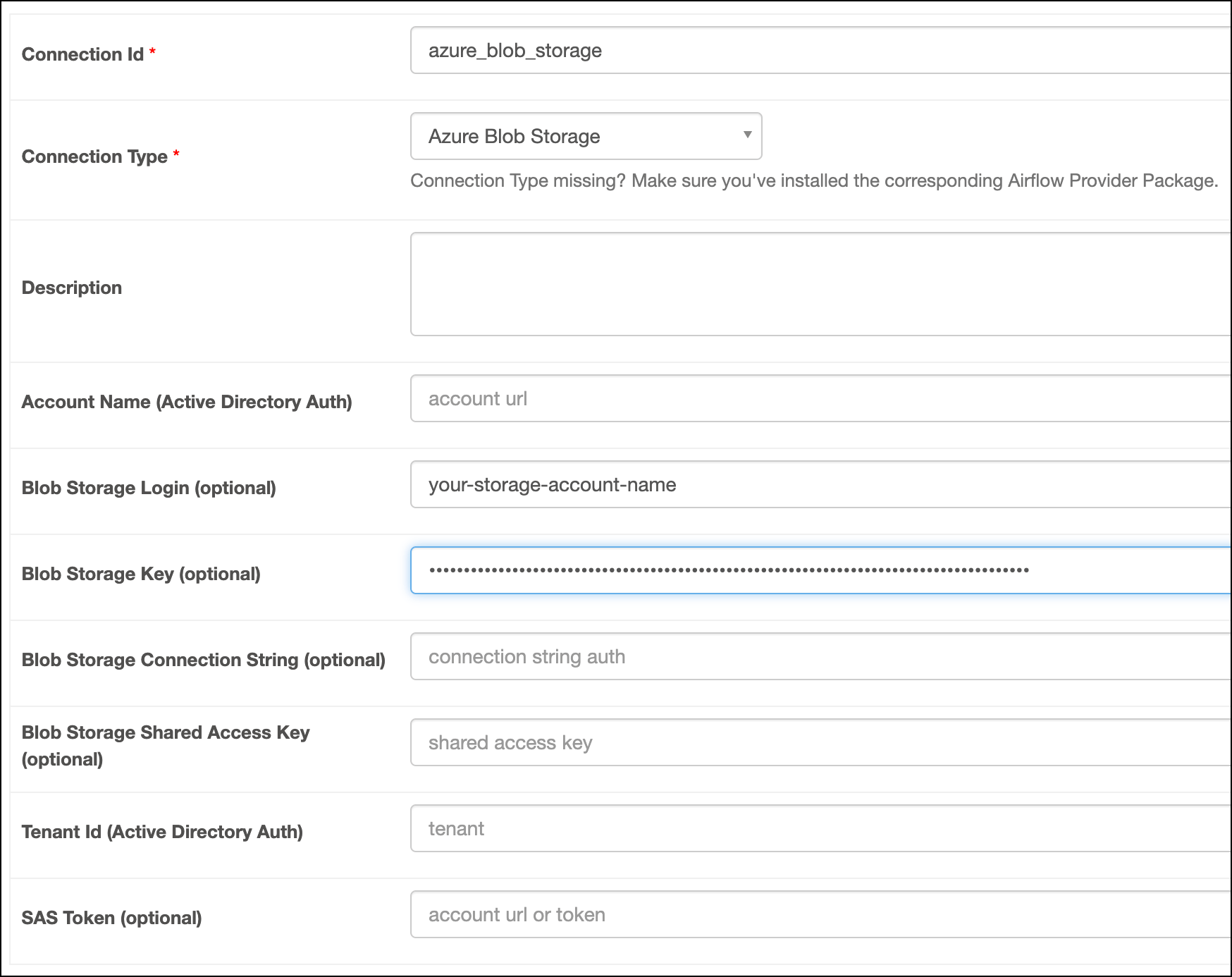
3. In the Airflow UI for your local Airflow environment, go to **Admin** > **Connections**. Click **+** to add a new connection, then choose the **Azure Blob Storage** connection type.
4. Fill out the following connection fields using the information you retrieved from [Get connection details](#get-connection-details):
* **Connection Id**: Enter a name for the connection.
* **Blob Storage Login**: Enter your storage account name.
* **Blob Storage Key**: Enter your storage account **Key**.
5. Click **Test**. After the connection test succeeds, click **Save**.
Connection String
1. Open your Astro project and add the following line to your `requirements.txt` file:
```text wrap theme={null}
apache-airflow-providers-microsoft-azure
```
This installs the Microsoft Azure provider package, which makes the Azure Blob Storage connection type available in Airflow.
2. Run `astro dev restart` to restart your local Airflow environment and apply your changes in `requirements.txt`.
3. In the Airflow UI for your local Airflow environment, go to **Admin** > **Connections**. Click **+** to add a new connection, then choose the **Azure Blob Storage** connection type.
4. Fill out the following connection fields using the information you retrieved from [Get connection details](#get-connection-details):
* **Connection Id**: Enter a name for the connection.
* **Blob Storage Connection String**: Enter your storage account connection string.
5. Click **Test**. After the connection test succeeds, click **Save**.
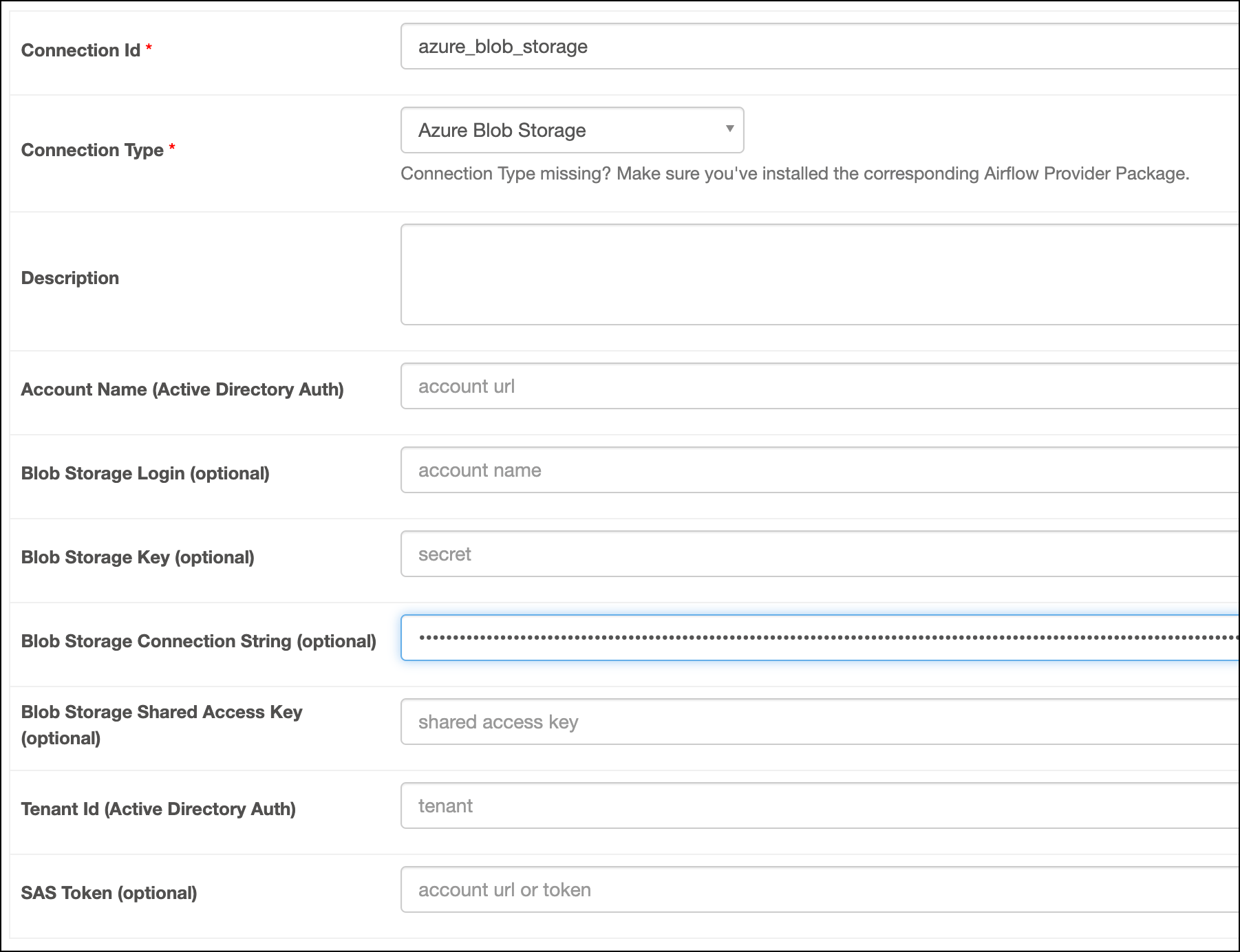 If you want, you can replace the value in **Blob Storage Connection String** with the connection string for an SAS token.
SAS Token
1. Open your Astro project and add the following line to your `requirements.txt` file:
```text wrap theme={null}
apache-airflow-providers-microsoft-azure
```
This installs the Microsoft Azure provider package, which makes the Azure Blob Storage connection type available in Airflow.
2. Run `astro dev restart` to restart your local Airflow environment and apply your changes in `requirements.txt`.
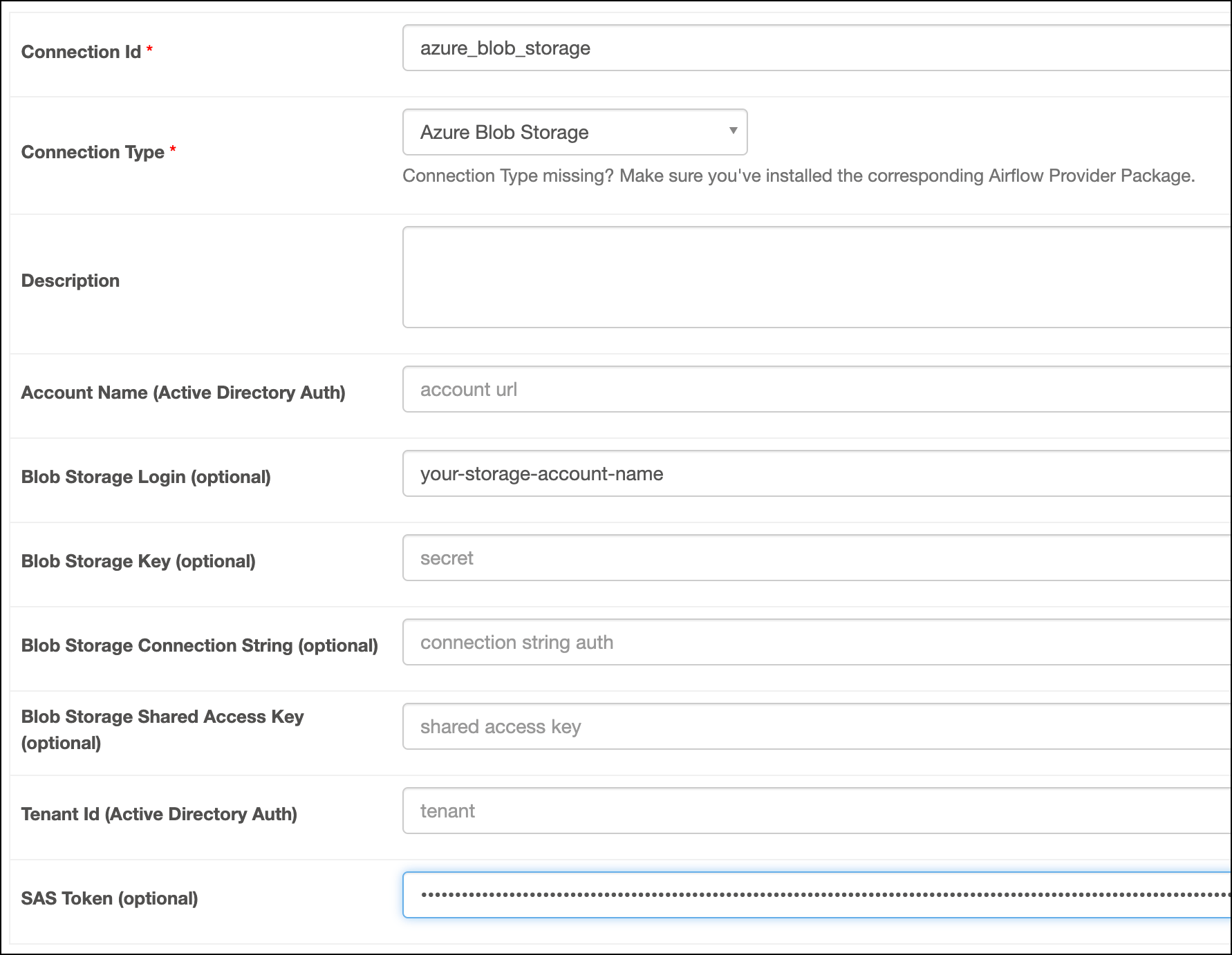
3. In the Airflow UI for your local Airflow environment, go to **Admin** > **Connections**. Click **+** to add a new connection, then choose the **Azure Blob Storage** connection type.
4. Fill out the following connection fields using the information you retrieved from [Get connection details](#get-connection-details):
* **Connection Id**: Enter a name for the connection.
* **Blob Storage Login**: Enter the name of your storage account.
* **SAS Token**: Enter your SAS token.
5. Click **Test**. After the connection test succeeds, click **Save**.
Azure App Service Principal
1. Open your Astro project and add the following line to your `requirements.txt` file:
```text wrap theme={null}
apache-airflow-providers-microsoft-azure
```
This installs the Microsoft Azure provider package, which makes the Azure Blob Storage connection type available in Airflow.
2. Run `astro dev restart` to restart your local Airflow environment and apply your changes in `requirements.txt`.
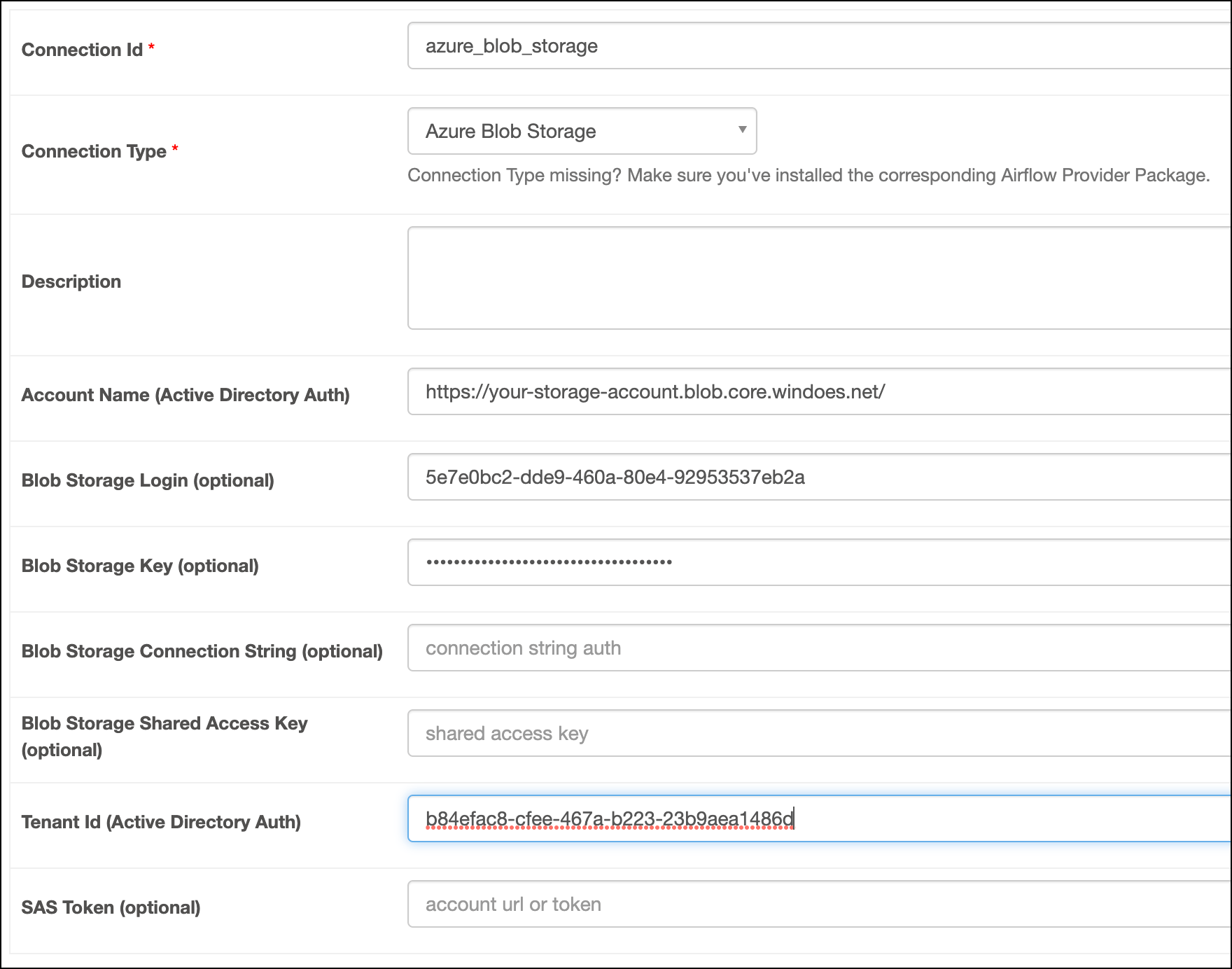
3. In the Airflow UI for your local Airflow environment, go to **Admin** > **Connections**. Click **+** to add a new connection, then choose the **Azure Blob Storage** connection type.
4. Fill out the following connection fields using the information you retrieved from [Get connection details](#get-connection-details):
* **Connection Id**: Enter a name for the connection.
* **Account Name**: Enter **Blob Service URL** for your storage account.
* **Blob Storage Login**: Enter your **Application (client) ID**.
* **Blob Storage Key**: Enter your client secret **Value**.
* **Tenant Id**: Enter your **Directory (tenant) ID**.
5. Click **Test**. After the connection test succeeds, click **Save**.
## How it works
Airflow uses the [Azure SDK for Python](https://github.com/Azure/azure-sdk-for-python) to connect to Azure services through the [`WasbHook`](https://airflow.apache.org/docs/apache-airflow-providers-microsoft-azure/stable/_api/airflow/providers/microsoft/azure/hooks/wasb/index.html).
## See also
* [Apache Airflow Microsoft Azure provider package documentation](https://airflow.apache.org/docs/apache-airflow-providers-microsoft-azure/stable/connections/wasb.html).
* Azure blob storage modules in the [Airflow Registry](https://airflow.apache.org/registry/).
* [Import and export Airflow connections using Astro CLI](/docs/astro/import-export-connections-variables#from-environment-variables).