> ## Documentation Index
> Fetch the complete documentation index at: https://astronomer.io/docs/llms.txt
> Use this file to discover all available pages before exploring further.
# Partitioned Dag runs and asset events in Apache Airflow®
Airflow 3.2 introduced the concept of partitioned Dag runs and partitioned asset events. A partitioned Dag run is a Dag run with a `partition_key` attached to it, and a partitioned asset event is an asset event that has a `partition_key` attached to it. Any string can be a partition key, with time-based partition keys being the most common. Partition keys can be used in tasks in a partitioned Dag run to partition data, for example in a SQL statement.
In this guide, you'll learn:
* When to use partitioned Dag runs and asset events.
* How to create a partitioned Dag run.
* How to create a partitioned asset event.
* How to schedule a Dag based on partitioned asset events.
## Assumed knowledge
To get the most out of this guide, you should have an existing knowledge of:
* Airflow scheduling concepts. See [Schedule Dags in Airflow](/docs/learn/scheduling-in-airflow).
* Basic asset-based scheduling. See [Basic asset-based scheduling in Apache Airflow®](/docs/learn/airflow-datasets).
## When to use partitions
Situations in which you should consider using partitioned Dag runs and asset events are:
* When you want to process data from a specific time period in every Dag run. For example, if you have a Dag that runs once a day and should always process the data from the previous day.
* When you have a Dag that is scheduled based on asset events, within which you want to process data from a specific time period. You can use the `partition_key` to partition the data inside of the downstream Dag run. The `partition_key` propagates from the upstream Dag run to the downstream Dag run, and you can adjust its grain with [partition key mappers](#partition-key-mappers).
* When you want to process data for a specific segment in manual or API-triggered Dag runs. For example, if your Dag generates a report for a specific department, you can set a different `partition_key` for each Dag run in the Trigger Dag run config or the API request body.
## Create a partitioned Dag run
A partitioned Dag run is a Dag run with a `partition_key` attached to it. There are four ways to create a partitioned Dag run:
* By running a Dag manually in the Airflow UI and attaching a `partition_key` in the Trigger Dag run config.
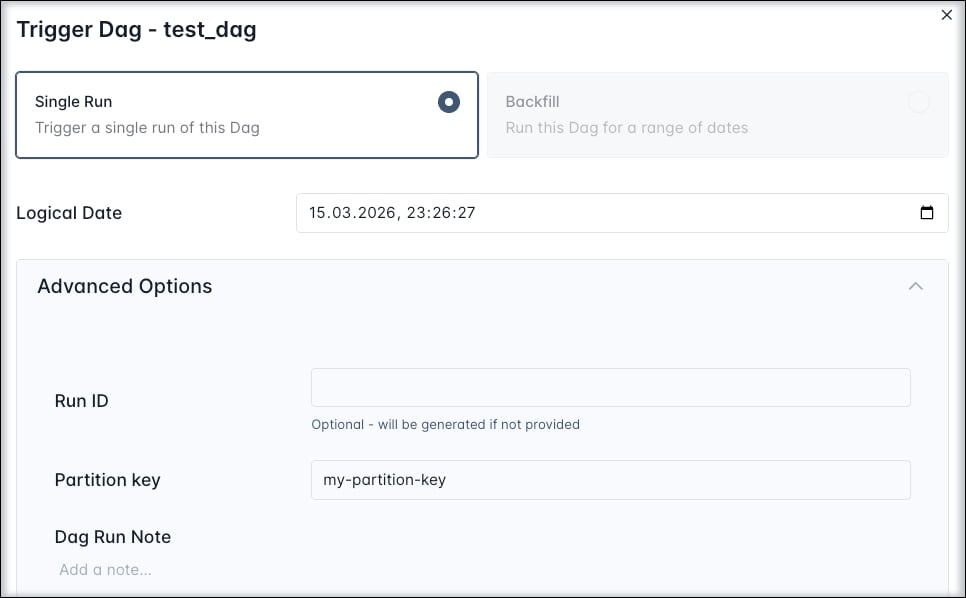 * By running a Dag using the [Airflow REST API](https://airflow.apache.org/docs/apache-airflow/stable/stable-rest-api-ref.html#operation/trigger_dag_run) and attaching a `partition_key` in the request body.
* By fulfilling the asset schedule condition of a Dag that uses the `PartitionedAssetTimetable` timetable.
* By using the `CronPartitionTimetable` timetable. Note that only Dag runs of the type `scheduled` and [`backfill`](/docs/learn/rerunning-dags#backfill) are partitioned, manual runs aren't, unless you are providing a `partition_key` in the Trigger Dag run config.
You can access partition keys from within any task in a partitioned Dag run, see [Access partition keys](#access-partition-keys) for more information.
### CronPartitionTimetable
The `CronPartitionTimetable` is a timetable that creates partitioned Dag runs with an automatic `partition_key` attached that is based on the `run_after` timestamp of each scheduled and backfilled Dag run.
```python wrap theme={null}
from airflow.sdk import CronPartitionTimetable
@dag(
schedule=CronPartitionTimetable("0 0 * * *", timezone="UTC"),
)
```
You can offset the partition key by providing the `run_offset` parameter to the `CronPartitionTimetable` instance. The offset is relative to the cron expression, for example if your Dag runs once every hour, a `run_offset` of `-12` will offset the partition key by 12 hours. The Dag run with the run id `2026-03-16T09:00:00` will have a partition key of `2026-03-15T21:00:00`.
```python wrap theme={null}
@dag(
schedule=CronPartitionTimetable("0 * * * *", timezone="UTC", run_offset=-12),
)
```
## Create a partitioned asset event
A partitioned asset event is an asset event that has a `partition_key` attached to it. There are four ways to create a partitioned asset event:
* By updating an asset manually in the Airflow UI and providing a `partition_key` in the Asset Event creation dialog.
* By running a Dag using the [Airflow REST API](https://airflow.apache.org/docs/apache-airflow/stable/stable-rest-api-ref.html#operation/trigger_dag_run) and attaching a `partition_key` in the request body.
* By fulfilling the asset schedule condition of a Dag that uses the `PartitionedAssetTimetable` timetable.
* By using the `CronPartitionTimetable` timetable. Note that only Dag runs of the type `scheduled` and [`backfill`](/docs/learn/rerunning-dags#backfill) are partitioned, manual runs aren't, unless you are providing a `partition_key` in the Trigger Dag run config.
You can access partition keys from within any task in a partitioned Dag run, see [Access partition keys](#access-partition-keys) for more information.
### CronPartitionTimetable
The `CronPartitionTimetable` is a timetable that creates partitioned Dag runs with an automatic `partition_key` attached that is based on the `run_after` timestamp of each scheduled and backfilled Dag run.
```python wrap theme={null}
from airflow.sdk import CronPartitionTimetable
@dag(
schedule=CronPartitionTimetable("0 0 * * *", timezone="UTC"),
)
```
You can offset the partition key by providing the `run_offset` parameter to the `CronPartitionTimetable` instance. The offset is relative to the cron expression, for example if your Dag runs once every hour, a `run_offset` of `-12` will offset the partition key by 12 hours. The Dag run with the run id `2026-03-16T09:00:00` will have a partition key of `2026-03-15T21:00:00`.
```python wrap theme={null}
@dag(
schedule=CronPartitionTimetable("0 * * * *", timezone="UTC", run_offset=-12),
)
```
## Create a partitioned asset event
A partitioned asset event is an asset event that has a `partition_key` attached to it. There are four ways to create a partitioned asset event:
* By updating an asset manually in the Airflow UI and providing a `partition_key` in the Asset Event creation dialog.
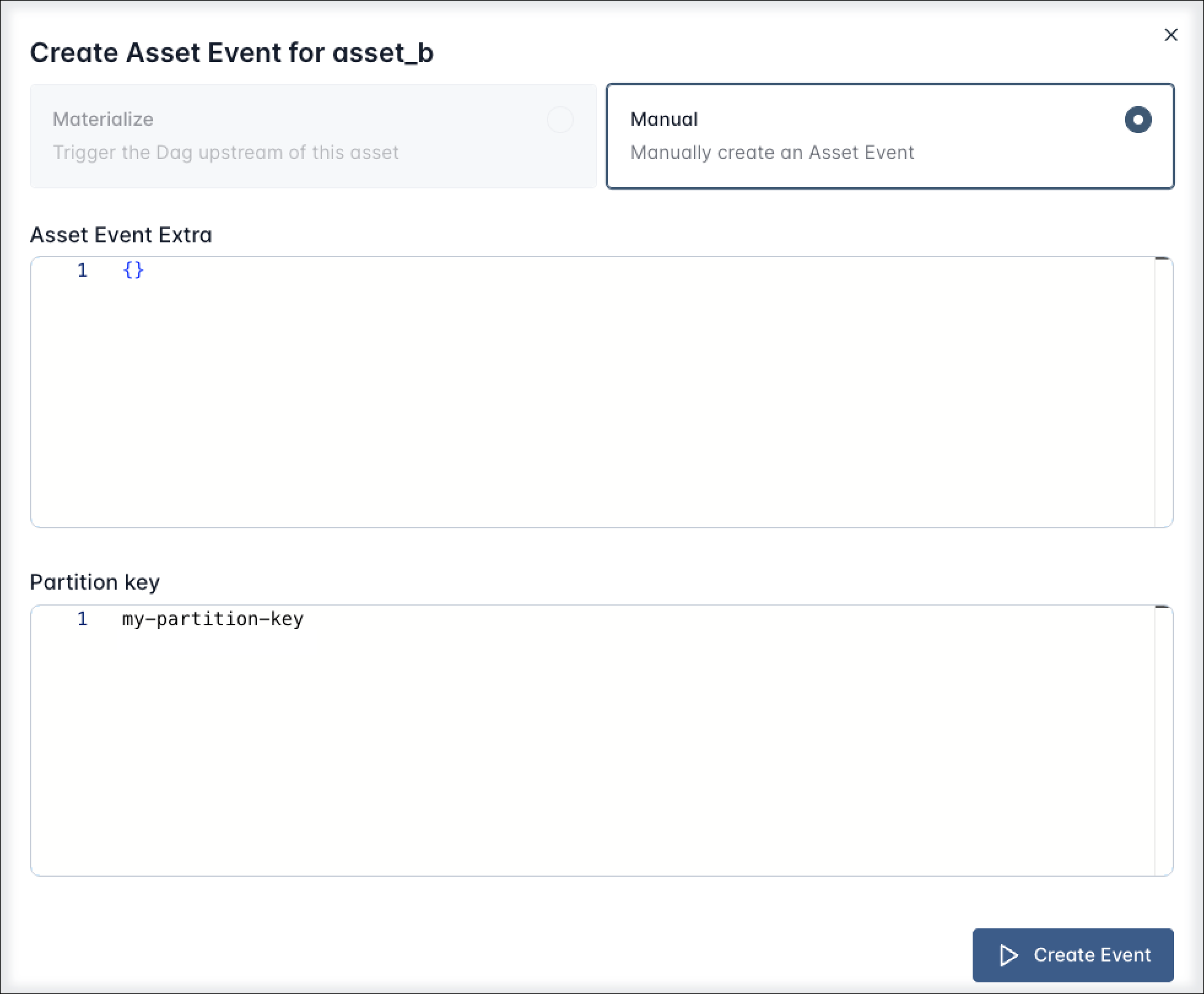 * By updating an asset using the [Airflow REST API](https://airflow.apache.org/docs/apache-airflow/stable/stable-rest-api-ref.html#operation/create_asset_event) and providing a `partition_key` in the request body.
* By updating an asset using the `outlets` parameter of a task in a Dag that is scheduled using a `CronPartitionTimetable` timetable.
* (Airflow 3.3+) By updating an asset using the `outlets` parameter of a task and using the `.add_partitions` method on the asset event object inside the task to add one or more `partition_key` values to the asset event. See [Create partitions in a task](#create-partitions-in-a-task).
Partitioned asset events created by a task in a Dag scheduled with a `CronPartitionTimetable` or by using the `add_partitions` method are intended for partition-aware downstream scheduling, and don't trigger non-partition-aware Dags.
The example below shows a Dag that is scheduled using a `CronPartitionTimetable` timetable. In every *scheduled* or *backfilled* run of this Dag, successful completion of the `my_task_partitioned_upstream` task will create a partitioned asset event for the `my_partitioned_asset` asset. The `partition_key` will be the `run_after` timestamp of the Dag run.
```python wrap theme={null}
from airflow.sdk import dag, task, Asset, CronPartitionTimetable
my_asset = Asset("my_partitioned_asset")
@dag(
schedule=CronPartitionTimetable("0 0 * * *", timezone="UTC"),
)
def my_dag_partitioned_upstream():
@task(outlets=[my_asset])
def my_task_partitioned_upstream(**context):
pass
my_task_partitioned_upstream()
my_dag_partitioned_upstream()
```
### Create partitions in a task
In Airflow 3.3+ you can assign `partition_key` values at runtime from within your task code, using the `.add_partitions` method of the asset event fetched from the Airflow context.
The example Dag below contains one task (`my_task`) that updates one asset `my_partition_at_runtime_asset`, creating 3 asset events at runtime, each with a different partition key. In this example the task chooses 3 random values from the list of departments.
```python expandable wrap theme={null}
import random
from airflow.sdk import (
Asset,
dag,
task
)
data_ready = Asset("my_partition_at_runtime_asset")
DEPARTMENTS = [
"Engineering",
"Product",
"Legal",
"Sales",
"Marketing",
"Finance",
"HR",
"Operations",
]
@dag
def my_partition_at_runtime_dag():
@task(outlets=[data_ready])
def my_task(**context):
context["outlet_events"][data_ready].add_partitions(
random.sample(DEPARTMENTS, 3)
)
my_task()
my_partition_at_runtime_dag()
```
In the **Asset Events** tab of the task instance you can see 3 asset events for the `my_partition_at_runtime_asset` were created, each with a different partition key value.
* By updating an asset using the [Airflow REST API](https://airflow.apache.org/docs/apache-airflow/stable/stable-rest-api-ref.html#operation/create_asset_event) and providing a `partition_key` in the request body.
* By updating an asset using the `outlets` parameter of a task in a Dag that is scheduled using a `CronPartitionTimetable` timetable.
* (Airflow 3.3+) By updating an asset using the `outlets` parameter of a task and using the `.add_partitions` method on the asset event object inside the task to add one or more `partition_key` values to the asset event. See [Create partitions in a task](#create-partitions-in-a-task).
Partitioned asset events created by a task in a Dag scheduled with a `CronPartitionTimetable` or by using the `add_partitions` method are intended for partition-aware downstream scheduling, and don't trigger non-partition-aware Dags.
The example below shows a Dag that is scheduled using a `CronPartitionTimetable` timetable. In every *scheduled* or *backfilled* run of this Dag, successful completion of the `my_task_partitioned_upstream` task will create a partitioned asset event for the `my_partitioned_asset` asset. The `partition_key` will be the `run_after` timestamp of the Dag run.
```python wrap theme={null}
from airflow.sdk import dag, task, Asset, CronPartitionTimetable
my_asset = Asset("my_partitioned_asset")
@dag(
schedule=CronPartitionTimetable("0 0 * * *", timezone="UTC"),
)
def my_dag_partitioned_upstream():
@task(outlets=[my_asset])
def my_task_partitioned_upstream(**context):
pass
my_task_partitioned_upstream()
my_dag_partitioned_upstream()
```
### Create partitions in a task
In Airflow 3.3+ you can assign `partition_key` values at runtime from within your task code, using the `.add_partitions` method of the asset event fetched from the Airflow context.
The example Dag below contains one task (`my_task`) that updates one asset `my_partition_at_runtime_asset`, creating 3 asset events at runtime, each with a different partition key. In this example the task chooses 3 random values from the list of departments.
```python expandable wrap theme={null}
import random
from airflow.sdk import (
Asset,
dag,
task
)
data_ready = Asset("my_partition_at_runtime_asset")
DEPARTMENTS = [
"Engineering",
"Product",
"Legal",
"Sales",
"Marketing",
"Finance",
"HR",
"Operations",
]
@dag
def my_partition_at_runtime_dag():
@task(outlets=[data_ready])
def my_task(**context):
context["outlet_events"][data_ready].add_partitions(
random.sample(DEPARTMENTS, 3)
)
my_task()
my_partition_at_runtime_dag()
```
In the **Asset Events** tab of the task instance you can see 3 asset events for the `my_partition_at_runtime_asset` were created, each with a different partition key value.
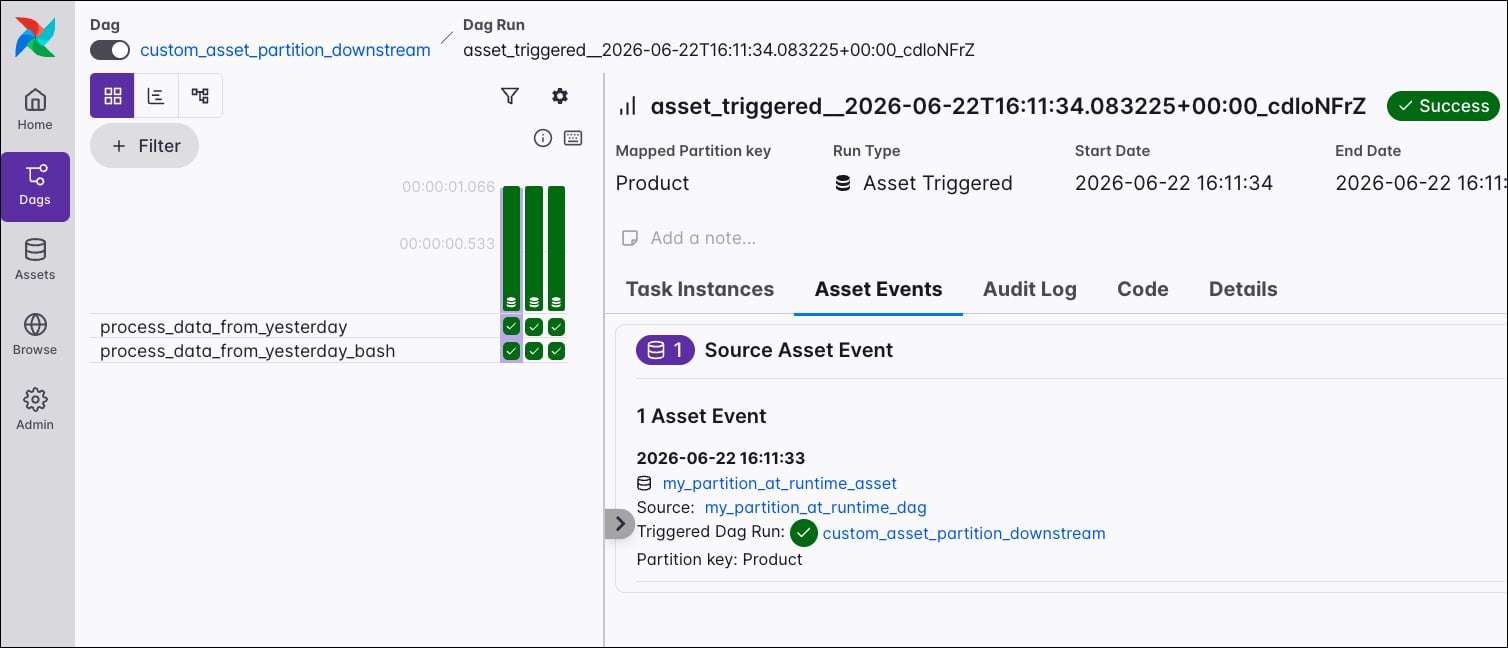
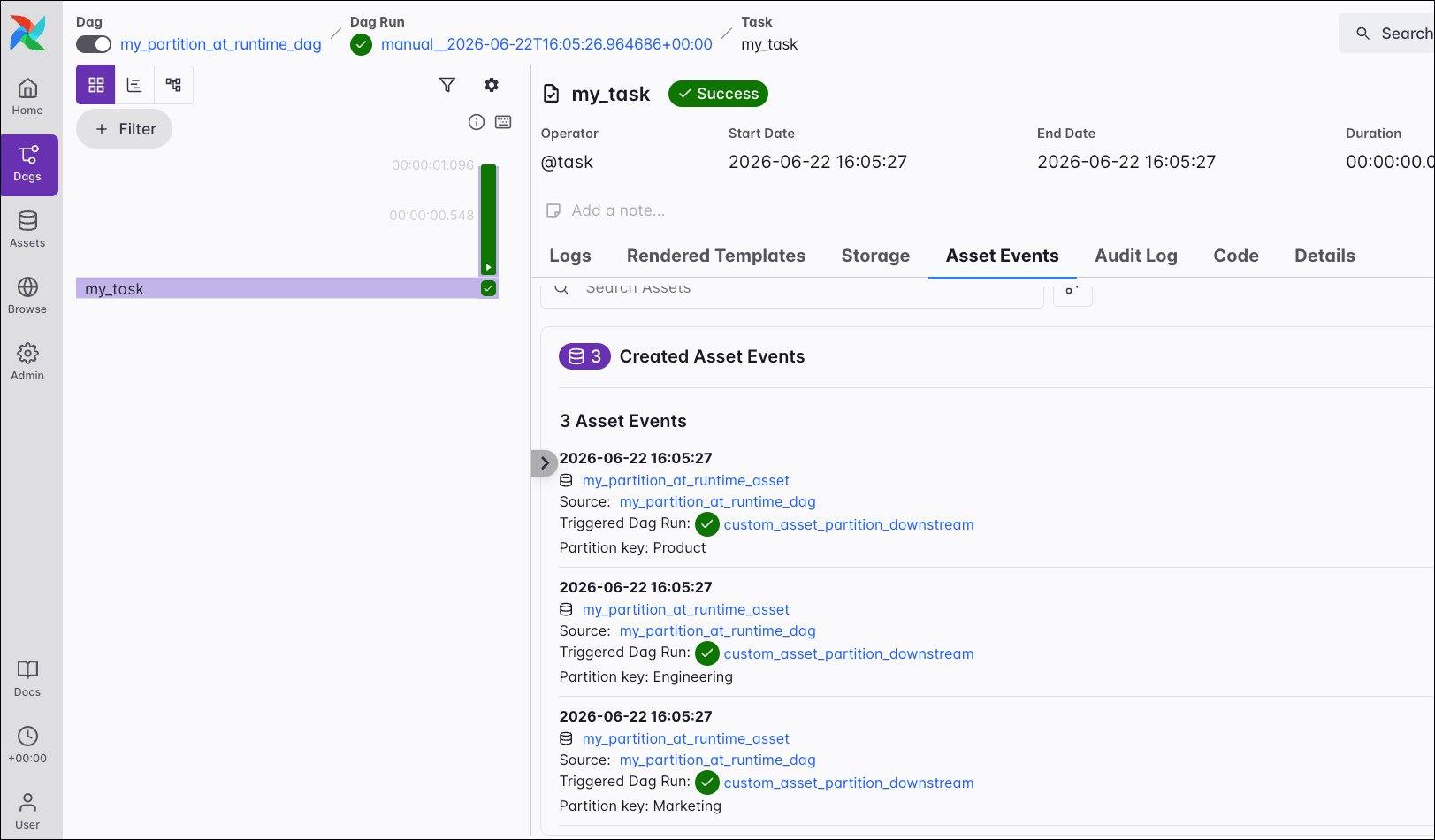 A Dag scheduled to run based on partitioned asset events of the `my_partition_at_runtime_asset` asset will start 3 runs, one for each partition key.
 ## Schedule on a partitioned asset
To schedule a Dag on a partitioned asset, you set its `schedule` parameter to an instance of `PartitionedAssetTimetable`.
```python wrap theme={null}
from airflow.sdk import dag, PartitionedAssetTimetable, Asset
@dag(schedule=PartitionedAssetTimetable(assets=Asset("my_partitioned_asset")))
```
This Dag will run whenever the `my_partitioned_asset` is updated by a *partitioned* asset event. It won't run based on regular asset events produced for the `my_partitioned_asset` asset.
You can modify the grain of the partition key by providing a partition key mapper to the `PartitionedAssetTimetable` instance.
For example, to partition the data by day, you can use the `StartOfDayMapper` to normalize the partition key to the day in the format `YYYY-MM-DD`. See [Partition key mappers](#partition-key-mappers) for more information on the available partition key mappers.
```python wrap theme={null}
from airflow.sdk import dag, PartitionedAssetTimetable, Asset, StartOfDayMapper
my_partitioned_asset = Asset("my_partitioned_asset")
@dag(
schedule=PartitionedAssetTimetable(
assets=my_partitioned_asset,
partition_mapper_config={my_partitioned_asset: StartOfDayMapper()}
)
)
def my_dag():
@task
def my_task(**context):
print(context["dag_run"].partition_key) # will print the partition key in the format `YYYY-MM-DD`
my_task()
my_dag()
```
### Combined partitioned asset schedules
You can combine multiple assets in a single `PartitionedAssetTimetable` instance to create a composite asset schedule using the same logical expressions (AND (`&`) plus OR (`|`)) as when creating a [conditional asset schedule](/docs/learn/airflow-advanced-asset-scheduling#conditional-asset-scheduling) with regular assets.
```python wrap theme={null}
from airflow.sdk import dag, PartitionedAssetTimetable, Asset
my_combined_asset_one = Asset("my_combined_asset_one")
my_combined_asset_two = Asset("my_combined_asset_two")
@dag(
schedule=(
PartitionedAssetTimetable(assets=(my_combined_asset_one & my_combined_asset_two))
)
)
def my_combined_partitioned_asset_dag():
@task
def my_task(**context):
partition_key = context["dag_run"].partition_key
print(partition_key)
my_task()
my_combined_partitioned_asset_dag()
```
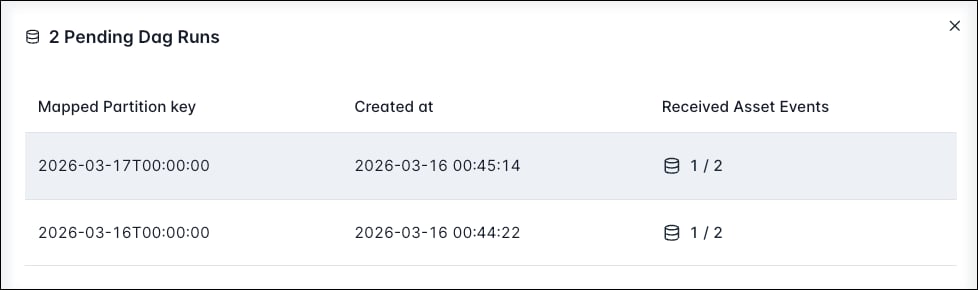
If one of the assets is updated with a partitioned asset event, a pending run of this Dag will be created. Pending runs are visible in the Airflow UI by clicking on its schedule.
## Schedule on a partitioned asset
To schedule a Dag on a partitioned asset, you set its `schedule` parameter to an instance of `PartitionedAssetTimetable`.
```python wrap theme={null}
from airflow.sdk import dag, PartitionedAssetTimetable, Asset
@dag(schedule=PartitionedAssetTimetable(assets=Asset("my_partitioned_asset")))
```
This Dag will run whenever the `my_partitioned_asset` is updated by a *partitioned* asset event. It won't run based on regular asset events produced for the `my_partitioned_asset` asset.
You can modify the grain of the partition key by providing a partition key mapper to the `PartitionedAssetTimetable` instance.
For example, to partition the data by day, you can use the `StartOfDayMapper` to normalize the partition key to the day in the format `YYYY-MM-DD`. See [Partition key mappers](#partition-key-mappers) for more information on the available partition key mappers.
```python wrap theme={null}
from airflow.sdk import dag, PartitionedAssetTimetable, Asset, StartOfDayMapper
my_partitioned_asset = Asset("my_partitioned_asset")
@dag(
schedule=PartitionedAssetTimetable(
assets=my_partitioned_asset,
partition_mapper_config={my_partitioned_asset: StartOfDayMapper()}
)
)
def my_dag():
@task
def my_task(**context):
print(context["dag_run"].partition_key) # will print the partition key in the format `YYYY-MM-DD`
my_task()
my_dag()
```
### Combined partitioned asset schedules
You can combine multiple assets in a single `PartitionedAssetTimetable` instance to create a composite asset schedule using the same logical expressions (AND (`&`) plus OR (`|`)) as when creating a [conditional asset schedule](/docs/learn/airflow-advanced-asset-scheduling#conditional-asset-scheduling) with regular assets.
```python wrap theme={null}
from airflow.sdk import dag, PartitionedAssetTimetable, Asset
my_combined_asset_one = Asset("my_combined_asset_one")
my_combined_asset_two = Asset("my_combined_asset_two")
@dag(
schedule=(
PartitionedAssetTimetable(assets=(my_combined_asset_one & my_combined_asset_two))
)
)
def my_combined_partitioned_asset_dag():
@task
def my_task(**context):
partition_key = context["dag_run"].partition_key
print(partition_key)
my_task()
my_combined_partitioned_asset_dag()
```
If one of the assets is updated with a partitioned asset event, a pending run of this Dag will be created. Pending runs are visible in the Airflow UI by clicking on its schedule.
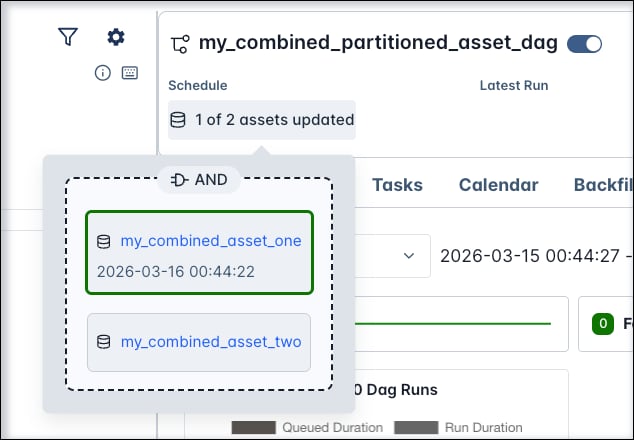 If several assets have been updated with a partitioned asset event of different partition keys, several pending runs are created, each with a different partition key. Each pending run has a visualization of which assets have been updated for that specific partition key and which assets are still pending.
 A run of this Dag is only triggered when both `my_combined_asset_one` and `my_combined_asset_two` are updated with a partitioned asset event sharing the *same* partition key. Note that queued partitioned asset events for other partition keys are *not* reset by this.
You can use different partition key mappers for each asset in the `PartitionedAssetTimetable`, see [Partition key mappers](#partition-key-mappers).
## Partition keys
Partition keys are strings attached to partitioned Dag runs and asset events. You can use them in tasks in a partitioned Dag run to partition data, for example in a SQL statement.
### Access partition keys
The `partition_key` can be accessed inside any task in a partitioned Dag run from within the [Airflow context](/docs/learn/airflow-context) or by using [Jinja templating](/docs/learn/templating).
```python wrap theme={null}
# from airflow.sdk import task
# from airflow.providers.standard.operators.bash import BashOperator
@task
def print_partition_key(**context):
print(context["partition_key"])
BashOperator(
task_id="print_partition_key",
bash_command="echo {{ partition_key }}",
)
```
One of the most common use cases is to use the partition key in a SQL statement to partition the data used in a specific Dag run. For example, in a Dag that runs once a day, you can use the partition key to select the data for the previous day.
```python wrap theme={null}
from airflow.providers.common.sql.operators.sql import SQLExecuteQueryOperator
SQLExecuteQueryOperator(
task_id="execute_query",
conn_id="my_snowflake_conn",
sql="""
SELECT * FROM my_table
WHERE
my_timestamp >= DATEADD(day, -1, '{{ partition_key }}'::DATE)
AND my_timestamp < '{{ partition_key }}'::DATE
;""",
)
```
In Airflow 3.3+ you can also directly access `partition_date` in partitioned Dag runs to format the date directly, for example with `ds` to convert the full key into `yyyy-mm-dd` format.
```python wrap theme={null}
from airflow.providers.common.sql.operators.sql import SQLExecuteQueryOperator
SQLExecuteQueryOperator(
task_id="execute_query",
conn_id="my_snowflake_conn",
sql="""
SELECT * FROM my_table
WHERE
my_timestamp >= DATEADD(day, -1, '{{ partition_date | ds }}')
AND my_timestamp < '{{ partition_date | ds }}'
;""",
)
```
## Partition key mappers
Partition key mappers are used to modify the partition key of a Dag run. You can use them to change the grain of the partition key, to map composite keys segment by segment, to create one-to-many or many-to-one patterns, or to validate that keys are in a fixed allow-list.
### One-to-one mappers
The following one-to-one partition key mappers are available:
* `IdentityMapper`: keeps keys unchanged. Default mapper.
* Temporal mappers change the grain of the partition key:
* `StartOfHourMapper`: normalizes time keys to the hour in the format `YYYY-MM-DDTHH`, for example the partition key `2026-03-16T09:37:51` is mapped to `2026-03-16T09`.
* `StartOfDayMapper`: normalizes time keys to the day in the format `YYYY-MM-DD` (`2026-03-16T09:37:51` -> `2026-03-16`)
* `StartOfWeekMapper`: normalizes time keys to the week in the format `YYYY-MM-DD (W%V)` (`2026-03-16T09:37:51` -> `2026-03-16 (W12)`)
* `StartOfMonthMapper`: normalizes time keys to the month in the format `YYYY-MM` (`2026-03-16T09:37:51` -> `2026-03`)
* `StartOfQuarterMapper`: normalizes time keys to the quarter in the format `YYYY-Q` (`2026-03-16T09:37:51` -> `2026-Q1`). The quarters are based on the calendar year, Q1 starts in January, Q2 in April, Q3 in July, and Q4 in October.
* `StartOfYearMapper`: normalizes time keys to the year in the format `YYYY` (`2026-03-16T09:37:51` -> `2026`).
* `ProductMapper`: maps composite keys segment by segment, applying one mapper per segment and then rejoining the mapped segments. For example, with the key `Finance|2026-03-16T09:00:00`, `ProductMapper(IdentityMapper(), StartOfDayMapper())` produces `Finance|2026-03-16`. See [Composite partition keys](#composite-partition-keys).
* `AllowedKeyMapper`: validates that keys are in a fixed allow-list and passes the key through unchanged if valid. For example, `AllowedKeyMapper(["Marketing", "Finance", "Sales"])` accepts only those department keys and rejects all others.
You can also change the default partition key mapper for all assets in the `PartitionedAssetTimetable` by providing a `default_partition_mapper` parameter.
```python wrap theme={null}
from airflow.sdk import dag, PartitionedAssetTimetable, Asset, StartOfDayMapper
@dag(
schedule=PartitionedAssetTimetable(
assets=Asset("my_partitioned_asset"),
default_partition_mapper=StartOfDayMapper(),
)
)
```
To override the default partition key mapper for a specific asset, you can set the `partition_mapper_config` parameter of the `PartitionedAssetTimetable` instance to a dictionary of asset instances and partition key mappers.
```python wrap theme={null}
from airflow.sdk import dag, PartitionedAssetTimetable, Asset, StartOfDayMapper, StartOfWeekMapper
@dag(
schedule=PartitionedAssetTimetable(
assets=Asset("my_partitioned_asset"),
default_partition_mapper=StartOfDayMapper(),
partition_mapper_config={
Asset("my_partitioned_asset"): StartOfWeekMapper(),
},
)
)
```
You can use different partition key mappers for each asset in the `PartitionedAssetTimetable`.
```python wrap theme={null}
from airflow.sdk import dag, PartitionedAssetTimetable, Asset, StartOfQuarterMapper, StartOfWeekMapper
@dag(
schedule=PartitionedAssetTimetable(
assets=(my_combined_asset_one & my_combined_asset_two),
partition_mapper_config={
my_combined_asset_one: StartOfQuarterMapper(),
my_combined_asset_two: StartOfWeekMapper(),
},
)
)
```
When chaining several Dags with a partitioned asset schedule, the partition key mappers need to be identical for all Dags after the first one in the chain. For example a Dag which uses a `StartOfDayMapper` will fail the task producing to the next asset in the chain if the next Dag in the chain uses a `StartOfWeekMapper`.
### Composite partition keys
Composite partition keys are partition keys that are composed of multiple segments, separated by `|` delimiters. For example, the partition key `Finance|2026-03-16T09:00:00|Revenue` is a composite partition key with three segments: `Finance`, `2026-03-16T09:00:00`, and `Revenue`.
You can use the `ProductMapper` partition key mapper to map composite keys segment by segment, applying one mapper per segment and then rejoining the mapped segments. For example, with the key `Finance|2026-03-16T09:00:00`, `ProductMapper(IdentityMapper(), StartOfDayMapper())` produces `Finance|2026-03-16`.
```python wrap theme={null}
from airflow.sdk import dag, task, PartitionedAssetTimetable, Asset, ProductMapper, IdentityMapper, StartOfDayMapper, AllowedKeyMapper
@dag(
schedule=PartitionedAssetTimetable(
assets=Asset("my_partitioned_asset"),
partition_mapper_config={
Asset("my_partitioned_asset"): ProductMapper(IdentityMapper(), StartOfDayMapper(), AllowedKeyMapper(["Revenue", "ARR"])),
},
)
)
def my_composite_dag():
@task
def my_task(**context):
partition_key = context["dag_run"].partition_key
print(partition_key) # prints the partition key in the format `Finance|2026-03-16|Revenue`
my_task()
my_composite_dag()
```
The given composite partition key needs to match the number of segments in the `ProductMapper` instance and needs to be valid for all mappers in the `ProductMapper` instance in order to trigger a Dag run. Invalid composite partition keys cause an error.
### One-to-many: `FanOutMapper`
The `FanOutMapper`, introduced in Airflow 3.3, creates multiple downstream Dag runs based on one partitioned asset event.
The `FanOutMapper` uses an `upstream_mapper` to normalize the upstream key to its period start, a `window` instance that enumerates the elements in that period, and an optional `downstream_mapper` to format each element.
The available windows are `HourWindow`, `DayWindow`, `WeekWindow`, `MonthWindow`, `QuarterWindow`, and `YearWindow`. Each window provides a default `downstream_mapper`, except `HourWindow` and custom windows, for which you need to set a `downstream_mapper` explicitly.
For example, if your asset `my_asset` gets updated once a day and you'd like to create 24 Dag runs, each Dag run processing the data for one hour in the day, you can use the `FanOutMapper` with the `upstream_mapper=StartOfDayMapper()`, which normalizes the often irregular partition key (for example: `2026-06-22T03:19:23`) to the start of the day (`2026-06-22`) and then use the `DayWindow` to fan out to create a set of 24 Dag runs, with hourly partition keys (`2026-06-22T00`, `2026-06-22T01`, ..., `2026-06-22T23`).
```python wrap theme={null}
from airflow.sdk import dag, PartitionedAssetTimetable, Asset, FanOutMapper, StartOfDayMapper, DayWindow
@dag(
schedule=PartitionedAssetTimetable(
assets=Asset("my_asset"),
default_partition_mapper=FanOutMapper(
upstream_mapper=StartOfDayMapper(),
window=DayWindow(),
),
)
)
```
By default the maximum number of partitions a `FanOutMapper` can create is `1000`. You can adjust this setting for your entire Airflow instance with the [`AIRFLOW__SCHEDULER__PARTITION_MAPPER_MAX_DOWNSTREAM_KEYS`](http://apache-airflow-docs.s3-website.eu-central-1.amazonaws.com/docs/apache-airflow/stable/configurations-ref.html#partition-mapper-max-downstream-keys) configuration variable, and override it for individual `FanOutMapper` instances with the `max_downstream_keys` parameter. If the number of partitioned Dag runs that would be created by a partitioned asset event exceed `max_downstream_keys`, *no* Dag runs are created for that partitioned asset event and the audit logs of the *upstream* Dag log a `partition fan-out exceeded` event.
### Many-to-one: `RollupMapper`
The `RollupMapper`, introduced in Airflow 3.3, is the inverse of the `FanOutMapper`. It maps multiple upstream partition keys to one downstream partition key, creating a single downstream Dag run once all expected upstream keys have arrived. It takes an `upstream_mapper` to normalize each upstream key to the downstream grain and a `window` instance that declares the full set of upstream keys required for a given downstream key.
For example, if `my_asset` gets updated every hour and you want a downstream Dag to run as soon as all 24 partitions for a day have been updated, you can use the `RollupMapper` with the `StartOfDayMapper` as `upstream_mapper` and the `DayWindow` as the `window`.
```python wrap theme={null}
from airflow.sdk import dag, PartitionedAssetTimetable, Asset, RollupMapper, StartOfDayMapper, DayWindow
@dag(
schedule=PartitionedAssetTimetable(
assets=Asset("my_partitioned_asset"),
default_partition_mapper=RollupMapper(
upstream_mapper=StartOfDayMapper(),
window=DayWindow(),
),
)
)
```
The Airflow UI displays how many and which of the partitions have arrived.
A run of this Dag is only triggered when both `my_combined_asset_one` and `my_combined_asset_two` are updated with a partitioned asset event sharing the *same* partition key. Note that queued partitioned asset events for other partition keys are *not* reset by this.
You can use different partition key mappers for each asset in the `PartitionedAssetTimetable`, see [Partition key mappers](#partition-key-mappers).
## Partition keys
Partition keys are strings attached to partitioned Dag runs and asset events. You can use them in tasks in a partitioned Dag run to partition data, for example in a SQL statement.
### Access partition keys
The `partition_key` can be accessed inside any task in a partitioned Dag run from within the [Airflow context](/docs/learn/airflow-context) or by using [Jinja templating](/docs/learn/templating).
```python wrap theme={null}
# from airflow.sdk import task
# from airflow.providers.standard.operators.bash import BashOperator
@task
def print_partition_key(**context):
print(context["partition_key"])
BashOperator(
task_id="print_partition_key",
bash_command="echo {{ partition_key }}",
)
```
One of the most common use cases is to use the partition key in a SQL statement to partition the data used in a specific Dag run. For example, in a Dag that runs once a day, you can use the partition key to select the data for the previous day.
```python wrap theme={null}
from airflow.providers.common.sql.operators.sql import SQLExecuteQueryOperator
SQLExecuteQueryOperator(
task_id="execute_query",
conn_id="my_snowflake_conn",
sql="""
SELECT * FROM my_table
WHERE
my_timestamp >= DATEADD(day, -1, '{{ partition_key }}'::DATE)
AND my_timestamp < '{{ partition_key }}'::DATE
;""",
)
```
In Airflow 3.3+ you can also directly access `partition_date` in partitioned Dag runs to format the date directly, for example with `ds` to convert the full key into `yyyy-mm-dd` format.
```python wrap theme={null}
from airflow.providers.common.sql.operators.sql import SQLExecuteQueryOperator
SQLExecuteQueryOperator(
task_id="execute_query",
conn_id="my_snowflake_conn",
sql="""
SELECT * FROM my_table
WHERE
my_timestamp >= DATEADD(day, -1, '{{ partition_date | ds }}')
AND my_timestamp < '{{ partition_date | ds }}'
;""",
)
```
## Partition key mappers
Partition key mappers are used to modify the partition key of a Dag run. You can use them to change the grain of the partition key, to map composite keys segment by segment, to create one-to-many or many-to-one patterns, or to validate that keys are in a fixed allow-list.
### One-to-one mappers
The following one-to-one partition key mappers are available:
* `IdentityMapper`: keeps keys unchanged. Default mapper.
* Temporal mappers change the grain of the partition key:
* `StartOfHourMapper`: normalizes time keys to the hour in the format `YYYY-MM-DDTHH`, for example the partition key `2026-03-16T09:37:51` is mapped to `2026-03-16T09`.
* `StartOfDayMapper`: normalizes time keys to the day in the format `YYYY-MM-DD` (`2026-03-16T09:37:51` -> `2026-03-16`)
* `StartOfWeekMapper`: normalizes time keys to the week in the format `YYYY-MM-DD (W%V)` (`2026-03-16T09:37:51` -> `2026-03-16 (W12)`)
* `StartOfMonthMapper`: normalizes time keys to the month in the format `YYYY-MM` (`2026-03-16T09:37:51` -> `2026-03`)
* `StartOfQuarterMapper`: normalizes time keys to the quarter in the format `YYYY-Q` (`2026-03-16T09:37:51` -> `2026-Q1`). The quarters are based on the calendar year, Q1 starts in January, Q2 in April, Q3 in July, and Q4 in October.
* `StartOfYearMapper`: normalizes time keys to the year in the format `YYYY` (`2026-03-16T09:37:51` -> `2026`).
* `ProductMapper`: maps composite keys segment by segment, applying one mapper per segment and then rejoining the mapped segments. For example, with the key `Finance|2026-03-16T09:00:00`, `ProductMapper(IdentityMapper(), StartOfDayMapper())` produces `Finance|2026-03-16`. See [Composite partition keys](#composite-partition-keys).
* `AllowedKeyMapper`: validates that keys are in a fixed allow-list and passes the key through unchanged if valid. For example, `AllowedKeyMapper(["Marketing", "Finance", "Sales"])` accepts only those department keys and rejects all others.
You can also change the default partition key mapper for all assets in the `PartitionedAssetTimetable` by providing a `default_partition_mapper` parameter.
```python wrap theme={null}
from airflow.sdk import dag, PartitionedAssetTimetable, Asset, StartOfDayMapper
@dag(
schedule=PartitionedAssetTimetable(
assets=Asset("my_partitioned_asset"),
default_partition_mapper=StartOfDayMapper(),
)
)
```
To override the default partition key mapper for a specific asset, you can set the `partition_mapper_config` parameter of the `PartitionedAssetTimetable` instance to a dictionary of asset instances and partition key mappers.
```python wrap theme={null}
from airflow.sdk import dag, PartitionedAssetTimetable, Asset, StartOfDayMapper, StartOfWeekMapper
@dag(
schedule=PartitionedAssetTimetable(
assets=Asset("my_partitioned_asset"),
default_partition_mapper=StartOfDayMapper(),
partition_mapper_config={
Asset("my_partitioned_asset"): StartOfWeekMapper(),
},
)
)
```
You can use different partition key mappers for each asset in the `PartitionedAssetTimetable`.
```python wrap theme={null}
from airflow.sdk import dag, PartitionedAssetTimetable, Asset, StartOfQuarterMapper, StartOfWeekMapper
@dag(
schedule=PartitionedAssetTimetable(
assets=(my_combined_asset_one & my_combined_asset_two),
partition_mapper_config={
my_combined_asset_one: StartOfQuarterMapper(),
my_combined_asset_two: StartOfWeekMapper(),
},
)
)
```
When chaining several Dags with a partitioned asset schedule, the partition key mappers need to be identical for all Dags after the first one in the chain. For example a Dag which uses a `StartOfDayMapper` will fail the task producing to the next asset in the chain if the next Dag in the chain uses a `StartOfWeekMapper`.
### Composite partition keys
Composite partition keys are partition keys that are composed of multiple segments, separated by `|` delimiters. For example, the partition key `Finance|2026-03-16T09:00:00|Revenue` is a composite partition key with three segments: `Finance`, `2026-03-16T09:00:00`, and `Revenue`.
You can use the `ProductMapper` partition key mapper to map composite keys segment by segment, applying one mapper per segment and then rejoining the mapped segments. For example, with the key `Finance|2026-03-16T09:00:00`, `ProductMapper(IdentityMapper(), StartOfDayMapper())` produces `Finance|2026-03-16`.
```python wrap theme={null}
from airflow.sdk import dag, task, PartitionedAssetTimetable, Asset, ProductMapper, IdentityMapper, StartOfDayMapper, AllowedKeyMapper
@dag(
schedule=PartitionedAssetTimetable(
assets=Asset("my_partitioned_asset"),
partition_mapper_config={
Asset("my_partitioned_asset"): ProductMapper(IdentityMapper(), StartOfDayMapper(), AllowedKeyMapper(["Revenue", "ARR"])),
},
)
)
def my_composite_dag():
@task
def my_task(**context):
partition_key = context["dag_run"].partition_key
print(partition_key) # prints the partition key in the format `Finance|2026-03-16|Revenue`
my_task()
my_composite_dag()
```
The given composite partition key needs to match the number of segments in the `ProductMapper` instance and needs to be valid for all mappers in the `ProductMapper` instance in order to trigger a Dag run. Invalid composite partition keys cause an error.
### One-to-many: `FanOutMapper`
The `FanOutMapper`, introduced in Airflow 3.3, creates multiple downstream Dag runs based on one partitioned asset event.
The `FanOutMapper` uses an `upstream_mapper` to normalize the upstream key to its period start, a `window` instance that enumerates the elements in that period, and an optional `downstream_mapper` to format each element.
The available windows are `HourWindow`, `DayWindow`, `WeekWindow`, `MonthWindow`, `QuarterWindow`, and `YearWindow`. Each window provides a default `downstream_mapper`, except `HourWindow` and custom windows, for which you need to set a `downstream_mapper` explicitly.
For example, if your asset `my_asset` gets updated once a day and you'd like to create 24 Dag runs, each Dag run processing the data for one hour in the day, you can use the `FanOutMapper` with the `upstream_mapper=StartOfDayMapper()`, which normalizes the often irregular partition key (for example: `2026-06-22T03:19:23`) to the start of the day (`2026-06-22`) and then use the `DayWindow` to fan out to create a set of 24 Dag runs, with hourly partition keys (`2026-06-22T00`, `2026-06-22T01`, ..., `2026-06-22T23`).
```python wrap theme={null}
from airflow.sdk import dag, PartitionedAssetTimetable, Asset, FanOutMapper, StartOfDayMapper, DayWindow
@dag(
schedule=PartitionedAssetTimetable(
assets=Asset("my_asset"),
default_partition_mapper=FanOutMapper(
upstream_mapper=StartOfDayMapper(),
window=DayWindow(),
),
)
)
```
By default the maximum number of partitions a `FanOutMapper` can create is `1000`. You can adjust this setting for your entire Airflow instance with the [`AIRFLOW__SCHEDULER__PARTITION_MAPPER_MAX_DOWNSTREAM_KEYS`](http://apache-airflow-docs.s3-website.eu-central-1.amazonaws.com/docs/apache-airflow/stable/configurations-ref.html#partition-mapper-max-downstream-keys) configuration variable, and override it for individual `FanOutMapper` instances with the `max_downstream_keys` parameter. If the number of partitioned Dag runs that would be created by a partitioned asset event exceed `max_downstream_keys`, *no* Dag runs are created for that partitioned asset event and the audit logs of the *upstream* Dag log a `partition fan-out exceeded` event.
### Many-to-one: `RollupMapper`
The `RollupMapper`, introduced in Airflow 3.3, is the inverse of the `FanOutMapper`. It maps multiple upstream partition keys to one downstream partition key, creating a single downstream Dag run once all expected upstream keys have arrived. It takes an `upstream_mapper` to normalize each upstream key to the downstream grain and a `window` instance that declares the full set of upstream keys required for a given downstream key.
For example, if `my_asset` gets updated every hour and you want a downstream Dag to run as soon as all 24 partitions for a day have been updated, you can use the `RollupMapper` with the `StartOfDayMapper` as `upstream_mapper` and the `DayWindow` as the `window`.
```python wrap theme={null}
from airflow.sdk import dag, PartitionedAssetTimetable, Asset, RollupMapper, StartOfDayMapper, DayWindow
@dag(
schedule=PartitionedAssetTimetable(
assets=Asset("my_partitioned_asset"),
default_partition_mapper=RollupMapper(
upstream_mapper=StartOfDayMapper(),
window=DayWindow(),
),
)
)
```
The Airflow UI displays how many and which of the partitions have arrived.
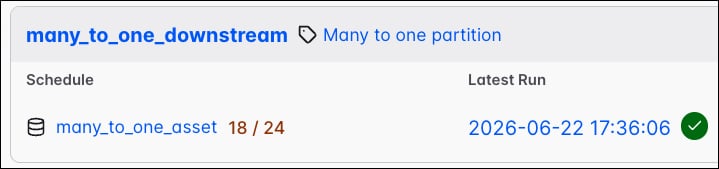 By default the downstream Dag waits for all keys in the window to arrive. This is the `wait_policy=WaitForAll()`. You can also set `wait_policy=MinimumCount(n=5)`, which means the downstream Dag runs as soon as 5 partition keys for the window have arrived.
#### `SegmentWindow`
The `RollupMapper` also supports categorical rollups, where a fixed set of string segment keys roll up into one downstream partition key. Pair a `FixedKeyMapper`, which collapses every upstream key onto one fixed downstream key, with a `SegmentWindow`, which declares the set of segment keys that make up the downstream partition. The downstream Dag run is triggered once every segment key in the window has arrived. For example, in the code sample below, the `Legal` and `Sales` segment keys roll up into one `legal_and_sales` downstream Dag run.
```python wrap theme={null}
from airflow.sdk import dag, PartitionedAssetTimetable, Asset, RollupMapper, FixedKeyMapper, SegmentWindow
@dag(
schedule=PartitionedAssetTimetable(
assets=Asset("my_partitioned_asset"),
default_partition_mapper=RollupMapper(
upstream_mapper=FixedKeyMapper("legal_and_sales"),
window=SegmentWindow(["Legal", "Sales"]),
),
)
)
```
By default the downstream Dag waits for all keys in the window to arrive. This is the `wait_policy=WaitForAll()`. You can also set `wait_policy=MinimumCount(n=5)`, which means the downstream Dag runs as soon as 5 partition keys for the window have arrived.
#### `SegmentWindow`
The `RollupMapper` also supports categorical rollups, where a fixed set of string segment keys roll up into one downstream partition key. Pair a `FixedKeyMapper`, which collapses every upstream key onto one fixed downstream key, with a `SegmentWindow`, which declares the set of segment keys that make up the downstream partition. The downstream Dag run is triggered once every segment key in the window has arrived. For example, in the code sample below, the `Legal` and `Sales` segment keys roll up into one `legal_and_sales` downstream Dag run.
```python wrap theme={null}
from airflow.sdk import dag, PartitionedAssetTimetable, Asset, RollupMapper, FixedKeyMapper, SegmentWindow
@dag(
schedule=PartitionedAssetTimetable(
assets=Asset("my_partitioned_asset"),
default_partition_mapper=RollupMapper(
upstream_mapper=FixedKeyMapper("legal_and_sales"),
window=SegmentWindow(["Legal", "Sales"]),
),
)
)
```