> ## Documentation Index
> Fetch the complete documentation index at: https://astronomer.io/docs/llms.txt
> Use this file to discover all available pages before exploring further.
# Use Cohere and OpenSearch to analyze customer feedback in an MLOps pipeline
With recent advances in the field of Large Language Model Operations (LLMOps), you can now combine the power of different language models to more efficiently get an answer to a query. This use case shows how you can use Apache Airflow to orchestrate an MLOps pipeline using two different models: You'll use embeddings and text classification by [Cohere](https://cohere.com/) with an [OpenSearch](https://opensearch.org/) search engine to analyze synthetic customer feedback data.
 ## Before you start
Before trying this example, make sure you have:
* The [Astro CLI](/docs/cli/v1.43/overview).
## Clone the project
Clone the example project from the [Astronomer GitHub](https://github.com/astronomer/use-case-llm-customer-feedback.git). To keep your credentials secure when you deploy this project to your own git repository, create a file called `.env` with the contents of the `.env_example` file in the project root directory.
The repository is configured to create and use a local [OpenSearch](https://opensearch.org/docs/latest/) instance, accessible on port `9200`. If you already have a cloud-based OpenSearch instance, you can update the value of `AIRFLOW_CONN_OPENSEARCH_DEFAULT` in `.env` to connect to your own instance.
To use the Cohere API, you need to [create an account](https://dashboard.cohere.com/welcome/register) and get an [API key](https://dashboard.cohere.com/api-keys). A free tier key is sufficient for this example. To use your API key, replace `` in the `.env` file with your API key value.
## Run the project
To run the example project, open your project directory and run:
```sh wrap theme={null}
astro dev start
```
This command builds your project and spins up 6 containers on your machine to run it:
* The Airflow webserver, which runs the Airflow UI and can be accessed at `https://localhost:8080/`.
* The Airflow scheduler, which is responsible for monitoring and triggering tasks.
* The Airflow triggerer, which is an Airflow component used to run [deferrable operators](/docs/learn/2.x/deferrable-operators).
* The Airflow metadata database, which is a Postgres database that runs on port `5432`.
* A Python container running a mock API that generates synthetic customer feedback data, accessible at port `5000`.
* A local OpenSearch instance, running on port `9200`.
To run the pipeline, run the `analyze_customer_feedback` DAG by clicking the **Play** button. Note that the `get_sentiment` and `get_embeddings` tasks can take a few minutes to complete while the Cohere API processes the text. If you want to quickly test the DAG, set the `NUM_CUSTOMERS` variable at the beginning of the DAG to a lower number.
The other parameters at the beginning of the DAG, such as `TESTIMONIAL_SEARCH_TERM` or `FEEDBACK_SEARCH_TERMS` can be adjusted as well to change parts of the OpenSearch queries in the DAG. If you adjust these parameters, make sure to also change the `feedback_options` in the [`app.py`](https://github.com/astronomer/use-case-llm-customer-feedback/blob/main/include/mock_api/app.py) file of the mock API to create customer feedback that matches your updated search terms.
## Project contents
### Data source
The data in this example is generated using the [`app.py`](https://github.com/astronomer/use-case-llm-customer-feedback/blob/main/include/mock_api/app.py) script included in the project. The script creates synthetic customer reviews based on a list of examples and a set of randomized customer parameters.
### Project overview
This project contains two DAGs, one for the MLOps pipeline and one DAG to delete the index in OpenSearch for testing purposes.
The [`analyze_customer_feedback` DAG](https://github.com/astronomer/use-case-llm-customer-feedback/blob/main/dags/analyze_customer_feedback.py) ingests data from the mock API and loads it into an [OpenSearch index](https://opensearch.org/docs/latest/im-plugin/index/). The DAG then uses the Cohere API to get sentiment scores and embeddings for a subset of the customer feedback returned by a keyword OpenSearch query. The embeddings and sentiment analysis scores are ingested back into OpenSearch and a final query is performed to get the positive feedback most similar to a target testimonial. The DAG ends by printing the retrieved testimonial to the logs.
The [`delete_opensearch_index` DAG](https://github.com/astronomer/use-case-llm-customer-feedback/blob/main/dags/delete_opensearch_index.py) deletes the `INDEX_TO_DELETE` in OpenSearch. This DAG is used during development to allow the `analyze_customer_feedback` DAG to create the index from scratch. Run this DAG if you would like to start from a clean slate, for example when making changes to the index schema to adapt the project to your own use case.
### Project code
This use case showcases how you can use the [OpenSearch](https://airflow.apache.org/registry/providers/opensearch/) and [Cohere Airflow provider](https://airflow.apache.org/registry/providers/cohere/) to analyze customer feedback in an MLOps Airflow pipeline.
The tasks in the `analyze_customer_feedback` DAG can be grouped into four sections:
* Ingest customer feedback data into OpenSearch
## Before you start
Before trying this example, make sure you have:
* The [Astro CLI](/docs/cli/v1.43/overview).
## Clone the project
Clone the example project from the [Astronomer GitHub](https://github.com/astronomer/use-case-llm-customer-feedback.git). To keep your credentials secure when you deploy this project to your own git repository, create a file called `.env` with the contents of the `.env_example` file in the project root directory.
The repository is configured to create and use a local [OpenSearch](https://opensearch.org/docs/latest/) instance, accessible on port `9200`. If you already have a cloud-based OpenSearch instance, you can update the value of `AIRFLOW_CONN_OPENSEARCH_DEFAULT` in `.env` to connect to your own instance.
To use the Cohere API, you need to [create an account](https://dashboard.cohere.com/welcome/register) and get an [API key](https://dashboard.cohere.com/api-keys). A free tier key is sufficient for this example. To use your API key, replace `` in the `.env` file with your API key value.
## Run the project
To run the example project, open your project directory and run:
```sh wrap theme={null}
astro dev start
```
This command builds your project and spins up 6 containers on your machine to run it:
* The Airflow webserver, which runs the Airflow UI and can be accessed at `https://localhost:8080/`.
* The Airflow scheduler, which is responsible for monitoring and triggering tasks.
* The Airflow triggerer, which is an Airflow component used to run [deferrable operators](/docs/learn/2.x/deferrable-operators).
* The Airflow metadata database, which is a Postgres database that runs on port `5432`.
* A Python container running a mock API that generates synthetic customer feedback data, accessible at port `5000`.
* A local OpenSearch instance, running on port `9200`.
To run the pipeline, run the `analyze_customer_feedback` DAG by clicking the **Play** button. Note that the `get_sentiment` and `get_embeddings` tasks can take a few minutes to complete while the Cohere API processes the text. If you want to quickly test the DAG, set the `NUM_CUSTOMERS` variable at the beginning of the DAG to a lower number.
The other parameters at the beginning of the DAG, such as `TESTIMONIAL_SEARCH_TERM` or `FEEDBACK_SEARCH_TERMS` can be adjusted as well to change parts of the OpenSearch queries in the DAG. If you adjust these parameters, make sure to also change the `feedback_options` in the [`app.py`](https://github.com/astronomer/use-case-llm-customer-feedback/blob/main/include/mock_api/app.py) file of the mock API to create customer feedback that matches your updated search terms.
## Project contents
### Data source
The data in this example is generated using the [`app.py`](https://github.com/astronomer/use-case-llm-customer-feedback/blob/main/include/mock_api/app.py) script included in the project. The script creates synthetic customer reviews based on a list of examples and a set of randomized customer parameters.
### Project overview
This project contains two DAGs, one for the MLOps pipeline and one DAG to delete the index in OpenSearch for testing purposes.
The [`analyze_customer_feedback` DAG](https://github.com/astronomer/use-case-llm-customer-feedback/blob/main/dags/analyze_customer_feedback.py) ingests data from the mock API and loads it into an [OpenSearch index](https://opensearch.org/docs/latest/im-plugin/index/). The DAG then uses the Cohere API to get sentiment scores and embeddings for a subset of the customer feedback returned by a keyword OpenSearch query. The embeddings and sentiment analysis scores are ingested back into OpenSearch and a final query is performed to get the positive feedback most similar to a target testimonial. The DAG ends by printing the retrieved testimonial to the logs.
The [`delete_opensearch_index` DAG](https://github.com/astronomer/use-case-llm-customer-feedback/blob/main/dags/delete_opensearch_index.py) deletes the `INDEX_TO_DELETE` in OpenSearch. This DAG is used during development to allow the `analyze_customer_feedback` DAG to create the index from scratch. Run this DAG if you would like to start from a clean slate, for example when making changes to the index schema to adapt the project to your own use case.
### Project code
This use case showcases how you can use the [OpenSearch](https://airflow.apache.org/registry/providers/opensearch/) and [Cohere Airflow provider](https://airflow.apache.org/registry/providers/cohere/) to analyze customer feedback in an MLOps Airflow pipeline.
The tasks in the `analyze_customer_feedback` DAG can be grouped into four sections:
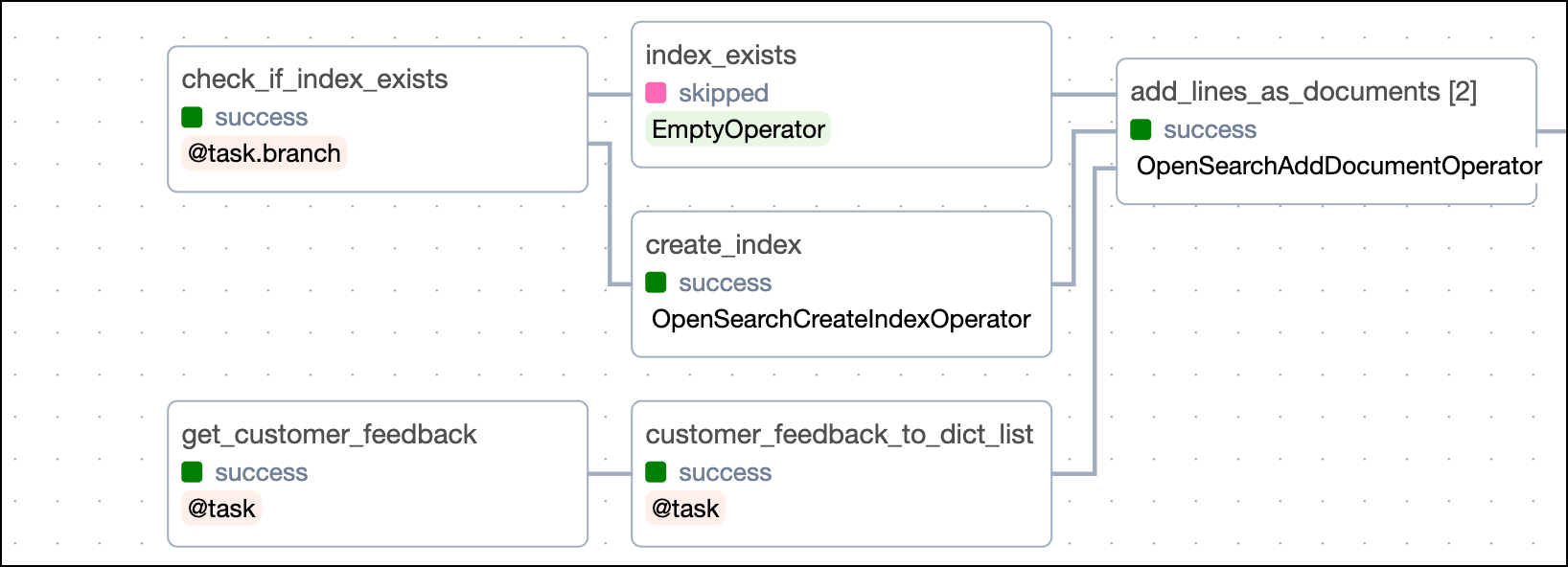
* Ingest customer feedback data into OpenSearch
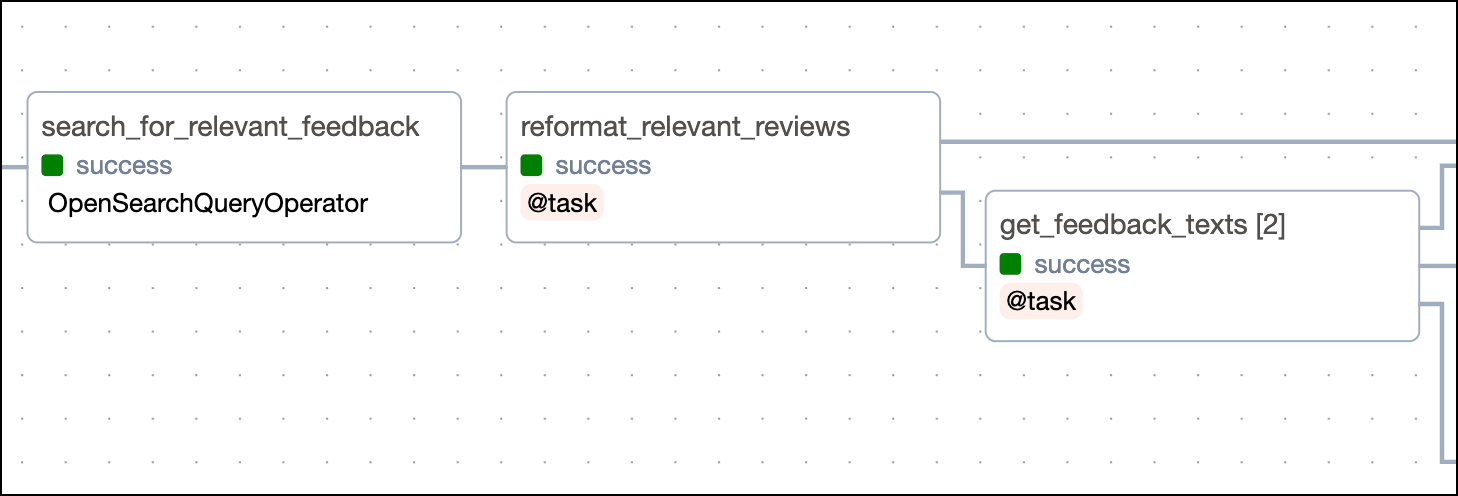
 * Query customer feedback data from OpenSearch
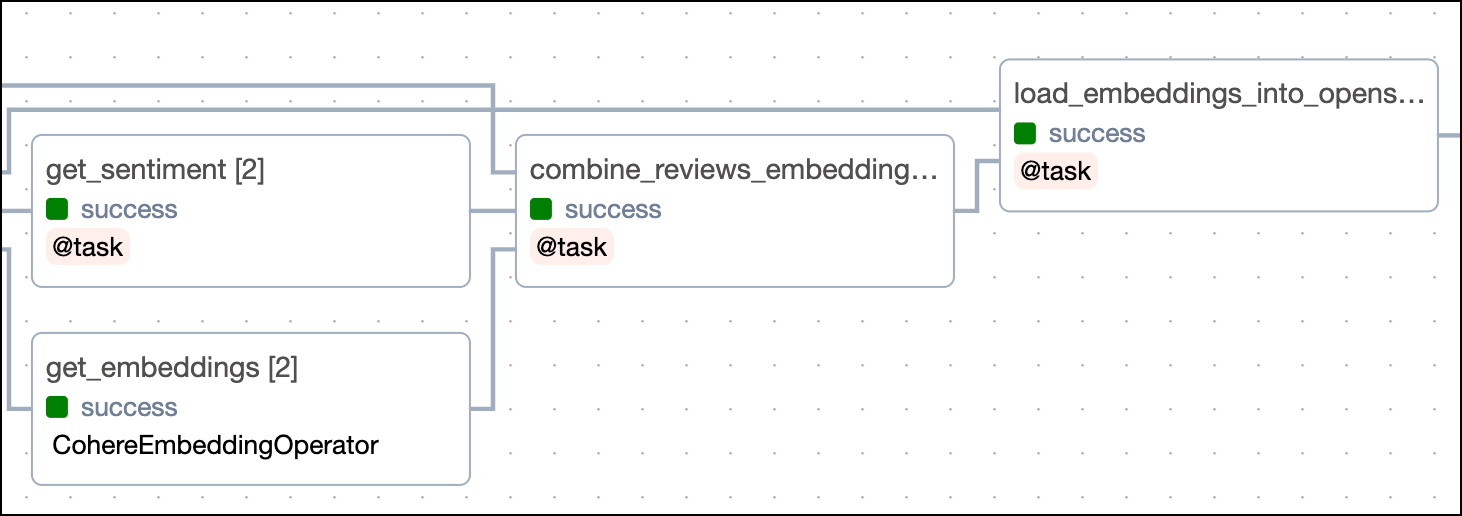
 * Perform sentiment analysis on relevant customer feedback and get embeddings using the Cohere API
 * Query OpenSearch for the most similar testimonial using a [k-nearest neighbors (k-NN) algorithm](https://opensearch.org/docs/latest/search-plugins/knn/filter-search-knn/) on the embeddings and filter for positive sentiment
 Several parameters are set at the beginning of the DAG. You can adjust the number of pieces of customer feedback returned by the mock API by changing the `NUM_CUSTOMERS` variable.
#### Ingest customer feedback data into OpenSearch
The first six tasks in the `analyze_customer_feedback` DAG perform the necessary steps to ingest data from the mock API into OpenSearch.
First, the `check_if_index_exists` task uses the [`OpenSearchHook`](https://airflow.apache.org/registry/providers/opensearch#opensearch-opensearch-OpenSearchHook) to check if an [index](https://opensearch.org/docs/latest/im-plugin/index/) of the name `OPEN_SEARCH_INDEX` already exists in your OpenSearch instance. The task is defined using the [`@task.branch`](/docs/learn/2.x/airflow-branch-operator#@task-branch-branchpythonoperator) decorator and returns a different `task_id` depending on the result of the check. If the index already exists, the empty `index_exists` task will be executed. If the index does not exist, the `create_index` task will be executed.
```python wrap theme={null}
@task.branch
def check_if_index_exists(index_name: str, conn_id: str) -> str:
"Check if the index already exists in OpenSearch."
client = OpenSearchHook(open_search_conn_id=conn_id, log_query=True).client
is_index_exist = client.indices.exists(index_name)
if is_index_exist:
return "index_exists"
return "create_index"
```
The `create_index` task performs index creation using the [`OpenSearchCreateIndexOperator`](https://airflow.apache.org/registry/providers/opensearch#opensearch-opensearch-OpenSearchCreateIndexOperator). Note how the dictionary passed to the `index_body` parameter includes the properties of the customer feedback documents, including fields for the embeddings and sentiment scores.
```python expandable wrap theme={null}
create_index = OpenSearchCreateIndexOperator(
task_id="create_index",
opensearch_conn_id=OPENSEARCH_CONN_ID,
index_name=OPENSEARCH_INDEX_NAME,
index_body={
"settings": {
"index": {
"number_of_shards": 1,
"knn": True,
"knn.algo_param.ef_search": 100,
}
},
"mappings": {
"properties": {
"customer_feedback": {"type": "text"},
"customer_rating": {"type": "integer"},
"customer_id": {"type": "keyword"},
"timestamp": {"type": "date"},
"customer_location": {"type": "keyword"},
"product_type": {"type": "keyword"},
"ab_test_group": {"type": "keyword"},
"embeddings": {
"type": "knn_vector",
"dimension": MODEL_VECTOR_LENGTH,
"method": {
"name": "hnsw",
"space_type": "cosinesimil",
"engine": "nmslib",
},
},
"sentiment_prediction": {"type": "keyword"},
"sentiment_confidence": {"type": "float"},
}
},
},
)
```
Running in parallel, the `get_customer_feedback` task makes a call to the mock API exposed at `customer_ticket_api:5000`.
```python wrap theme={null}
@task
def get_customer_feedback(num_customers: int) -> list:
"Query the mock API for customer feedback data."
r = requests.get(
f"http://customer_ticket_api:5000/api/data?num_reviews={num_customers}"
)
return r.json()
```
The payload of the mock API is in the format of:
```python wrap theme={null}
{
'ab_test_group': 'A',
'customer_feedback': 'This product has transformed the way I work, absolutely fantastic UX!',
'customer_id': 1714,
'customer_location': 'Switzerland',
'customer_rating': 3,
'product_type': 'cloud service A',
'timestamp': '2023-11-24T11:25:37Z'
}
```
Next, the `customer_feedback_to_dict_list` task transforms the above payload into a list of dictionaries to be provided to the [`OpenSearchAddDocumentOperator`](https://airflow.apache.org/registry/providers/opensearch#opensearch-opensearch-OpenSearchAddDocumentOperator) `document` and `doc_id` parameters.
```python wrap theme={null}
@task
def customer_feedback_to_dict_list(customer_feedback: list):
"Convert the customer feedback data into a list of dictionaries."
list_of_feedback = []
for customer in customer_feedback:
unique_line_id = uuid.uuid5(
name=" ".join(
[str(customer["customer_id"]), str(customer["timestamp"])]
),
namespace=uuid.NAMESPACE_DNS,
)
kwargs = {"doc_id": str(unique_line_id), "document": customer}
list_of_feedback.append(kwargs)
return list_of_feedback
```
The resulting list of dictionaries takes the form of:
```python wrap theme={null}
[
{
"doc_id": "9c3880f4-f883-50d2-8a41-056c0efe4b2b",
"document": {
"ab_test_group": "A",
"customer_feedback": "This product has transformed the way I work, absolutely fantastic UX!",
"customer_id": 1714,
"customer_location": "Switzerland",
"customer_rating": 3,
"product_type": "cloud service A",
"timestamp": "2023-11-24T11:25:37Z",
},
},
{
"doc_id": "804dfcfd-62f5-5f8c-b64e-b167dcb4b1dc",
"document": {
"ab_test_group": "A",
"customer_feedback": "The product did not meet my expectations, ugly UI.",
"customer_id": 1843,
"customer_location": "Switzerland",
"customer_rating": 1,
"product_type": "cloud service A",
"timestamp": "2023-11-24T11:25:37Z",
},
},
]
```
Lastly, the `add_lines_as_documents` task uses the [`OpenSearchAddDocumentOperator`](https://airflow.apache.org/registry/providers/opensearch#opensearch-opensearch-OpenSearchAddDocumentOperator) to add the customer feedback data to the OpenSearch index. This task is [dynamically mapped](/docs/learn/2.x/dynamic-tasks) over the list of dictionaries returned by the `customer_feedback_to_dict_list` task to create one mapped task instance per set of `doc_id` and `document` parameter inputs. To map over a list of dictionaries, the `.expand_kwargs` method is used.
```python wrap theme={null}
add_lines_as_documents = OpenSearchAddDocumentOperator.partial(
task_id="add_lines_as_documents",
opensearch_conn_id=OPENSEARCH_CONN_ID,
trigger_rule="none_failed",
index_name=OPENSEARCH_INDEX_NAME,
).expand_kwargs(list_of_document_kwargs)
```
#### Query customer feedback data from OpenSearch
In the second part of the DAG, OpenSearch is queried to get the subset of customer feedback data we are interested in. For this example, we chose feedback from Swiss customers in the `A` test group using `cloud service A` who mentioned the user experience in their feedback.
The `search_for_relevant_feedback` task uses the [`OpenSearchQueryOperator`](https://airflow.apache.org/registry/providers/opensearch#opensearch-opensearch-OpenSearchQueryOperator) to query OpenSearch for the relevant customer feedback data. The query is defined using [query domain-specific language (DSL)](https://opensearch.org/docs/latest/query-dsl/index/) and passed to the `query` parameter of the operator. OpenSearch fuzzy matches the terms provided in the `FEEDBACK_SEARCH_TERMS` variable while filtering for the `CUSTOMER_LOCATION`, `AB_TEST_GROUP`, and `PRODUCT_TYPE` variables.
```python wrap theme={null}
search_for_relevant_feedback = OpenSearchQueryOperator(
task_id="search_for_relevant_feedback",
opensearch_conn_id=OPENSEARCH_CONN_ID,
index_name=OPENSEARCH_INDEX_NAME,
query={
"size": MAX_NUMBER_OF_RESULTS,
"query": {
"bool": {
"must": [
{
"match": {
"customer_feedback": {
"query": FEEDBACK_SEARCH_TERMS,
"analyzer": "english",
"fuzziness": "AUTO",
}
}
}
],
"filter": [
{"term": {"customer_location": CUSTOMER_LOCATION}},
{"term": {"ab_test_group": AB_TEST_GROUP}},
{"term": {"product_type": PRODUCT_TYPE}},
],
},
},
},
)
```
The returned customer feedback data is then transformed using the `reformat_relevant_reviews` task to get a list of dictionaries.
```python wrap theme={null}
@task
def reformat_relevant_reviews(search_results: dict) -> list:
"Reformat the relevant reviews from the OpenSearch query results."
ids = [x["_id"] for x in search_results["hits"]["hits"]]
reviews_of_interest = [x["_source"] for x in search_results["hits"]["hits"]]
reviews_with_id = []
for id, review in zip(ids, reviews_of_interest):
review["id"] = id
reviews_with_id.append(review)
return reviews_of_interest
```
The dictionaries returned contain a flattened version of the verbose output from the `search_for_relevant_feedback` task. They take the following format:
```python wrap theme={null}
[
{
"ab_test_group": "A",
"customer_feedback": "The product did not meet my expectations, ugly UI.",
"customer_id": 1843,
"customer_location": "Switzerland",
"customer_rating": 1,
"product_type": "cloud service A",
"timestamp": "2023-11-24T11:25:37Z",
"id": "804dfcfd-62f5-5f8c-b64e-b167dcb4b1dc",
},
{
"ab_test_group": "A",
"customer_feedback": "This product has transformed the way I work, absolutely fantastic UX!",
"customer_id": 1714,
"customer_location": "Switzerland",
"customer_rating": 3,
"product_type": "cloud service A",
"timestamp": "2023-11-24T11:25:37Z",
"id": "9c3880f4-f883-50d2-8a41-056c0efe4b2b",
},
]
```
A second task, `get_feedback_texts`, is dynamically mapped over the list of dictionaries returned by the `reformat_relevant_reviews` task to extract the `customer_feedback` field from each dictionary.
```python wrap theme={null}
@task
def get_feedback_texts(review_of_interest: dict) -> str:
"Get the feedback text from the relevant reviews."
feedback_text = review_of_interest["customer_feedback"]
return feedback_text
feedback_texts = get_feedback_texts.expand(review_of_interest=relevant_reviews)
```
#### Perform sentiment analysis on relevant customer feedback and get embeddings using the Cohere API
The third section of the DAG consists of four tasks that perform sentiment analysis, get vector embeddings and load the results back into OpenSearch.
The first task in this section, `get_sentiment`, uses the [`CohereHook`](https://airflow.apache.org/registry/providers/cohere#cohere-cohere-CohereHook) to get the sentiment of the customer feedback using the Cohere API [text classification endpoint](https://docs.cohere.com/reference/classify). The task is dynamically mapped over the list of feedback texts returned by the `get_feedback_texts` task to create one mapped task instance per customer feedback to be analyzed in parallel. Sentiment examples are stored in the [`classification_examples` file](https://github.com/astronomer/use-case-llm-customer-feedback/blob/main/include/classification_examples.py) in the `include` folder.
```python wrap theme={null}
@task
def get_sentiment(input_text: str, sentiment_examples: list, conn_id: str) -> float:
"Get the sentiment of the customer feedback using the Cohere API."
co = CohereHook(conn_id=conn_id).get_conn
response = co.classify(
model="large",
inputs=[input_text],
examples=sentiment_examples,
)
print(input_text)
print(response.classifications)
return {
"prediction": response.classifications[0].prediction,
"confidence": response.classifications[0].confidence,
}
sentiment_scores = get_sentiment.partial(
conn_id=COHERE_CONN_ID, sentiment_examples=SENTIMENT_EXAMPLES
).expand(input_text=feedback_texts)
```
Sentiment scores are returned in the format of:
```python wrap theme={null}
{'prediction': 'positive', 'confidence': 0.9305259}
```
In parallel, the [`CohereEmbeddingOperator`](https://airflow.apache.org/registry/providers/cohere#cohere-embedding-CohereEmbeddingOperator) defines the `get_embeddings` task which uses the [embedding endpoint](https://docs.cohere.com/reference/embed) of the Cohere API to get vector embeddings for customer feedback. Similar to the `get_sentiment` task, the `get_embeddings` task is dynamically mapped over the list of feedback texts returned by the `get_feedback_texts` task to create one mapped task instance per customer feedback to be embedded in parallel.
```python wrap theme={null}
get_embeddings = CohereEmbeddingOperator.partial(
task_id="get_embeddings",
conn_id=COHERE_CONN_ID,
).expand(input_text=feedback_texts)
```
Next, the `combine_reviews_embeddings_and_sentiments` task combines the embeddings and sentiment scores into a single list of dictionaries.
```python wrap theme={null}
@task
def combine_reviews_embeddings_and_sentiments(
reviews: list, embeddings: list, sentiments: list
) -> list:
"Combine the reviews, embeddings and sentiments into a single list of dictionaries."
review_with_embeddings = []
for review, embedding, sentiment in zip(reviews, embeddings, sentiments):
review_with_embeddings.append(
{
"review": review,
"embedding": embedding[0],
"sentiment_prediction": sentiment["prediction"],
"sentiment_confidence": sentiment["confidence"],
}
)
return review_with_embeddings
full_data = combine_reviews_embeddings_and_sentiments(
reviews=relevant_reviews,
embeddings=get_embeddings.output,
sentiments=sentiment_scores,
)
```
For each combined dictionary, the `load_embeddings_into_opensearch` task uses the [`OpenSearchHook`](https://airflow.apache.org/registry/providers/opensearch#opensearch-opensearch-OpenSearchHook) to update the relevant document in OpenSearch with the embeddings and sentiment scores.
```python wrap theme={null}
@task
def load_embeddings_into_opensearch(full_data: dict, conn_id: str) -> None:
"Load the embeddings and sentiment into OpenSearch."
client = OpenSearchHook(open_search_conn_id=conn_id, log_query=True).client
client.update(
index=OPENSEARCH_INDEX_NAME,
id=full_data["review"]["id"],
body={
"doc": {
"embeddings": [float(x) for x in full_data["embedding"]],
"sentiment_prediction": full_data["sentiment_prediction"],
"sentiment_confidence": full_data["sentiment_confidence"],
}
},
)
load_embeddings_obj = load_embeddings_into_opensearch.partial(
conn_id=OPENSEARCH_CONN_ID
).expand(full_data=full_data)
```
#### Query OpenSearch for the most similar testimonial using k-NN on the embeddings and filter for positive sentiment
The final section of the DAG queries OpenSearch using both k-NN on the embeddings and a filter on the sentiment scores to get the most similar positive customer feedback to a target testimonial.
First, the `get_embeddings_testimonial_search_term` task converts the target testimonial to vector embeddings using the [`CohereEmbeddingOperator`](https://airflow.apache.org/registry/providers/cohere#cohere-embedding-CohereEmbeddingOperator).
```python wrap theme={null}
get_embeddings_testimonial_search_term = CohereEmbeddingOperator(
task_id="get_embeddings_testimonial_search_term",
conn_id=COHERE_CONN_ID,
input_text=TESTIMONIAL_SEARCH_TERM,
)
```
Next, the `prep_search_term_embeddings_for_query` task converts the embeddings returned by the `get_embeddings_testimonial_search_term` task to a list of floats to be used in the OpenSearch query.
```python wrap theme={null}
@task
def prep_search_term_embeddings_for_query(embeddings: list) -> list:
"Prepare the embeddings for the OpenSearch query."
return [float(x) for x in embeddings[0]]
search_term_embeddings = prep_search_term_embeddings_for_query(
embeddings=get_embeddings_testimonial_search_term.output
)
```
The `search_for_testimonial_candidates` task uses the [`OpenSearchQueryOperator`](https://airflow.apache.org/registry/providers/opensearch#opensearch-opensearch-OpenSearchQueryOperator) to query OpenSearch for the most similar customer feedback to the target testimonial using a [k-NN](https://opensearch.org/docs/latest/search-plugins/knn/filter-search-knn/) algorithm on the embeddings and filter for positive sentiment. Note that k-NN search requires the `knn` plugin to be installed in OpenSearch.
```python wrap theme={null}
search_for_testimonial_candidates = OpenSearchQueryOperator(
task_id="search_for_testimonial_candidates",
opensearch_conn_id=OPENSEARCH_CONN_ID,
index_name=OPENSEARCH_INDEX_NAME,
query={
"size": 10,
"query": {
"bool": {
"must": [
{
"knn": {
"embeddings": {
"vector": search_term_embeddings,
"k": 10,
}
}
}
],
"filter": [
{"term": {"sentiment_prediction": "positive"}},
],
}
},
},
)
```
Lastly, the `print_testimonial_candidates` task prints positive customer feedback that is closest to the target testimonial feedback and mentions the user experience of the `cloud A service` to the logs.
```python wrap theme={null}
@task
def print_testimonial_candidates(search_results: dict) -> None:
"Print the testimonial candidates from the OpenSearch query results."
for result in search_results["hits"]["hits"]:
print("Customer ID: ", result["_source"]["customer_id"])
print("Customer feedback: ", result["_source"]["customer_feedback"])
print("Customer location: ", result["_source"]["customer_location"])
print("Customer rating: ", result["_source"]["customer_rating"])
print("Customer sentiment: ", result["_source"]["sentiment_prediction"])
print(
"Customer sentiment confidence: ",
result["_source"]["sentiment_confidence"],
)
```
You can review the output of the task in the task logs. They should look similar to the following:
```text wrap theme={null}
[2023-11-24, 11:25:48 UTC] {logging_mixin.py:154} INFO - Customer ID: 1714
[2023-11-24, 11:25:48 UTC] {logging_mixin.py:154} INFO - Customer feedback: This product has transformed the way I work, absolutely fantastic UX!
[2023-11-24, 11:25:48 UTC] {logging_mixin.py:154} INFO - Customer location: Switzerland
[2023-11-24, 11:25:48 UTC] {logging_mixin.py:154} INFO - Customer rating: 3
[2023-11-24, 11:25:48 UTC] {logging_mixin.py:154} INFO - Customer sentiment: positive
[2023-11-24, 11:25:48 UTC] {logging_mixin.py:154} INFO - Customer sentiment confidence: 0.99412733
```
Congratulations! You've successfully run a full MLOps pipeline with Airflow, Cohere, and OpenSearch which efficiently finds a customer feedback testimonial based on a set of parameters, including its sentiment and similarity to a target testimonial.
## See also
* Tutorial: [Orchestrate OpenSearch operations with Apache Airflow](/docs/learn/airflow-opensearch).
* Tutorial: [Orchestrate Cohere LLMs with Apache Airflow](/docs/learn/airflow-cohere)
* Documentation: [Airflow OpenSearch provider documentation](https://airflow.apache.org/docs/apache-airflow-providers-opensearch/stable/index.html).
* Documentation: [Airflow Cohere provider documentation](https://airflow.apache.org/docs/apache-airflow-providers-cohere/stable/index.html).
Several parameters are set at the beginning of the DAG. You can adjust the number of pieces of customer feedback returned by the mock API by changing the `NUM_CUSTOMERS` variable.
#### Ingest customer feedback data into OpenSearch
The first six tasks in the `analyze_customer_feedback` DAG perform the necessary steps to ingest data from the mock API into OpenSearch.
First, the `check_if_index_exists` task uses the [`OpenSearchHook`](https://airflow.apache.org/registry/providers/opensearch#opensearch-opensearch-OpenSearchHook) to check if an [index](https://opensearch.org/docs/latest/im-plugin/index/) of the name `OPEN_SEARCH_INDEX` already exists in your OpenSearch instance. The task is defined using the [`@task.branch`](/docs/learn/2.x/airflow-branch-operator#@task-branch-branchpythonoperator) decorator and returns a different `task_id` depending on the result of the check. If the index already exists, the empty `index_exists` task will be executed. If the index does not exist, the `create_index` task will be executed.
```python wrap theme={null}
@task.branch
def check_if_index_exists(index_name: str, conn_id: str) -> str:
"Check if the index already exists in OpenSearch."
client = OpenSearchHook(open_search_conn_id=conn_id, log_query=True).client
is_index_exist = client.indices.exists(index_name)
if is_index_exist:
return "index_exists"
return "create_index"
```
The `create_index` task performs index creation using the [`OpenSearchCreateIndexOperator`](https://airflow.apache.org/registry/providers/opensearch#opensearch-opensearch-OpenSearchCreateIndexOperator). Note how the dictionary passed to the `index_body` parameter includes the properties of the customer feedback documents, including fields for the embeddings and sentiment scores.
```python expandable wrap theme={null}
create_index = OpenSearchCreateIndexOperator(
task_id="create_index",
opensearch_conn_id=OPENSEARCH_CONN_ID,
index_name=OPENSEARCH_INDEX_NAME,
index_body={
"settings": {
"index": {
"number_of_shards": 1,
"knn": True,
"knn.algo_param.ef_search": 100,
}
},
"mappings": {
"properties": {
"customer_feedback": {"type": "text"},
"customer_rating": {"type": "integer"},
"customer_id": {"type": "keyword"},
"timestamp": {"type": "date"},
"customer_location": {"type": "keyword"},
"product_type": {"type": "keyword"},
"ab_test_group": {"type": "keyword"},
"embeddings": {
"type": "knn_vector",
"dimension": MODEL_VECTOR_LENGTH,
"method": {
"name": "hnsw",
"space_type": "cosinesimil",
"engine": "nmslib",
},
},
"sentiment_prediction": {"type": "keyword"},
"sentiment_confidence": {"type": "float"},
}
},
},
)
```
Running in parallel, the `get_customer_feedback` task makes a call to the mock API exposed at `customer_ticket_api:5000`.
```python wrap theme={null}
@task
def get_customer_feedback(num_customers: int) -> list:
"Query the mock API for customer feedback data."
r = requests.get(
f"http://customer_ticket_api:5000/api/data?num_reviews={num_customers}"
)
return r.json()
```
The payload of the mock API is in the format of:
```python wrap theme={null}
{
'ab_test_group': 'A',
'customer_feedback': 'This product has transformed the way I work, absolutely fantastic UX!',
'customer_id': 1714,
'customer_location': 'Switzerland',
'customer_rating': 3,
'product_type': 'cloud service A',
'timestamp': '2023-11-24T11:25:37Z'
}
```
Next, the `customer_feedback_to_dict_list` task transforms the above payload into a list of dictionaries to be provided to the [`OpenSearchAddDocumentOperator`](https://airflow.apache.org/registry/providers/opensearch#opensearch-opensearch-OpenSearchAddDocumentOperator) `document` and `doc_id` parameters.
```python wrap theme={null}
@task
def customer_feedback_to_dict_list(customer_feedback: list):
"Convert the customer feedback data into a list of dictionaries."
list_of_feedback = []
for customer in customer_feedback:
unique_line_id = uuid.uuid5(
name=" ".join(
[str(customer["customer_id"]), str(customer["timestamp"])]
),
namespace=uuid.NAMESPACE_DNS,
)
kwargs = {"doc_id": str(unique_line_id), "document": customer}
list_of_feedback.append(kwargs)
return list_of_feedback
```
The resulting list of dictionaries takes the form of:
```python wrap theme={null}
[
{
"doc_id": "9c3880f4-f883-50d2-8a41-056c0efe4b2b",
"document": {
"ab_test_group": "A",
"customer_feedback": "This product has transformed the way I work, absolutely fantastic UX!",
"customer_id": 1714,
"customer_location": "Switzerland",
"customer_rating": 3,
"product_type": "cloud service A",
"timestamp": "2023-11-24T11:25:37Z",
},
},
{
"doc_id": "804dfcfd-62f5-5f8c-b64e-b167dcb4b1dc",
"document": {
"ab_test_group": "A",
"customer_feedback": "The product did not meet my expectations, ugly UI.",
"customer_id": 1843,
"customer_location": "Switzerland",
"customer_rating": 1,
"product_type": "cloud service A",
"timestamp": "2023-11-24T11:25:37Z",
},
},
]
```
Lastly, the `add_lines_as_documents` task uses the [`OpenSearchAddDocumentOperator`](https://airflow.apache.org/registry/providers/opensearch#opensearch-opensearch-OpenSearchAddDocumentOperator) to add the customer feedback data to the OpenSearch index. This task is [dynamically mapped](/docs/learn/2.x/dynamic-tasks) over the list of dictionaries returned by the `customer_feedback_to_dict_list` task to create one mapped task instance per set of `doc_id` and `document` parameter inputs. To map over a list of dictionaries, the `.expand_kwargs` method is used.
```python wrap theme={null}
add_lines_as_documents = OpenSearchAddDocumentOperator.partial(
task_id="add_lines_as_documents",
opensearch_conn_id=OPENSEARCH_CONN_ID,
trigger_rule="none_failed",
index_name=OPENSEARCH_INDEX_NAME,
).expand_kwargs(list_of_document_kwargs)
```
#### Query customer feedback data from OpenSearch
In the second part of the DAG, OpenSearch is queried to get the subset of customer feedback data we are interested in. For this example, we chose feedback from Swiss customers in the `A` test group using `cloud service A` who mentioned the user experience in their feedback.
The `search_for_relevant_feedback` task uses the [`OpenSearchQueryOperator`](https://airflow.apache.org/registry/providers/opensearch#opensearch-opensearch-OpenSearchQueryOperator) to query OpenSearch for the relevant customer feedback data. The query is defined using [query domain-specific language (DSL)](https://opensearch.org/docs/latest/query-dsl/index/) and passed to the `query` parameter of the operator. OpenSearch fuzzy matches the terms provided in the `FEEDBACK_SEARCH_TERMS` variable while filtering for the `CUSTOMER_LOCATION`, `AB_TEST_GROUP`, and `PRODUCT_TYPE` variables.
```python wrap theme={null}
search_for_relevant_feedback = OpenSearchQueryOperator(
task_id="search_for_relevant_feedback",
opensearch_conn_id=OPENSEARCH_CONN_ID,
index_name=OPENSEARCH_INDEX_NAME,
query={
"size": MAX_NUMBER_OF_RESULTS,
"query": {
"bool": {
"must": [
{
"match": {
"customer_feedback": {
"query": FEEDBACK_SEARCH_TERMS,
"analyzer": "english",
"fuzziness": "AUTO",
}
}
}
],
"filter": [
{"term": {"customer_location": CUSTOMER_LOCATION}},
{"term": {"ab_test_group": AB_TEST_GROUP}},
{"term": {"product_type": PRODUCT_TYPE}},
],
},
},
},
)
```
The returned customer feedback data is then transformed using the `reformat_relevant_reviews` task to get a list of dictionaries.
```python wrap theme={null}
@task
def reformat_relevant_reviews(search_results: dict) -> list:
"Reformat the relevant reviews from the OpenSearch query results."
ids = [x["_id"] for x in search_results["hits"]["hits"]]
reviews_of_interest = [x["_source"] for x in search_results["hits"]["hits"]]
reviews_with_id = []
for id, review in zip(ids, reviews_of_interest):
review["id"] = id
reviews_with_id.append(review)
return reviews_of_interest
```
The dictionaries returned contain a flattened version of the verbose output from the `search_for_relevant_feedback` task. They take the following format:
```python wrap theme={null}
[
{
"ab_test_group": "A",
"customer_feedback": "The product did not meet my expectations, ugly UI.",
"customer_id": 1843,
"customer_location": "Switzerland",
"customer_rating": 1,
"product_type": "cloud service A",
"timestamp": "2023-11-24T11:25:37Z",
"id": "804dfcfd-62f5-5f8c-b64e-b167dcb4b1dc",
},
{
"ab_test_group": "A",
"customer_feedback": "This product has transformed the way I work, absolutely fantastic UX!",
"customer_id": 1714,
"customer_location": "Switzerland",
"customer_rating": 3,
"product_type": "cloud service A",
"timestamp": "2023-11-24T11:25:37Z",
"id": "9c3880f4-f883-50d2-8a41-056c0efe4b2b",
},
]
```
A second task, `get_feedback_texts`, is dynamically mapped over the list of dictionaries returned by the `reformat_relevant_reviews` task to extract the `customer_feedback` field from each dictionary.
```python wrap theme={null}
@task
def get_feedback_texts(review_of_interest: dict) -> str:
"Get the feedback text from the relevant reviews."
feedback_text = review_of_interest["customer_feedback"]
return feedback_text
feedback_texts = get_feedback_texts.expand(review_of_interest=relevant_reviews)
```
#### Perform sentiment analysis on relevant customer feedback and get embeddings using the Cohere API
The third section of the DAG consists of four tasks that perform sentiment analysis, get vector embeddings and load the results back into OpenSearch.
The first task in this section, `get_sentiment`, uses the [`CohereHook`](https://airflow.apache.org/registry/providers/cohere#cohere-cohere-CohereHook) to get the sentiment of the customer feedback using the Cohere API [text classification endpoint](https://docs.cohere.com/reference/classify). The task is dynamically mapped over the list of feedback texts returned by the `get_feedback_texts` task to create one mapped task instance per customer feedback to be analyzed in parallel. Sentiment examples are stored in the [`classification_examples` file](https://github.com/astronomer/use-case-llm-customer-feedback/blob/main/include/classification_examples.py) in the `include` folder.
```python wrap theme={null}
@task
def get_sentiment(input_text: str, sentiment_examples: list, conn_id: str) -> float:
"Get the sentiment of the customer feedback using the Cohere API."
co = CohereHook(conn_id=conn_id).get_conn
response = co.classify(
model="large",
inputs=[input_text],
examples=sentiment_examples,
)
print(input_text)
print(response.classifications)
return {
"prediction": response.classifications[0].prediction,
"confidence": response.classifications[0].confidence,
}
sentiment_scores = get_sentiment.partial(
conn_id=COHERE_CONN_ID, sentiment_examples=SENTIMENT_EXAMPLES
).expand(input_text=feedback_texts)
```
Sentiment scores are returned in the format of:
```python wrap theme={null}
{'prediction': 'positive', 'confidence': 0.9305259}
```
In parallel, the [`CohereEmbeddingOperator`](https://airflow.apache.org/registry/providers/cohere#cohere-embedding-CohereEmbeddingOperator) defines the `get_embeddings` task which uses the [embedding endpoint](https://docs.cohere.com/reference/embed) of the Cohere API to get vector embeddings for customer feedback. Similar to the `get_sentiment` task, the `get_embeddings` task is dynamically mapped over the list of feedback texts returned by the `get_feedback_texts` task to create one mapped task instance per customer feedback to be embedded in parallel.
```python wrap theme={null}
get_embeddings = CohereEmbeddingOperator.partial(
task_id="get_embeddings",
conn_id=COHERE_CONN_ID,
).expand(input_text=feedback_texts)
```
Next, the `combine_reviews_embeddings_and_sentiments` task combines the embeddings and sentiment scores into a single list of dictionaries.
```python wrap theme={null}
@task
def combine_reviews_embeddings_and_sentiments(
reviews: list, embeddings: list, sentiments: list
) -> list:
"Combine the reviews, embeddings and sentiments into a single list of dictionaries."
review_with_embeddings = []
for review, embedding, sentiment in zip(reviews, embeddings, sentiments):
review_with_embeddings.append(
{
"review": review,
"embedding": embedding[0],
"sentiment_prediction": sentiment["prediction"],
"sentiment_confidence": sentiment["confidence"],
}
)
return review_with_embeddings
full_data = combine_reviews_embeddings_and_sentiments(
reviews=relevant_reviews,
embeddings=get_embeddings.output,
sentiments=sentiment_scores,
)
```
For each combined dictionary, the `load_embeddings_into_opensearch` task uses the [`OpenSearchHook`](https://airflow.apache.org/registry/providers/opensearch#opensearch-opensearch-OpenSearchHook) to update the relevant document in OpenSearch with the embeddings and sentiment scores.
```python wrap theme={null}
@task
def load_embeddings_into_opensearch(full_data: dict, conn_id: str) -> None:
"Load the embeddings and sentiment into OpenSearch."
client = OpenSearchHook(open_search_conn_id=conn_id, log_query=True).client
client.update(
index=OPENSEARCH_INDEX_NAME,
id=full_data["review"]["id"],
body={
"doc": {
"embeddings": [float(x) for x in full_data["embedding"]],
"sentiment_prediction": full_data["sentiment_prediction"],
"sentiment_confidence": full_data["sentiment_confidence"],
}
},
)
load_embeddings_obj = load_embeddings_into_opensearch.partial(
conn_id=OPENSEARCH_CONN_ID
).expand(full_data=full_data)
```
#### Query OpenSearch for the most similar testimonial using k-NN on the embeddings and filter for positive sentiment
The final section of the DAG queries OpenSearch using both k-NN on the embeddings and a filter on the sentiment scores to get the most similar positive customer feedback to a target testimonial.
First, the `get_embeddings_testimonial_search_term` task converts the target testimonial to vector embeddings using the [`CohereEmbeddingOperator`](https://airflow.apache.org/registry/providers/cohere#cohere-embedding-CohereEmbeddingOperator).
```python wrap theme={null}
get_embeddings_testimonial_search_term = CohereEmbeddingOperator(
task_id="get_embeddings_testimonial_search_term",
conn_id=COHERE_CONN_ID,
input_text=TESTIMONIAL_SEARCH_TERM,
)
```
Next, the `prep_search_term_embeddings_for_query` task converts the embeddings returned by the `get_embeddings_testimonial_search_term` task to a list of floats to be used in the OpenSearch query.
```python wrap theme={null}
@task
def prep_search_term_embeddings_for_query(embeddings: list) -> list:
"Prepare the embeddings for the OpenSearch query."
return [float(x) for x in embeddings[0]]
search_term_embeddings = prep_search_term_embeddings_for_query(
embeddings=get_embeddings_testimonial_search_term.output
)
```
The `search_for_testimonial_candidates` task uses the [`OpenSearchQueryOperator`](https://airflow.apache.org/registry/providers/opensearch#opensearch-opensearch-OpenSearchQueryOperator) to query OpenSearch for the most similar customer feedback to the target testimonial using a [k-NN](https://opensearch.org/docs/latest/search-plugins/knn/filter-search-knn/) algorithm on the embeddings and filter for positive sentiment. Note that k-NN search requires the `knn` plugin to be installed in OpenSearch.
```python wrap theme={null}
search_for_testimonial_candidates = OpenSearchQueryOperator(
task_id="search_for_testimonial_candidates",
opensearch_conn_id=OPENSEARCH_CONN_ID,
index_name=OPENSEARCH_INDEX_NAME,
query={
"size": 10,
"query": {
"bool": {
"must": [
{
"knn": {
"embeddings": {
"vector": search_term_embeddings,
"k": 10,
}
}
}
],
"filter": [
{"term": {"sentiment_prediction": "positive"}},
],
}
},
},
)
```
Lastly, the `print_testimonial_candidates` task prints positive customer feedback that is closest to the target testimonial feedback and mentions the user experience of the `cloud A service` to the logs.
```python wrap theme={null}
@task
def print_testimonial_candidates(search_results: dict) -> None:
"Print the testimonial candidates from the OpenSearch query results."
for result in search_results["hits"]["hits"]:
print("Customer ID: ", result["_source"]["customer_id"])
print("Customer feedback: ", result["_source"]["customer_feedback"])
print("Customer location: ", result["_source"]["customer_location"])
print("Customer rating: ", result["_source"]["customer_rating"])
print("Customer sentiment: ", result["_source"]["sentiment_prediction"])
print(
"Customer sentiment confidence: ",
result["_source"]["sentiment_confidence"],
)
```
You can review the output of the task in the task logs. They should look similar to the following:
```text wrap theme={null}
[2023-11-24, 11:25:48 UTC] {logging_mixin.py:154} INFO - Customer ID: 1714
[2023-11-24, 11:25:48 UTC] {logging_mixin.py:154} INFO - Customer feedback: This product has transformed the way I work, absolutely fantastic UX!
[2023-11-24, 11:25:48 UTC] {logging_mixin.py:154} INFO - Customer location: Switzerland
[2023-11-24, 11:25:48 UTC] {logging_mixin.py:154} INFO - Customer rating: 3
[2023-11-24, 11:25:48 UTC] {logging_mixin.py:154} INFO - Customer sentiment: positive
[2023-11-24, 11:25:48 UTC] {logging_mixin.py:154} INFO - Customer sentiment confidence: 0.99412733
```
Congratulations! You've successfully run a full MLOps pipeline with Airflow, Cohere, and OpenSearch which efficiently finds a customer feedback testimonial based on a set of parameters, including its sentiment and similarity to a target testimonial.
## See also
* Tutorial: [Orchestrate OpenSearch operations with Apache Airflow](/docs/learn/airflow-opensearch).
* Tutorial: [Orchestrate Cohere LLMs with Apache Airflow](/docs/learn/airflow-cohere)
* Documentation: [Airflow OpenSearch provider documentation](https://airflow.apache.org/docs/apache-airflow-providers-opensearch/stable/index.html).
* Documentation: [Airflow Cohere provider documentation](https://airflow.apache.org/docs/apache-airflow-providers-cohere/stable/index.html).