---
title: 'Airflow Secrets Management: Best Practices for Airflow 2.0'
description: >-
Secrets are sensitive information that are used as part of your DAG. Here are
some best practices for managing them in Apache Airflow® 2.0.
date: '2021-03-08T00:00'
authors:
- author: src/content/people/eric-griffing.md
tags: []
categories: []
canonical_url: 'https://www.astronomer.io/blog/secrets-management-airflow-2/'
---
## What Are Airflow Secrets?
**Secrets** are sensitive information that are used as part of your [DAG](/docs/learn/dags).
Types of Secrets:
* **Variables** are a generic way to store and retrieve arbitrary content or settings as a simple **key value** store within [Airflow](/airflow/).
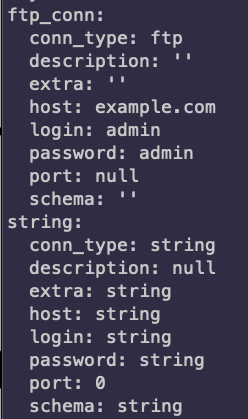
* **Connections** are information needed to connect to external systems. Must be stored in the format of a **URL-encoded URI**.
* **Configurations** are Airflow Configurations that can be stored in your secrets backends.
To get started check out our webinar below on the best practices for Secrets Management in [Airflow 2.0](/blog/introducing-airflow-2-0). You can also use these [example DAGs](https://github.com/astronomer/webinar-secrets-management/tree/master) from the webinar.
## Where Are All the Secrets?
### Environment variables
* Simple and easy to use, difficult to maintain.
* No encryption built in.
* Cannot access them from UI or the Airflow CLI.
* Using them from Kubernetes secrets is safer.
* Lives and dies with your Airflow deployment or its configuration.
### Airflow Metastore DB
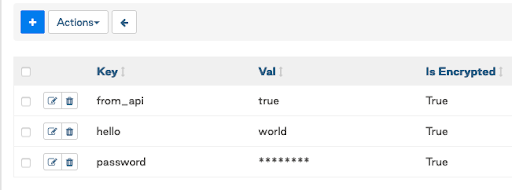
* Can be accessed from the Airflow UI, CLI, or API.
* Adding Connections with these does the URL-encoding and URI formatting for you.
* Encrypted with Fernet key in the DB.
* Lives and dies with the Airflow Metastore DB.
* Can be exported and imported easily.
* Probably won’t be approved by many security teams in production.

\---

### Alternative Secrets Backend
* HashiCorp Vault
* GCP Secret Manager
* AWS Secrets Manager
* Azure Key Vault
Airflow was designed to orchestrate and connect to everything needed for pipelines. So why should your Secrets be any different to Airflow?
* Secure storage and access of your sensitive Secrets.
* Lives beyond your Airflow deployments.
* Can be managed, rotated, versioned, and audited easily.
* Flexibility to choose what combination of Secret types you use with the backend (new in 2.0).
## GCP Workload Identity & AWS IAM Roles
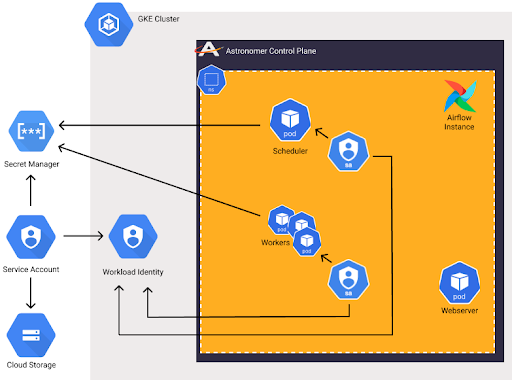
IAM Integration allows you to connect to cloud resources implicitly with Service Accounts.
* **Secure:** No one needs to touch the Service Accounts.
* **Flexible:** Cloud Service Accounts are tied to Kubernetes Service Accounts.
* **Easy to manage:** Set it up once and just maintain permissions.
## So Where Should Airflow Secrets Be Kept?
* Cloud Resources should use Workload Identity / AWS IAM Roles when possible.
* Connections and sensitive Variables should be stored in an Alternative Secrets Backend.
* Variables depend on development and security patterns.
* Ideally use an Alternative Secrets Backend whenever possible.
* Use Airflow Metastore DB if you want to be able to see, access, and manage them directly from Airflow.
## Best Practices for Airflow Secrets
* Separation of Concerns.
* Use Airflow for what it does best.
* Integrate it with systems that are better for other things.
* Do not pass sensitive information around when possible.
* Have a strategy for how to manage your Secrets and and controlling access.
* Use the right combination of Secrets Backends.
* Sensitive information should be in an Alternative Backend or integrated with IAM Roles.
This repo contains an [example DAG and configurations](https://github.com/astronomer/webinar-secrets-management/tree/master) that were used in an Astronomer webinar on Secrets Management with Airflow 2.0.
The easiest way to get started with Apache Airflow® 2.0 is by using the Astronomer CLI. To make it easy you can get up and running with Airflow by following our [Quickstart Guide.](/docs/astro/cli/get-started-cli)